

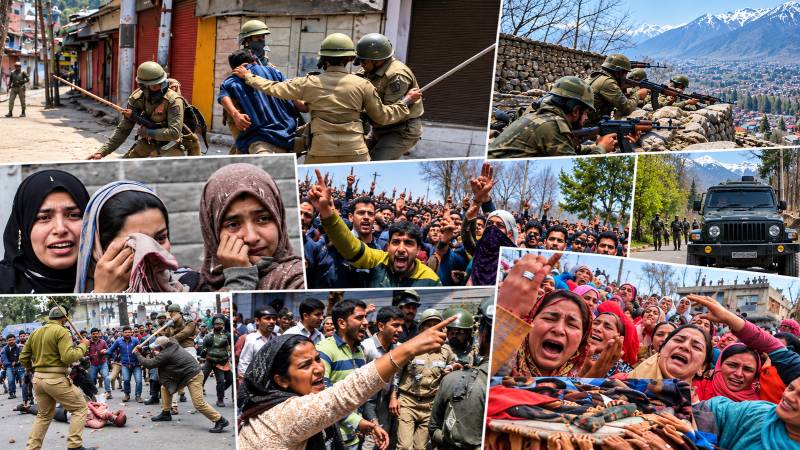
October 27 marks 79 years since Indian troops landed in Srinagar, beginning a military presence that has denied generations of Kashmiris their right to self-determination. For Pakistan and the valiant people of Jammu and Kashmir, it remains a Black Day of broken promises, prolonged repression and an unfinished struggle for freedom. Like Palestine, Kashmir stands as a painful reminder of the international community's failure to honour its own resolutions.
But Black Day 2026 comes at a turning point. India's military confrontation with Pakistan in May 2025 challenged its claims of regional superiority, while Islamabad's subsequent diplomatic role strengthened its international standing. From Prime Minister Shehbaz Sharif's renewed appeal for Kashmiri self-determination at the UN General Assembly last month to Field Marshal Asim Munir's leadership during the May conflict, Pakistan's political and military leadership has demonstrated a common resolve to keep the Kashmir cause alive.
The turning point came after the Pahalgam attack in April 2025, when India blamed Pakistan without publicly establishing conclusive evidence and launched military strikes. Pakistan's response exposed the limits of India's conventional military advantage. A similar pattern had unfolded after the Pulwama attack in February 2019, when India's Balakot airstrike was followed by the loss of an Indian aircraft and the capture of its pilot. In both confrontations, New Delhi failed to achieve the decisive military outcome it had anticipated.
The May 2025 conflict changed the strategic equation between the two countries. Pakistan demonstrated its ability to counter Indian military pressure, while President Donald Trump's subsequent involvement in ceasefire diplomacy showed that New Delhi could not prevent international attention to a confrontation between two nuclear-armed neighbours. Pakistan has since become an important diplomatic actor in efforts to contain the Iran conflict, while strengthening security cooperation with Saudi Arabia and other Gulf partners and maintaining close engagement with Washington and Beijing. These developments have challenged India's attempts to isolate Pakistan and created new opportunities to advance the Kashmir cause.
For Prime Minister Narendra Modi's Hindutva-driven government, the changed regional environment presents an uncomfortable reality. Its claims of unquestioned military superiority have been challenged, while New Delhi's insistence that Operation Sindoor remains suspended rather than concluded raises concerns about renewed military action. Another terrorist incident could become the pretext for escalation, risking a dangerous confrontation and distracting Pakistan from its role in Middle Eastern conflict resolution.
India's difficulties are equally evident in occupied Jammu and Kashmir. Seven years after the unilateral abrogation of Articles 370 and 35A, New Delhi has failed to win Kashmiri political confidence. More seriously, it has pursued policies widely criticised as settler colonialism. New domicile and land laws have dismantled protections for permanent residents, opening property ownership and public employment to outsiders. By April 2025, over 3.5 million domicile certificates had been issued, including 83,742 to people not previously recognised as state subjects. These measures, combined with sweeping security laws, political restrictions and continued central control, have raised fears of demographic change and the erosion of Kashmiri identity. Even the elected government remains deprived of the powers associated with full statehood.
Black Day must not be confined to official statements and expressions of solidarity. Islamabad should seek renewed consideration of the dispute at the UN Security Council, highlight India's post-2019 political and demographic measures, and press for implementation of the relevant UN resolutions.
The frustration is now visible even among politicians traditionally loyal to India. The other day, veteran National Conference leader Farooq Abdullah openly questioned New Delhi's treatment of Kashmiris and acknowledged Pakistan's role in keeping the dispute internationally alive. His observation was revealing: "Everywhere they say, 'the decision regarding Kashmir has not been made'. That is what is saving us."
Coming from a politician whose family has defended Kashmir's accession to India for generations, this admission is extraordinary. Abdullah was not advocating accession to Pakistan. Rather, he was acknowledging that Pakistan's international advocacy had helped prevent the dispute from disappearing beneath India's claims of permanent integration. The BJP's angry reaction exposed the growing gulf between New Delhi and its own Kashmiri political allies.
An important assessment by the International Crisis Group last week reinforces this reality. Its report, A Trigger in Jammu and Kashmir: Militant Violence under Indian Central Rule, challenges India's claims of normalcy since August 2019. It highlights continuing political alienation, extensive security controls and the risks arising from New Delhi's refusal to restore meaningful political authority to Kashmiris. The report also records the psychological impact of the May 2025 confrontation on Kashmiri public opinion. The appearance of Pakistani drones over Indian military installations challenged the hopelessness that had followed India's actions in 2019. As one Srinagar resident observed, the conflict countered the perception that Pakistan was no longer interested in Kashmir.
The Crisis Group warns that another major militant attack could trigger renewed conflict between India and Pakistan. Its findings expose the central failure of India's Kashmir policy: military control may suppress visible resistance, but it cannot resolve the political grievances of a people denied the right to determine their future. Neither constitutional decrees nor demographic changes can erase Kashmir's internationally disputed status. These developments demand a more active Kashmir policy from Pakistan. Black Day must not be confined to official statements and expressions of solidarity. Islamabad should seek renewed consideration of the dispute at the UN Security Council, highlight India's post-2019 political and demographic measures, and press for implementation of the relevant UN resolutions.
Pakistan's access to President Trump offers an opportunity to explain why lasting peace in South Asia requires a settlement of Kashmir, not merely another ceasefire. China, as a permanent Security Council member and Pakistan's strategic partner, remains indispensable. Saudi Arabia, Türkiye and other influential Muslim countries can help broaden diplomatic support. Islamabad should also engage international human rights organisations and explore appropriate legal avenues to challenge India's unilateral actions.
At the same time, Pakistan must remain vigilant against renewed Indian military adventurism. The Modi government may seek another confrontation to recover lost prestige or divert attention from its domestic difficulties. Strong defence and sustained diplomacy are essential to prevent another miscalculation. Ultimately, October 27 is a tribute to the extraordinary resilience of Kashmiris, whose struggle has survived 79 years of repression, broken promises and international indifference. Their aspiration for freedom remains alive in occupied Jammu and Kashmir, Azad Jammu and Kashmir and across the Kashmiri diaspora. Black Day 2026 must renew Pakistan's national resolve to secure Kashmiri self-determination. The people of Kashmir have waited long enough. Their future cannot remain hostage to India's military power and Hindutva majoritarianism. Pakistan must now turn its diplomatic opportunities into sustained international action to fulfil the promise of Kashmiri freedom.