

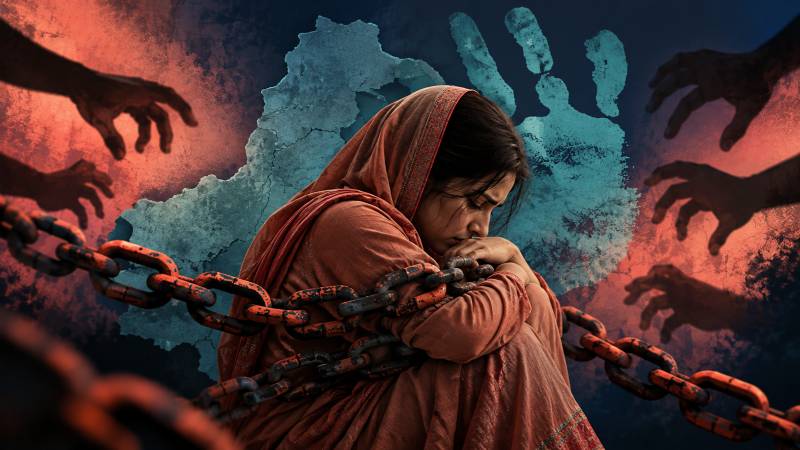
It has become horrible to come across a reel every other day where some beautiful little angel is trampled. She is either Zainab, Muntaha, or three-year-old Kulsoom from Karachi. The cases of sexual abuse aren’t actually increasing; rather, they are being reported increasingly. It is a crisis of visibility, as social media has finally revealed to us the heavy silence in which our women have survived for generations. Yet, the state has shown little or no seriousness, reflecting its 79-year legacy. It is tangled in bureaucratic apathy. Its leadership lacks the ability and will to bring structural and long-term solutions.
But in all this darkness, the public, and especially GenZ, has emerged as a light of hope. They are actively engaging with this issue. Content creators are raising their voices. People are demanding the public hanging of rapists, actively shifting their profound disgust for these perpetrators into action. A hope for the revival of justice was demonstrated when the central perpetrator of the Sargodha incident, the one who took angel Muntaha from us, was killed by the CCD. Later, the public did not just refuse his Janaza but refused to let his body be buried in their graveyards. It sends a strong message to potential rapists to not to dare.
On the surface, it seems right. It feels as if society has finally found its spine. But by looking closer, we find this is not a cure for the violence. It is the performative fury of a public that has lost all trust in the state and its institutions. In a desperate bid to see "justice served," they are merely "serving punishments" to satisfy an intense anger. We are not eliminating the crime, but the criminals. Instead of creating awareness for the rights and dignity of the opposite gender, giving moral literacy, and building healthy emotional frameworks, we are merely suppressing the impulse. It actually does not vanish but is simply forced underground by the extreme consequences and punishments of the act. Perpetrators having the potential for violence merge themselves into the very same mobs demanding public hangings of rapists. Under the right "favorable conditions" and absolute secrecy, where the chances of consequences seem lowest, they will commit the exact same act. They have been socially, culturally, politically, and financially wired to do so.
By distancing themselves from this violence and labeling the individual perpetrator as an absolute monster, the crowds transform themselves into "pious mobs." While the minds derive a sense of righteousness by closing the graveyard gates to an individual criminal, a deeper reality is allowed to be buried in his place instead. So, when a society focuses merely on punishment, an act executed ‘after’ the tragedy has occurred, and remains unconcerned about the psychological and structural drivers of the crime, sexual abuse cases will not stop. They will mutate. The uncured and suppressed impulse will eventually find expression where these severe consequences are least likely to happen. Such mutated perpetrators will target the most vulnerable spaces such as minorities, the homeless, and the children of those who possess the least social powers.
We use this rage to cover up our everyday language, our systemic misogyny, our political failures, and the cultural objectification of women which are the forces that are not just feeding, but giving birth to the very beasts we claim to hunt and hang.
The crime will mutate not just in its targets, but in its methods as well adapted in a manner to evade detection and escape mob punishment. One such horrifying mutation is the "acid bath" murder, where a perpetrator dissolves the victim's body in strong, corrosive chemicals. Thus, this trajectory will actually incentivize perpetrators to be even more beastly to erase the evidence.
In an environment where no procedural judicial inquiry is required before executing charges, society will pivot toward the weaponization of rape. Personal enemies, property rivals, and political opponents will use these accusations to eliminate their rivals without facing any legal challenge. Such an environment will disproportionately and unjustifiably punish the poor and powerless while shielding and benefiting the elite and the powerful.
When the primary drivers: such as deep sexual frustration and a complete lack of education, are ignored, the crime rate will refuse to drop. This failure will cause the public's threshold for punishment to rise even higher. They will no longer just demand legal execution but they might start lynching the accused themselves on the streets, publicly torture them, and live-stream their castrations to satisfy a collective bloodlust.
Ultimately, when hundreds of punishments have been carried out, hundreds of funerals refused, and hundreds lynched on camera but still our women and children are ‘not safe’ walking the streets, the psychological trauma of total anarchy and social distrust will hit the entire nation. It will project the illusion of a failure of justice, but in reality, it will be the failure of extrajudicial, anger-based mob punishments. Until it is too late to realize that we were trapped in a performative lie and have sacrificed our legal structures, we must wake up. We have to reflect on our immense desire to get “instant justice” as if it is more blood thirsty of rapists rather than demanding the actual solutions.
We must urgently address the psychological, social, emotional, political, and financial drivers of this violence through systematic moral and gender education, awareness campaigns, intentional and educated social media narratives, increasing employment rates, and institutional reforms. Otherwise, by focusing merely on punishments, we are not destroying monsters but, we are only creating more cautious ones.