

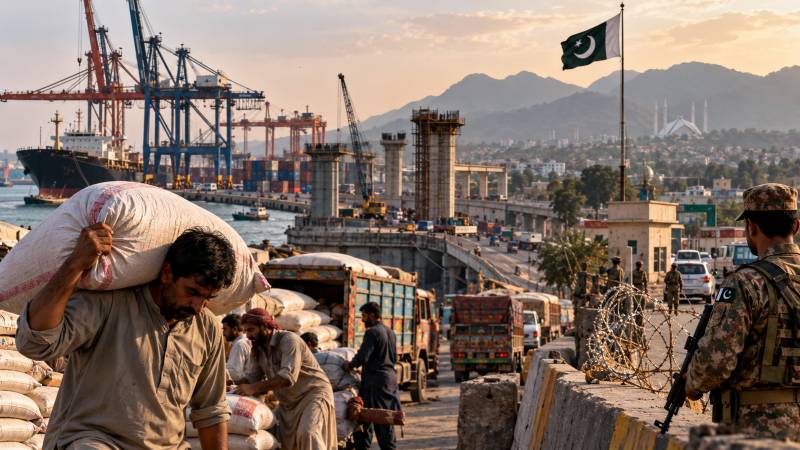
Pakistan’s economic crisis has renewed demands for national development, industrialization, and economic sovereignty, offered as solutions to persistent difficulties of capital formation, a limited industrial base, and stagflation since the 1950s. The neo-developmentalist turn of the 2010s expanded infrastructure financing and state-supported investment without resolving these historical problems, while integrating domestic production and public finances more deeply into international accumulation. Understanding this crisis requires examining the recomposition of capital through which financial claims increasingly shape productive activity and the conditions of everyday survival, while military and bureaucratic institutions consolidate their authority over investment and economic governance.
Capital increasingly appropriates existing productive capacities and socially generated wealth beyond investment in new production. IMF adjustment and public debt establish claims over future government revenues, while energy-sector cost recovery transfers financial obligations onto households and productive enterprises whose incomes do not adjust accordingly. For Marx, industrial capital generates expanded value through production and circulation, a process grounded in the exploitation of living labour. Interest-bearing capital, by contrast, appears to generate more money directly from money, concealing how financial returns ultimately depend on claims over value produced through labour. Drawing on Gago and Mezzadra’s expanded conception of extractivism, Pakistan’s emerging neo-extractivist economy connects the extraction of natural resources with the appropriation of revenues generated through existing productive and reproductive activities.
The proliferation of digital financial infrastructure increasingly incorporates household transactions into financial circuits, while the expansion of consumer credit and household indebtedness enables financial institutions to secure returns through interest, fees, and repayment obligations. These developments extend capitalist appropriation across circulation and social reproduction, the everyday work of sustaining life and labour, enabling capital to obtain returns from productive capacities and cooperative relationships that it does not directly organize. The result is growing precarity as working populations confront increasingly insecure livelihoods and rising costs of everyday survival, becoming more dependent on credit to meet basic needs while debt repayments absorb future earnings.
Understanding this crisis requires examining the recomposition of capital through which financial claims increasingly shape productive activity and the conditions of everyday survival, while military and bureaucratic institutions consolidate their authority over investment and economic governance.
Neo-Developmentalism Combines Redistribution with Extraction
During Latin America’s Pink Tide, state-led development combined expanded public investment and social programmes with intensified resource extraction, land dispossession, and dependence on international commodity markets. The expansion of public provision is financed through extractive revenues while existing relations of ownership, dispossession, and capitalist accumulation remain largely intact. Pakistan’s CPEC projects and investment arrangements associated with the Special Investment Facilitation Council operate under different historical and institutional conditions, although their integration of infrastructure financing, resource concessions, and international capital raises related questions concerning control over productive resources and future revenues. In this context, development must be examined through the relations of ownership, financial dependence, and political authority that govern the expansion of productive capacity.
A Stronger State Does Not Mean Greater Economic Independence
Contemporary economic nationalism presents the expansion of state authority as a means of recovering sovereignty from external dependence, even as investment institutions integrate domestic resources into transnational accumulation. IMF obligations, Chinese infrastructure financing, and Gulf investment have distinct financial terms and objectives, but each relies on domestic institutions enforcing claims over resources and future revenues. Pakistan’s colonial institutional inheritance and subsequent military-bureaucratic centralization shape these relationships. Financialized sovereignty describes this simultaneous expansion of domestic fiscal and coercive authority and its integration with international financial claims, revealing how the consolidation of state power can facilitate deeper economic dependence. The language of national interest transforms differentiated class interests into the appearance of a unified political project, obscuring who controls investment and resource allocation. The question is who determines investment priorities and receives their returns. The centralization of economic decision-making can strengthen the state’s capacity to secure investment while restricting the participation of populations whose livelihoods are directly affected, without establishing popular economic autonomy.
War and Border Restrictions Are Reshaping Pakistan’s Economy
These transformations unfold within an expanding war regime as security priorities shape investment and circulation. The atmospheric character of war describes the extension of military rationalities into ordinary economic administration, through which security assessments influence infrastructural development and determine the possibilities for civilian mobility and regional exchange. In Pakistan, the October 2026 emergency in Khyber Pakhtunkhwa concentrated provincial executive authority in a region already shaped by counterinsurgency, displacement, and movement restrictions. These arrangements restrict how populations contest decisions over land and resources, linking security power to accumulation. Across Pakistan’s borders, restrictions on trade and movement involving Afghanistan and India constrain agricultural markets and livelihoods dependent on regional exchange. Investment corridors receive strategic support under arrangements that privilege particular routes of circulation, while restrictions on civilian mobility and cross-border productive cooperation reproduce economic isolation. Changes in the international distribution of power do not necessarily weaken imperial relations, since competing geopolitical arrangements can reproduce the militarized conditions through which capital circulates.
Working-Class Life Extends Beyond Formal Wage Employment
Proletarianization cannot be measured by the expansion of stable industrial employment alone. It involves growing dependence on selling labour power as secure access to land and livelihoods diminishes, including through informal work, temporary migration, and household production. These differentiated forms of proletarian life remain integral to accumulation, as unpaid care and informal cooperation sustain labour and economic activity while debt establishes financial claims over household income. These conditions are also shaped by gendered divisions of labour, unequal access to resources, and the distribution of paid and unpaid work, through which the costs of economic precarity are unevenly absorbed across working populations. Their conditions are also shaped by unequal citizenship and mobility, as Pashtun migrants encounter policing and identification requirements in employment and urban life. The common refers to the shared productive capacities and cooperative relationships through which populations sustain themselves, without assuming that they constitute a unified national subject.
Beyond Development: Collective Power and Anti-War Internationalism
The idea that state sovereignty can substitute for popular freedom, public ownership for democratic control, or capitalist development for social progress must be challenged. An alternative politics must move beyond nationalization and centralized planning toward democratic control over production and social wealth, grounded in workers’ and communities’ struggles rather than insulated state institutions. That requires changing how public resources are appropriated and economic decisions made while confronting security objectives and regional isolation. Anti-war politics forms an integral part of this transformation because counterinsurgency and border closures establish conditions of control over economic life that extend beyond immediate military objectives. International solidarity must develop through the independent political capacities of working populations, not allegiance to competing geopolitical powers.