

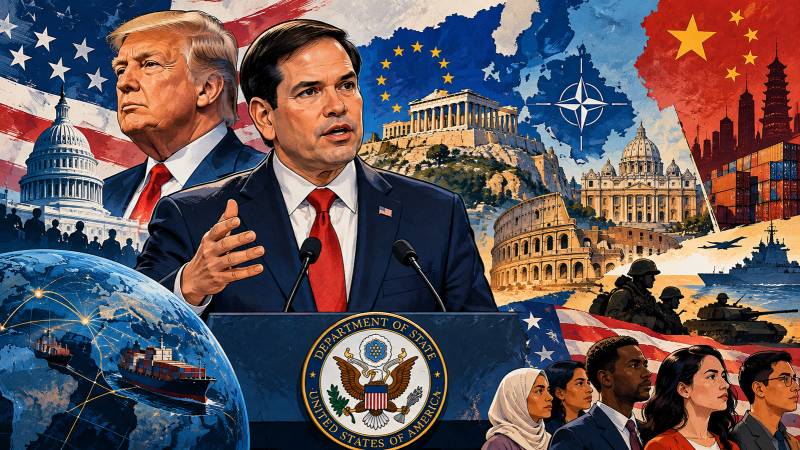
President Donald Trump’s statements and policies have strained relations with America’s traditional Western allies. Tariffs, proposals to bring Greenland under American control and make Canada a U.S. state, his treatment of Ukraine’s president in the Oval Office, and his approach to Vladimir Putin have contributed to resentment and mistrust. These disputes raise questions about the reliability of American leadership and the future of the transatlantic alliance.
Against this backdrop, Secretary of State Marco Rubio has offered an argument for Western solidarity. In speeches at the Munich Security Conference on February 14 and in Athens on October 7, he emphasized the historical, cultural, religious, and strategic bonds connecting the United States and Europe. His message was that their alliance rests on more than overlapping interests: Americans and Europeans are heirs to a common civilization whose future they must secure together.
Rubio’s speeches offer a coherent vision of Western renewal. Yet that vision faces two fundamental tests: whether it can restore confidence among allies unsettled by Trump’s policies, and whether it can command broad support within a diverse and divided America. Read together, the speeches reveal a consistent worldview. Rubio sees the United States and Europe as parts of a single historical community, with their security, prosperity, and survival inseparably linked. In Athens, he traced that inheritance through ancient Greece, Rome, Christianity, and the development of European thought before its transmission across the Atlantic.
This historical account serves a contemporary political purpose. Rubio argues that Western societies have lost confidence in the traditions and qualities that made them powerful. In his telling, cultural self-doubt has accompanied economic dependency, weakened defenses, and the transfer of national decision-making to international institutions. Renewal therefore requires recovering both material strength and a sense of common identity.
Globalization sits at the center of this diagnosis. Rubio argues that policies pursued under the banners of free trade and international integration have moved industries and jobs overseas, weakened domestic production, and left Western countries dependent on rivals for essential goods and resources. His proposed response combines reindustrialization, control over critical supply chains, technological leadership, and stronger defense capabilities. China appears to be a central reference point in this argument, even when it goes unnamed. Rubio’s concerns about manufacturing, critical minerals, technology, and economic dependency point toward the competition over who will control and command the industries and resources of the future.
His treatment of migration adds a cultural dimension to this economic argument. In both speeches, Christianity figures prominently in his account of Western civilization. His calls to secure national borders are closely connected to warnings that mass migration threatens cultural continuity and social cohesion. Here, border security is presented not simply as an administrative responsibility, but as a means of preserving a particular way of life.
Military power is another essential element of Rubio’s vision. In Munich, he cited American attacks on Iran and the seizure of Venezuela’s president as examples of decisive action where, in his account, diplomacy and international institutions had failed. His broader argument is that declarations and resolutions alone cannot protect national interests. Power requires both the ability to act and a credible willingness to do so. These themes place Rubio within a longstanding debate over the post–Cold War order. Francis Fukuyama’s End of History thesis suggested that liberal democracy had outlasted its principal ideological alternatives. By contrast, Samuel P. Huntington argued that cultural and civilizational divisions would become major sources of conflict.
Rubio’s speeches offer a coherent vision of Western renewal. Yet that vision faces two fundamental tests: whether it can restore confidence among allies unsettled by Trump’s policies, and whether it can command broad support within a diverse and divided America.
Rubio explicitly rejects the post–Cold War optimism he associates with the End of History: the expectation that commerce, liberal democracy, and international institutions would overcome national rivalries. His emphasis on civilizational identity echoes aspects of Huntington’s framework. The question is whether this intellectual framework can become a durable political project. Abroad, Rubio faces a credibility problem. European partners and Canada must assess his language of solidarity against the administration’s conduct. Appeals to common heritage may reassure some audiences, but they cannot by themselves resolve disputes over tariffs, sovereignty, territorial ambitions, or security commitments. Trust ultimately depends on policy as well as rhetoric.
At home, the political foundations are equally uncertain. Rubio’s outlook may appeal to conservatives who favor a stronger Western alliance, industrial renewal, and greater military capacity. Yet the more intervention-skeptical elements of Trump’s MAGA movement may resist his justification of military force. Trump campaigned as a leader who would keep America out of foreign wars and has repeatedly claimed credit for ending conflicts. Those promises do not necessarily prevent his supporters from endorsing limited military operations. They do, however, expose a tension between Rubio’s emphasis on exercising power and the movement’s resistance to prolonged foreign commitments.
America’s diversity poses another challenge. The country includes people of European, African, Asian, Indigenous, Latin American, and mixed ancestry, alongside many religious traditions and secular outlooks. Pew Research Center’s 2023–24 Religious Landscape Study found that 29 percent of American adults were religiously unaffiliated and 7 percent belonged to religions other than Christianity. These figures underscore the risks of building a national vision and narrative around European heritage and “Christendom.” Such a framing risks making millions of Americans feel peripheral to the national identity their government claims to defend. For Rubio or any politician contemplating a 2028 presidential campaign, the consequences could be substantial. A civilizational narrative may mobilize one constituency while alienating another, including Americans who value Western traditions but reject ancestry or religion as measures of national belonging. In an already polarized society, that distinction matters. Political disagreement becomes more dangerous when it turns into a struggle over whose identity and citizenship are fully recognized.
Meanwhile, Democrats are engaged in their own struggle over America’s future. The progressive economic agenda that Senator Bernie Sanders championed during the 2016 presidential primaries has gained influence, reinforced by the rise of democratic socialist and other progressive candidates. Zohran Mamdani’s election as New York City’s mayor and Abdul El-Sayed’s victory in Michigan’s Democratic Senate primary illustrate this movement’s growing electoral strength. Alongside established national figures such as Sanders, Senator Elizabeth Warren, and Congresswoman Alexandria Ocasio-Cortez, Mamdani and El-Sayed have become increasingly prominent voices in the debate over the party’s direction. Their emphasis on economic inequality, affordability, and curbing corporate power challenges the party’s centrist establishment.
On international affairs, however, Democrats broadly share a commitment to cooperating with allies, engaging with the United Nations, and taking collective action on climate change. Their agreement is less complete on globalization and free-market policies: progressives have challenged trade arrangements and market-oriented policies they believe undermine workers, deepen inequality, or weaken environmental protections. These differences will help shape both the Democratic agenda and the selection of its presidential nominee in 2028. These divisions differ from those within the Republican Party, but they underline a common reality: neither party has settled its vision of America’s economic priorities, national identity, and international responsibilities.
America faces a defining moment. It needs leadership that can rebuild trust with its allies and bridge the conflicting political narratives that divide the country. So far, neither Secretary Rubio nor any other leading political figure has convincingly demonstrated the ability to meet both challenges. The November 3 midterms and the 2028 presidential election will therefore be crucial in shaping America’s future at home and its capacity to exercise credible leadership abroad.