

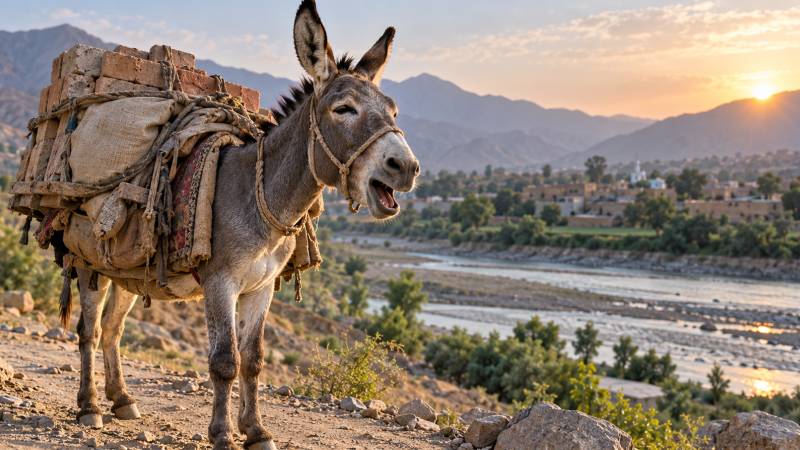
Huzaima stopped when she heard a donkey call. To her there was sadness in the sound. I had heard it often without wondering what the animal might be trying to say. We could not know from that call whether it was hungry, seeking company or suffering under a load. However, her response sent us back to a familiar rendering of the holy Qur’an: ‘the ugliest of all voices is the voice of the donkey’. How had a counsel about the way people speak become a judgment about an animal?
The trouble begins whenever we imagine that a great literary work can be carried into another language word for word. Its rhythm, associations and changes of register do not submit to a dictionary. The Qur’an poses a formidable challenge of this kind. It invites its doubters to produce a surah comparable to it. That challenge concerns a whole act of expression, not the replacement of each Arabic word with an English one. Translation is indispensable for millions of readers. It is also an interpretation, never a second original.
In Surah Luqman, 31:19, a father advises his son to be measured in his walk and to restrain his voice. The last clause reads: inna ankara al-aswati la-sawtu al-hamir. The word ankara has the root n-k-r, associated with the unrecognised, the strange and what one finds objectionable. Classical commentators also understood it here as an unpleasant or ugly sound. It would therefore be too easy to say that ‘ugliest’ is a dictionary error. A root offers possibilities; the sentence and its neighbours determine what work a word is doing.
Look at the translators’ choices. Muhammad Asad writes ‘ugliest’, but places ‘(loud)’ before the voice of asses. M A S Abdel Haleem also uses ‘ugliest’. A J Arberry chooses ‘most hideous’. Marmaduke Pickthall and Abdullah Yusuf Ali choose ‘harshest’. Saheeh International says ‘most disagreeable of sounds’; Muhammad Sarwar says ‘most unpleasant sound’.
G A Parwez’s Exposition of Holy Quran calls it ‘the most repulsive and ugliest voice’ and adds that it sounds harsh to listeners. The renderings converge in disapproval, yet they do not produce the same thought. ‘Harshest’ directs the ear towards a sound; ‘ugliest’ invites a more sweeping verdict. Parwez doubles the verdict with ‘repulsive’.
The verse does make a pointed comparison with a donkey’s voice. We must not erase it to suit our sympathies. However, we must also ask whom Luqman addresses. In the preceding verse, he warns his son against turning away from people in pride and strutting upon the earth. He then urges moderation of gait and voice. The failure under examination is human arrogance. The donkey supplies an image a hearer will recognise. To turn that image into a permanent moral disgrace for the animal is to change the subject.
The verse does make a pointed comparison with a donkey’s voice. We must not erase it to suit our sympathies. However, we must also ask whom Luqman addresses. In the preceding verse, he warns his son against turning away from people in pride and strutting upon the earth. He then urges moderation of gait and voice.
There is no scientific experiment that ranks all animal calls from beautiful to ugly. Acoustics can measure loudness, frequency and duration. Researchers have described the donkey’s unusual bray, formed on both inhalation and exhalation, and the variation between individual animals. Such measurements do not establish a universal aesthetic order. A bray can jar one listener and move another. Huzaima heard sadness; her response was a reason to pay attention, not proof of the animal’s condition.
Attention matters in the subcontinent. Genetic research places the donkey’s domestication in Africa, followed by its spread across regions through human use. The evidence we found does not fix a reliable date or route for its arrival in South Asia. What we can document is its present work. In a Pakistan study, owners estimated that most of the donkeys surveyed carried loads exceeding half their body weight; 87.4 per cent fell in that category.
Research at Indian brick kilns describes the hardship of donkeys alongside the debt and insecurity of the families who depend on them. The animal may be carrying another person’s bricks because that person, too, has little choice. None of these studies can diagnose the donkey whose call Huzaima heard. They do tell us why its welfare deserves attention. Language has meanwhile added its own load. In Urdu, calling someone a gadha means calling that person a fool; dictionaries record the usage without making it true. The hardworking creature becomes an easy insult for a human mistake.
Across the Atlantic, the same animal became the familiar emblem of the United States Democratic Party, following its association with Andrew Jackson’s campaign and later political cartoons. Symbols change with their users. Neither a party badge nor a commonplace insult tells us anything about a donkey’s intelligence or dignity. The Qur’an itself resists the idea that its comparisons deprive an animal of value. It calls living creatures and birds communities like us in 6:38. It names donkeys among creatures provided for transport and adornment in 16:8.
In 62:5 it compares people entrusted with the Torah, who failed to bear its responsibilities, to a donkey carrying books. The rebuke falls on those people, not on the animal: owning or transporting volumes does not amount to understanding and living by them. One might extend that warning to a person proud of a great library, but that is our application of the image, not the verse’s stated historical subject.
A further lesson lies in the Qur’an’s use of muhkam and mutashabih. In 3:7, some passages are called foundational and others admit more than one reading [explain abstract realities metaphorically]. In 11:1, the Book’s verses are described as made firm and then explained. In 39:23, the Book is mutashabih in the sense that its parts resemble and support one another.
A reader who forces the same meaning upon all three mistakenly announces a contradiction created by neglecting context. A reader who attends to each sentence sees the different claims. A debate attributed to a young Imam over these verses may make a vivid story, but its court, date and participants should not be asserted without a traceable source. The verses make the literary point on their own.
The point is to read an image without mistaking it for a laboratory finding or a licence to mistreat its subject. A translator may defend ‘ugliest’ from classical usage; another may judge ‘harshest’ or ‘disagreeable’ better suited to Luqman’s counsel against needless loudness. Each choice must be read with the son, the father and the surrounding injunctions in view. If we read one word alone, we risk hearing an insult where the larger passage asks us to discipline ourselves. One of us heard something that a stock phrase had taught us to ignore. We cannot translate a donkey’s call into a certain account of its feelings, any more than we can translate the Qur’an into a perfect English twin. We can listen more carefully to both. Then perhaps the burden of this verse will fall where Luqman placed it: upon the human voice.