

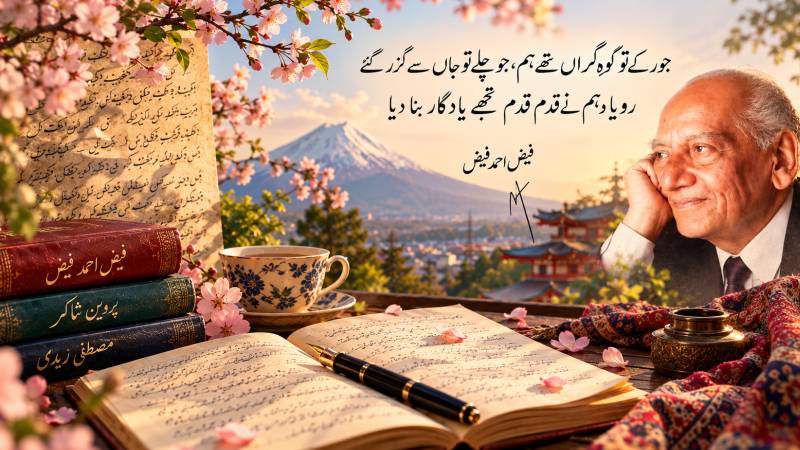
Sometime in the late '90s, a group of us — mostly civil servants, and me, somehow got pulled into a government’s Youth program built around promoting friendship between SAARC countries for the century ahead. I was young. I was, for reasons that still amuse me, a familiar face on TV at the time, so someone decided I should go in as a kind of cultural handler — "polish" the officers a bit, was roughly the brief. Part of the preparation, before we actually flew out to Japan, was a crash course in Nihongo — a pre-departure task, nothing more. Not fluency. Just enough to survive a sentence, order food, be polite.
When I actually met the group, I was surprised — mostly men, as happens even today, sadly and not all of them young, certainly not all under thirty. Most greeted me with a warmth I hadn't expected, and I'll admit I enjoyed my small celebrity status among them. They, in turn, were wonderfully unguarded with me. Most came from humble beginnings and seemed fascinated by this Islamabad girl who was too modern, too blunt, too much, too funny — and middle class besides — as though some strange creature had been dropped into their midst. I remember telling them, half-jokingly, exactly how I imagined they would look in a few years: bored, ugly and haggard.
Being team leader had its serious side. A civil servant handled the official side of things and, fortunately, was also a good friend. I was responsible for the group, and I had also been elected, by their own vote, as cultural leader. One of the hardest parts of the job was introducing some of our very substantial Pakistani men to the Japanese without getting caught in the question of age. Anyone who has travelled abroad from Pakistan with a group will know that foreign trips have a curious way of making rules, propriety and ordinary ethics rather elastic. The Japanese would look at one of our men and ask, quite innocently, “Young delegate or manager?” And there we were, trying to keep straight faces.
He was teaching us that Faiz had, without meaning to, described the physiology before we had ECGs to prove it: a heart in genuine crisis behaves exactly like that — restless, straining against its own vessels, and strangely, briefly lucid.
In our little side meetings, the gang of four would eventually burst into helpless laughter. It was particularly difficult to lie with a serious face: “They are all under thirty.” “Yes, in Pakistan our men are well built — except for the two who are my friends.” And, when necessary, I would add, with the gravest expression I could manage, “All the men are under thirty. And the women — you know — they are always under sixteen.” He he. Arigato. Sayonara
Three of them — one a woman, and my roommate too — became lifelong friends. In Japan, they would come to me with difficult Urdu words, and we would end up reciting Parveen Shakir, Mustafa Zaidi and others between lessons. And on road trips, my roommate and I would sing Gurya Japani for some of our kamzor dil hazraat in the group — quite badly, I should add. We sang it with great confidence and very little musical ability, which perhaps was the real cultural exchange.
Alif se achhi, gaaf se guriya,
Alif se achhi, gaaf se guriya, jeem se Japani
Loot liya hai tu ne ek musafir Pakistani
Pyaar bhara dil lekar main toh aaya tha Japan
Husn ka jalwa dekar tu ne loot liya mehman
I ended up wearing several hats on that trip: team leader, doctor when someone had had too much to drink, keeper of whatever discipline could still be salvaged, cultural leader, a title they had officially bestowed on me themselves, and, occasionally, the person expected to handle the bad news. At one point, one of the members called me to say that his mother had been killed during a daylight robbery in Islamabad. He was a doctor himself, but grief does not always respect professional qualifications, so I found myself consoling him, helping him pack his bag, and managing the inevitable change of plans. The “girls” complimented me afterwards: “You are very brave.” I still don’t know whether that was a genuine compliment or British sarcasm. Perhaps that was the joke of it all. Women doctors are often trusted with the difficult things , illness, emergencies, grief, other people’s crises, while being rather less readily cast as creatures of romance. Looking back, I suspect the title of “cultural leader” was partly an official excuse to let me interfere in everything.
None of that, of course, was where I thought my life was headed. Becoming a cardiologist was the dream I never finished. I'd been headed that way once medical school, the pull toward the heart specifically and then life forked, television and a parallel career in public health pulling me down a different road, one I never quite doubled back from.
I didn't have to wait years for the pieces to connect. Takotsubo cardiomyopathy — broken heart syndrome — was first identified and described in 1990 by Dr. Hikaru Sato and colleagues in Japan, named for the octopus trap the stunned heart resembles on the scan. Tako — octopus. Tsubo — pot, jar. I knew of the syndrome around that same stretch of time, still half in medicine, still paying attention. And the two words weren't strangers to me. They were exactly the kind of basic, early vocabulary a crash course hands you before anything harder, I could probably have said Takotsubo fluently before I ever heard it used as a diagnosis. Literary, literally. I noticed it right then, not in hindsight, a word I'd learned to order dinner with, turning up years' worth of textbooks later, describing a stunned human heart. That's usually how it goes with me and words. I collect the coincidences, even the ones attached to roads I didn't end up taking.
The first time I met the idea of a heart breaking hard enough to kill someone, I was a child, reading Oliver Twist (a children's edition from the British Council Library in Melody, G-6, Islamabad). When Noah taunts Oliver about his dead mother and asks what she died of, Oliver answers almost to himself — of a broken heart, some of the old nurses had told him, and he thought he knew what that must be like. I didn't understand grief yet. But I remember believing him completely. It felt like the most obvious cause of death in the world.
"Of a broken heart, some of our old nurses told me," replied Oliver: more as if he were talking to himself, than answering Noah. "I think I know what it must be to die of that!"
Urdu got there before Dickens did, and stayed there longer. Dil isn't incidental in Urdu poetry — it's practically the whole enterprise. Mir Taqi Mir built a reputation on it. Ghalib circled back to it constantly, nowhere more than here:.
دل ناداں تجھے ہوا کیا ہے
آخر اس درد کی دوا کیا ہے
Strip away the romance it's usually read as, and it's just two clinical questions, asked in order: what's wrong with you, and what will make it stop. That's history-taking and a treatment plan, compressed into a single line, a century before either had a name.
Faraz and Faiz, generations later, never let it go either. So when I was still a medical student, trying to memorise cardiology — my favourite subject since then, and part of that owes to our dearest, awesome Prof. Jawad Jaffery and his signature late-night lecture, three or four hours long, deep into final year, telling us all about the heart — through rote at 2 a.m., before the fork, before medicine and I parted ways, it was the poetry that stuck, not the textbook lines.
I remember the late Prof. Saadat Zaidi, head of medicine at PMC, commending me in a ward test for detecting Traube's sign; the sharp, booming "pistol-shot" sound of severe aortic regurgitation, heard over an uncompressed femoral artery in that violent college where the Jamiat and the PML were forever at each other's throats, and outside, at the national level, the IJI had just been installed. Even a heart sound had to be pistol-shot in those days, in that campus.
I remember the late Prof. Nasimullah — an ace internal medicine physician, the kind whose ward rounds ran so long the juniors dreaded and loved them in equal measure. My history-taking, my diagnoses, the labs I ordered — all correct, all precise. But he was a strict, serious-looking man who wasn't one for open praise, and I'd come to him as a resident from another college, PMC Faisalabad, not his own, even though we shared the same university, Punjab, and I'd needed the highest grades just to earn a place working under him. So his appreciation, when it came, came in its own style, sideways, through Faiz, mid-round at Holy Family Hospital, apropos of nothing and everything.
The way he used to grill us: "Jee, you've taken this history, Dr. Rakhshinda? Did you ask about his heart? Describe the pain. ECG findings? And why did you order these cardiac enzymes — in this some poor man's hospital?" Me: "Sir, patient presented with ———complaints, seems like the heart was damaged ————." And then came his cheeky taunt: "Jee, did you actually read Davidson, Harrison — or Faiz?"
درد اتنا تھا کہ اس رات دل وحشی نے
ہر رگ جاں سے الجھنا چاہا
………..
درد اتنا تھا کہ اس سے بھی گزرنا چاہا
ہم نے چاہا بھی مگر دل نہ ٹھہرنا چاہا
He'd bring up Faiz's poem literally titled "Heart-Attack," where Faiz doesn't just describe a broken heart, he describes a wahshi dil — a wild, restless heart, straining against every vein in the body like it's trying to escape its own chest. And even as the body is failing, what surfaces isn't panic, it's memory — the beloved's face flickering up like a dying candle in the last moment. I didn't understand, then, why a physician quoted poetry on rounds. I understand it now.
He was teaching us that Faiz had, without meaning to, described the physiology before we had ECGs to prove it: a heart in genuine crisis behaves exactly like that — restless, straining against its own vessels, and strangely, briefly lucid. Not every cardiac event announces itself so completely, though and Urdu had a couplet ready for that too, this one from Nasir Kazmi.
دل میں ایک لہر سی اُٹھی ہے ابھی
کوئی تازہ ہوا چلی ہے ابھی
That one became First wind angina in our heads. A ripple that rises and passes — not because it's official terminology, we knew that, but because it's exactly what transient, reversible chest pain feels like. It comes, it eases, life goes on.
شور برپا ہے خانۂ دِل میں
کوئی دیوار سی گِری ہے ابھی
That one was never up for debate. A wall, inside the heart's own house, coming down for good — that's an infarct. Nothing about it resolves on its own. There were others we leaned on too — verses from Anwar Mirza Puri, that we used the same way:
کیا یہ کم ہے مسیحا کے رہنے ہی سے موت کا بھی ارادہ بدل جائے گا
تیر کی جاں ہے دل دل کی جاں تیر ہے تیر کو یوں نہ کھینچو کہا مان لو
We used this one for something less textbook and more real — the effect a doctor's mere presence has on a frightened patient. Long before anyone had a term for the physiology of that, someone had already written it as: don't bother comforting me, just stay — your staying alone might change death's mind.
تیر کھینچا تو دل بھی نکل آئے گا دل جو نکلا تو دم بھی نکل جائے گا
ایک مدت ہوئی اس کو روئے ہوئے ایک عرصہ ہوا مسکرائے ہوئے
And this one, oddly, is trauma medicine in two lines — the standing rule that you never pull out an impaled object at the scene, because it might be the only thing holding a torn vessel shut. Pull the arrow, and the heart goes with it. And Faraz, in "Ranjish Hi Sahi," built one of the most-loved ghazals in the language around asking someone to come back and hurt him again — dil dukhana — because even that pain beat the absence.
رنجش ہی سہی دل ہی دکھانے کے لیے آ
آ پھر سے مجھے چھوڑ کے جانے کے لیے آ
I never did become a cardiologist. But I think that's almost fitting, for a piece like this — I ended up, instead, collecting the heart secondhand: through a language I learned to order dinner in, through ward rounds where poetry did the teaching a textbook couldn't, through ghazals and nazms written centuries and decades before anyone had a stethoscope. A Japanese octopus trap, the ghazals and nazms of Urdu, and my professors — one who lectured past midnight on the heart, one who commended me the day I caught a pistol-shot sound-a murmur most residents would have missed, one who quoted Faiz mid-round instead of praise — all of it describing the same organ, doing the same things, in rooms I only partly got to finish.