

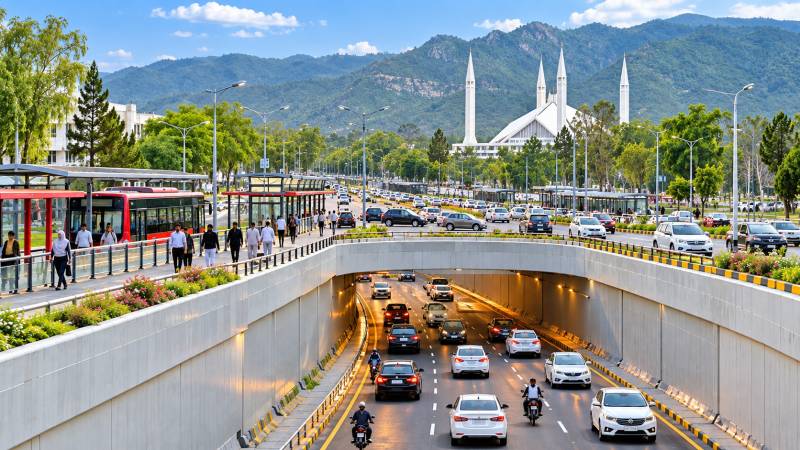
Underpasses can relieve isolated bottlenecks. But when they take priority over public transport, walkable streets, affordable housing, healthcare, education, water, public space and basic safety, they become a misuse of public money. Islamabad’s transport policy is increasingly judged by what can be built, photographed and opened. One junction gets an underpass; congestion shifts; another project follows. The Capital Development Authority is working on Kashmir Chowk after Shaheen Chowk and the Margalla Road underpass. Each is sold as a victory over traffic. Moving cars faster through one junction is not economic progress.
The issue is opportunity cost. Every rupee spent on visible road infrastructure is a rupee not spent on systems that move more people, improve health, reduce risk or connect poorer households to jobs and services. The more photogenic project is not necessarily the more productive one. The test is simple: does public spending raise productivity, widen access and reduce preventable risk? An underpass may remove a genuine bottleneck, but that only justifies assessment, not automatic approval. Each project should be weighed against alternatives: bus routes, safe pavements and crossings, hospital upgrades, better schools, affordable housing, water supply and basic services near opportunity.
Pakistan should have learnt this lesson from the power sector. The country created generation capacity beyond what its transmission and distribution systems could absorb. The result was not reliable, affordable electricity. It was a capacity-payment trap in which consumers and the economy were asked to pay for capacity that could not be fully used because the rest of the system had not been developed alongside it. Islamabad risks repeating that mistake. It is adding road capacity without building the water, transport, hospitals, schools, parks, drainage and municipal services needed for a growing population. Underpasses without these systems are the urban equivalent of power plants without transmission lines: visible structures attached to a weak network.
Islamabad’s programme also avoids the central transport question: why should the default be faster private-car movement rather than moving more people without cars? Reliable buses serve students, workers and jobseekers. Safe pavements and crossings make short trips possible without petrol. These options deserve the same fiscal seriousness as concrete megaprojects. The distributional question is sharper still: who benefits most? Much of the network appears to serve senior officials, visiting dignitaries and affluent commuters moving through the protected geography of the capital, from Rawalpindi and the airport corridor towards Parliament, the Presidency, the Prime Minister’s House and other high-security areas. Ordinary motorists may also use these roads, but the investment pattern suggests elite mobility has been treated as a public priority.
That image is misleading. A smooth airport-to-government route says little about conditions for ordinary citizens. It can obscure overcrowded hospitals, weak schools, unsafe streets, poor sanitation, unreliable transport, inadequate water and the daily struggle of people who cannot move through the city with the same ease. A capital should not be judged by how quickly a dignitary reaches a compound. It should be judged by how easily citizens reach work, education, healthcare, markets and public services.
This privileged geography also extends to the Diplomatic Enclave. Islamabad has created islands of protected mobility and superior services for diplomats, senior officials and affluent residents, while the wider population remains excluded from comparable standards of infrastructure, security and public provision. This separation is indefensible. Public resources should integrate citizens into a common system of opportunity, not build protected corridors for those already powerful and well connected.
For most citizens, walking is not a lifestyle choice; it is basic mobility. Yet pedestrians face broken pavements, encroachments, open drains, poor lighting and dangerous crossings. Women, older people, children and people with disabilities face even greater barriers. When walking is unsafe and public transport unreliable, people are pushed into cars, motorcycles and rickshaws. Daily movement becomes sitting in traffic, at work and at home, worsening obesity, diabetes, hypertension and heart disease.
Islamabad risks repeating that mistake. It is adding road capacity without building the water, transport, hospitals, schools, parks, drainage and municipal services needed for a growing population. Underpasses without these systems are the urban equivalent of power plants without transmission lines: visible structures attached to a weak network.
Pakistan’s Planning Commission has long argued that productive cities are connected, dense and mixed-use. When homes, workplaces, shops, schools and services are close together, people walk more, public transport carries more passengers and households rely less on private vehicles. Underpasses that ease outward car travel while neglecting buses and walkable neighbourhoods work against that logic. Road capacity also fills up. When driving becomes quicker, people make additional trips, travel farther or shift from walking and public transport to cars. Evidence from US cities suggests highway travel rises roughly with highway capacity. Islamabad needs local data, but the lesson is clear: road expansion is not a permanent cure for congestion.
Claims about large increases in motorised journeys or petrol use should therefore be treated as scenarios, not established Islamabad findings. The core point is modest but important: an underpass may save fuel at one junction while encouraging more driving elsewhere. In an oil-importing country with rising health costs, that trade-off matters. The transport debate also intersects with Islamabad’s extraordinary real-estate costs. Public investment that improves access to high-value, low-density areas can raise land values without making the city more affordable. The gains accrue largely to landowners, developers and affluent households, while lower- and middle-income families are pushed farther from jobs, schools and hospitals.
Other capitals show that high land values do not justify building only for motorists. London, Paris, Berlin, Washington and Singapore all face housing pressure, but they also invest in public transport, public spaces and services that allow people without private cars to participate in urban life. Expensive cities need stronger transit, better land-use planning, affordable housing and services close to where people live. In Islamabad, the state risks using public money to serve the already privileged while neglecting basic needs. Public hospitals remain overcrowded and under-equipped. Many children lack decent public schools. The state keeps funding visible concrete while underfunding the health and human capital that determine productivity.
The same imbalance appears in water and public space. Islamabad struggles to provide reliable water, yet continues to expand roads and development that increase demand for municipal services. It also lacks enough parks, playgrounds and civic facilities. Healthy urban life requires clean water, safe places to walk and gather, and institutions that serve people with dignity.
The failure is not limited to hospital capacity, medicines or equipment. Hospitals and public buildings must be maintained, inspected and made safe. Fire hazards, faulty wiring, blocked exits, weak emergency systems and other risks can turn public institutions into death traps. The recent fire at the Pakistan Institute of Medical Sciences, in which at least 14 infants died, shows what neglect can mean. It demands scrutiny of safety and emergency procedures, not ritual expressions of shock. This is not an argument against road investment. It is an argument for priorities. A new underpass should be compared with hospital upgrades, school reconstruction, bus networks, water systems, parks, affordable housing and basic services. Public spending should be judged by the lives it improves, not the size of the structure it produces.
Public transport and density reinforce each other. Compact, well-serviced neighbourhoods make frequent buses viable and reduce dependence on private vehicles. Density is not crowding people into badly serviced areas; it is planning water, sanitation, safe streets, parks, schools, hospitals and utilities together.
Underpasses can pull in the opposite direction. Easier driving to peripheral land encourages dispersed development, longer utility networks and greater vehicle dependence. Congestion returns, and another road project is proposed. The public pays twice: for the structure and for the sprawl it induces. There is also a question of capacity. At a busy crossing, should scarce public space and money be committed to passing more private cars, or to carrying more people reliably? A bus full of workers is not equivalent to a car carrying one commuter. A transport plan that counts vehicles but overlooks passengers can improve traffic flow while worsening access.
Islamabad needs a connected bus network, usable stops, safe access routes, accessible crossings, traffic calming and enforcement against encroachment and dangerous driving. It also needs affordable housing near jobs and services, safe hospitals, reliable water, drainage, parks, playgrounds and public spaces. An isolated road structure cannot substitute for that system. The habit of treating construction as growth reflects a deeper confusion. Concrete is an input. Growth comes when workers and firms use infrastructure to produce more, trade more and compete more effectively. A reliable road to a farm, industrial area or export route can earn its keep. So can dependable power, transmission and distribution, water, freight links, skills, hospitals, schools and public transport.
The power-sector experience should have taught us that infrastructure must be developed as a system. Generation without transmission and distribution creates stranded capacity and financial liabilities. Roads without water, public transport, schools, hospitals, parks and municipal services create stranded urban growth and social liabilities. Islamabad cannot keep adding population and road capacity while leaving the supporting systems underdeveloped.
A healthier and better-educated population is also an economic asset: fewer preventable illnesses mean lower medical costs, fewer lost workdays and greater productivity, while better schools expand the country’s productive capacity. Preventing hospital fires and other avoidable disasters is part of that same economic responsibility. An underpass that mainly shortens an already comfortable commute has a weak public case. If it serves protected routes more than ordinary citizens, encourages sedentary travel, increases fuel use, worsens pollution, makes walking harder or raises land values without broad public benefit, its apparent gain conceals a wider cost. The question is not whether a car reaches a junction faster. It is whether the city becomes more productive, accessible, healthy, safe and fair.
Politically visible projects keep appearing in the most visible places. Islamabad gets another signal-free crossing; Lahore gets another grand road scheme. Meanwhile, productive districts across Pakistan compete for basic roads, drainage, water, schools, parks, safe public spaces and hospitals. Governments owe the country a clear explanation for why prominent urban road projects deserve priority over investments with potentially higher returns elsewhere. Before approving another underpass, the government should publish its life-cycle cost, traffic forecasts, expected fuel savings, likely additional driving, and effects on buses, pedestrians, land use and public health. It should compare the project with serious alternatives: dedicated bus lanes, higher-frequency services, junction redesign, safe crossings, traffic calming, protected cycling routes, affordable housing and compact development around transit.
The comparison should measure people moved, not only vehicles cleared: access to jobs, schools, clinics and markets; operating costs; reliability; emissions; road safety; physical activity; and delivery times. It should show who gains and who pays, including car users, bus passengers, pedestrians, nearby residents, businesses, women, people with disabilities, older people and lower-income households. It should also account for rising land values and ask whether public investment is making housing and services more accessible or merely increasing the wealth of those who already own land.
The same scrutiny should apply to hospitals and other public buildings. Authorities should publish inspection records, fire-safety assessments, maintenance schedules, emergency-readiness reports and corrective-action plans. Every hospital should have functioning alarms, extinguishers, emergency lighting, accessible exits, backup power, trained staff and evacuation drills. A government that measures success by opening ceremonies but not by whether a hospital can safely evacuate newborns is measuring the wrong things. Approval should depend on network-wide outcomes, not ribbon-cutting. Authorities should publish baseline and follow-up data on travel times, passenger volumes, pedestrian counts, crashes, fuel use, emissions, maintenance costs, business access, walking conditions and distributional effects. If congestion shifts, fuel savings disappear, public transport worsens, walking becomes more dangerous, land prices rise without broad public benefit or public buildings remain unsafe, the policy has failed.
Pakistan needs infrastructure, but it must distinguish investment from construction activity. A successful city connects people, firms and goods efficiently, including those without cars. A successful capital also provides decent hospitals, effective schools, affordable housing, reliable water, public spaces, dependable transport and safe public institutions. Smooth roads for the affluent are not enough. An underpass may solve a specific problem. But underpasses are not substitutes for public transport, safe walking, affordable housing, quality education, reliable water, public space, well-serviced density or safe hospitals. Protected corridors and elite enclaves are not progress. Pakistan will not underpass its way to prosperity.