

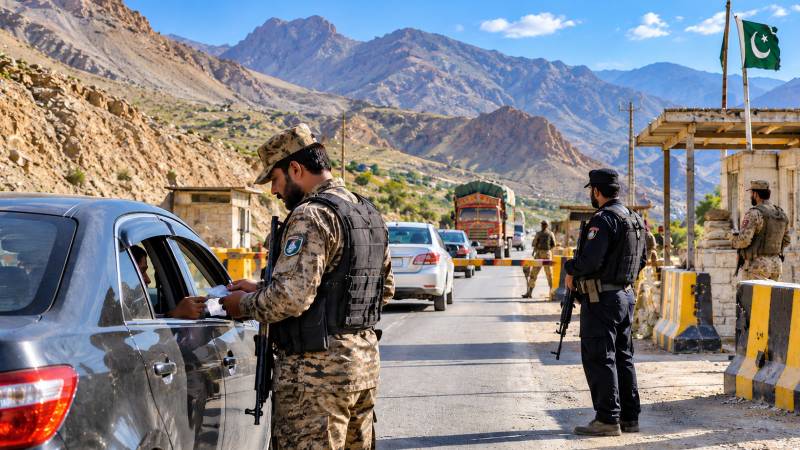
The tea was still hot when the question came to me. It was a Saturday afternoon in Quetta, the autumn breeze soft, the city bright and alive. My leave was over, and by Monday I had to be at my desk in Islamabad. I looked at the faces around me in the café, and an unwelcome thought slipped in. What if someone here knows I work for the government? I pushed it away. This is my home. I am a son of this soil. The flight cost nearly Rs50,000, more than I could afford. The road, then.
My parents said little as I packed, but their faces said enough. That night I lay awake asking one question. Will we make it? At dawn my mother stood at the door. “Leave early,” she said, her eyes wet, whispering a prayer as my younger brother and I got into the car.
Two strangers shared the ride. When they asked what we did, we said we worked at a hotel in Islamabad. On this road, you learn to say less. After breakfast in Killa Saifullah, we reached Zhob by two o’clock, and the car fell silent. In the Sherani area, Frontier Corps and Customs officials were checking vehicles for smuggled goods. One of them leaned toward my window. “Where are you going?” “Islamabad.”
He photographed my identity card, then me, then everyone else. Five minutes later the barrier lifted. The police stopped us soon after, and near Darazinda the Khyber Pakhtunkhwa Police checked us again. Nobody was rude, yet my chest tightened with every stop. Then came Daraband.
Around five o’clock, a few men in ordinary clothes and helmets stood across the road. No uniforms. One of them walked up to the car, long-haired, speaking a local language. “Show me your student card.” I handed him my identity card instead. He studied it, then me. “Are you a Kakar?” I nodded. “Is there any government official in this car?”
My hands went cold. We answered, and after a long moment he let us go. Once they were out of sight, the driver said quietly, “I don’t think those were officials.” I will never know. Darkness fell as we joined the Hakla–D.I. Khan motorway. When an elderly passenger asked to stop for Maghrib, the driver apologised. It was not safe to stop here. Nobody argued. I watched the map until Isa Khel, where Punjab Police waved us through. Then came lights and traffic, and I finally slept. I woke at the Islamabad toll plaza and called home. “We have reached,” I said, and heard my mother breathe again.
This was one journey, seen through one pair of eyes. The men at those checkpoints serve on lonely roads, far from their families, and they keep these routes open. Still, the journey raised questions that deserve answers at the policy level.
The question is not whether the state can move a convoy through Balochistan. It is whether an ordinary family can travel from Quetta to Karachi without calculating the risk at every checkpoint.
Fear changes behavior. A young man hides his job, a driver skips a prayer stop, and a family weighs an unaffordable fare against an untrusted road. Across a province, this means people who travel less and hesitate to take work linked to the state. Transporters price in risk, and investors read the same headlines. Balochistan is central to CPEC, but roads and ports deliver returns only when people move on them with confidence. The deepest cost is to trust. The question at Daraband was not random. It was meant to make the bond between citizen and state feel dangerous.
The response has leaned on security operations while governance, justice and public services have lagged behind. Operations can clear an area. Only schools, courts, police stations and jobs can hold it. Coordination is also fragmented. In one afternoon we met the Frontier Corps, Customs and several police forces, each with its own mandate and records, and the seams between jurisdictions are where unauthorised groups operate. Development is measured by what is built rather than by what local people feel, and militants exploit real grievances online faster than the state can respond. Sanctuaries across the western border add a layer that domestic policy alone cannot resolve.
Because it is not only a military problem. Our forces have made immense sacrifices and succeeded in many operations. But counter-insurgency is won when people see the state as the better choice, safer, fairer and present in daily life. That needs civilian institutions to follow every operation, and that follow-through has been uneven. Strategies also shift with political cycles while militants plan in decades. And we count checkpoints and arrests but rarely ask whether a student feels safe travelling home. Start with the road. A joint coordination cell for the N-50 and the Hakla–D.I. Khan motorway would let agencies share information instead of repeating checks. Personnel should be identifiable, checkpoints clearly signed and a single helpline available to verify a stop. Night patrols and safe rest areas would let families stop for prayer without fear.
Beyond the road, invest in the police and counter-terrorism departments so they can take over from paramilitary forces, strengthen local courts and make development projects, hire local people first. Hold structured dialogue with elders, students and transporters, and let credible local voices lead in the information space. Finally, measure success through a regular public survey on safety and trust, so policy is judged by how citizens feel rather than by how many checkpoints stand. I reached Islamabad safely, and I thank God for that. But what I felt at the toll plaza was relief, not confidence. A good road does more than connect two cities. It lets a mother sleep on the night, her sons are travelling.