

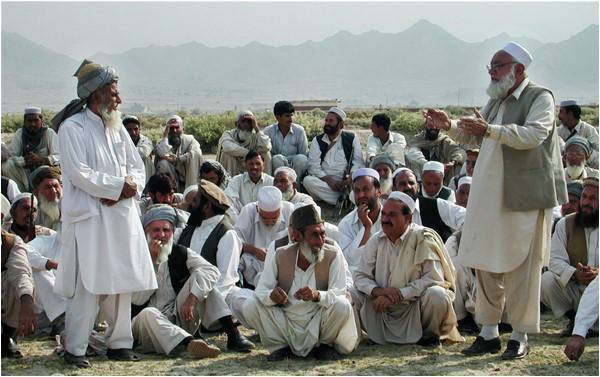
Postcolonial societies suffer from two major problems. One is the romanticisation and blind praise of traditional institutions, and another, more potent and more dangerous problem is the “dismissal” of these institutions as relics of the past, having no relevance in the modern world whatsoever.
The Jirga, which is a Pashtun tradition, an institution that has survived the test of time and is still a “go-to” first option in Pashtun societies, is something that carries the burden of both these extremes: the so-called progressives dismiss it, and those who keep the sacredness of tradition above all romanticise it.
Therefore, understanding what the Jirga truly is, what its significance is, and why it is important, lies in the middle of these extremes—balance is always good. The Pashtun Jirga, in its essence, is a governance institution that solves many problems of political economy. Its strength lies in solving problems efficiently and transparently compared to the formal legal system, which, in fact, is a relic of Pakistan’s colonial past.
The core problem addressed by the Jirga is what, in political economy literature, is termed the “cooperation problem”. In simple words, this problem is a situation that arises out of rational economic thinking of the disputants: all the parties prefer and want a settlement because neither one of them, rationally speaking, will want a conflict to be prolonged or to persist.
But, as the famous story about putting the ring in the cat’s collar goes, the disputants lack trust in each other in terms of who will move first, who will back off first. Some readers might question here that doesn’t the formal court also solve this problem? Yes, it does, to a great extent. But in theory.
In societies where the litigation process is slow, the cost of acquiring justice is high, the court, its language and procedures are socially distant, and the technicalities are so complex that the majority of the public cannot understand how to navigate, then people will look for an institution that is quicker, efficient, comprehensible, trustworthy, and also can enforce. In our case, it is the Jirga.
Fairness in terms of the Jirga is not only about statute; it is also about whether the decision makes sense within the moral vocabulary of the community
These attributes are the major strengths of the Jirga. As an institution, it has the ability to bring the parties to the table. The Jirga works as a forum that enjoys public recognition; it has social visibility and, most importantly, it has normative power.
In the Jirga, it is not about who wins or loses, nor does the Jirga declare a winner or a loser; no case is won or lost, but still the dispute is resolved. This makes it different and a more reliable option compared to formal litigation. The uniqueness of the Jirga is that its objective is different.
In textbook political economy terms, the Jirga’s objective is to restore a working equilibrium so that families, clans and communities can continue living together. This might appear as something unimportant or of little consequence to one who is not familiar with the social and political structure of Pashtun society.
But this uniqueness that the Jirga brings makes it fit within the broader structural arrangement of Pashtun society. The Pashtun live in a setup where there is repeated interaction; the disputants are not strangers to each other or to the Jirga.
The role of kinship, tribal identity, neighbourhood, reputation and memory all play a part in shaping the dynamics of the Jirga, its operation, its power to enforce and its ability to punish through a process that is neither socially distant, intellectually alien, nor technically complex.
This also explains why many people continue to trust the Jirga more than the courts. Formal courts promise legality, appeal and procedure, but for many citizens, these come with delay, cost and confusion. Legal language is often inaccessible. Procedure can become punishment.
By the time a verdict arrives, the dispute may already have consumed years of money, energy and dignity. The formal court system is incomprehensible to the citizen and socially distant, while the Jirga, by contrast, is comprehensible and socially visible.
People can see who is sitting, who is speaking, what claims are being made and how the matter is being weighed. Its public character gives it a kind of transparency that formal justice often lacks. Fairness in terms of the Jirga is not only about statute; it is also about whether the decision makes sense within the moral vocabulary of the community.
The Jirga also has a lower cost of verdict enforcement and assurance of compliance because, unlike the formal postcolonial legal structure, the Jirga does not depend or derive its legitimacy from a set of written rules, most of which were framed by a colonial extractive regime to keep order, not dispensing justice.
The Jirga does not require a police force to enforce its verdict, nor does it require prisons to punish. The Jirga derives its power of enforcement from the same source which gives the Jirga credibility: the norms.
From a political economy lens, the Jirga has done so by reducing uncertainty, lowering enforcement costs, making settlement credible and producing compliance where formal orders may remain unenforced
Non-compliance results in loss of reputation, shame, and being socially recognised as a “breaker of the Pashtun code”, and these mechanisms are in many cases more effective. These create a “moral economy” wherein if a party refuses a widely accepted settlement, it will risk isolation and dishonour, something that no one is willing to do.
We do not say that the Jirga is a perfect system. We are well aware that there is a risk, and sometimes it does happen that the Jirga is captured or influenced by powerful local elites, and that may also cause exclusion of vulnerable groups.
There is also a chance that a Jirga in a particular setting may produce outcomes that are not in line with the standards of the constitution or human rights standards. Therefore, while we are presenting a defence of the Jirga and the merits it has, we do acknowledge the limits of the Jirga. Our analysis of the Jirga is rooted in sentimentality.
But equally dangerous is a plain dismissal of the Jirga in the name of it being traditional, old and thus of little importance. Such an analysis is not only wrong, but it is also analytically poor.
The Jirga has survived for thousands of years, and this survival is not by accident. It has persisted because it has the strength and ability to perform governance functions in a more efficient and credible way compared to formal structures.
From a political economy lens, the Jirga has done so by reducing uncertainty, lowering enforcement costs, making settlement credible and producing compliance where formal orders may remain unenforced.
We do not argue or suggest that the formal legal structure should be replaced by the Jirga; we understand it is not only impractical, but it will also breed numerous new problems.
However, we do suggest that the formal judicial system, its practitioners and those who intend to reform the colonial-era relic have some very important lessons to learn from the Jirga.
What the Jirga teaches us is that justice reform should never ignore local trust structures. If formal justice remains distant, slow and socially unintelligible, as it is in postcolonial Pakistan, people will turn to institutions where they feel heard and feel close to the system where decisions are made.
Where decisions are made efficiently, where judgement is credible, and enforcement is guaranteed. In short, our legal reformers and those working on it should ask themselves these questions: how to make formal court procedures more in line with local trust structures, how to ensure transparency and efficiency, and most importantly, how to make the justice system accessible to all and reduce costs associated with it.
They need to understand how to make a justice system that has legal authority as well as social authority. Institutions that perform endure. The Pashtun Jirga still matters because, in many settings, it continues to do what institutions are supposed to do: reduce conflict, secure cooperation, and make settlement possible.