

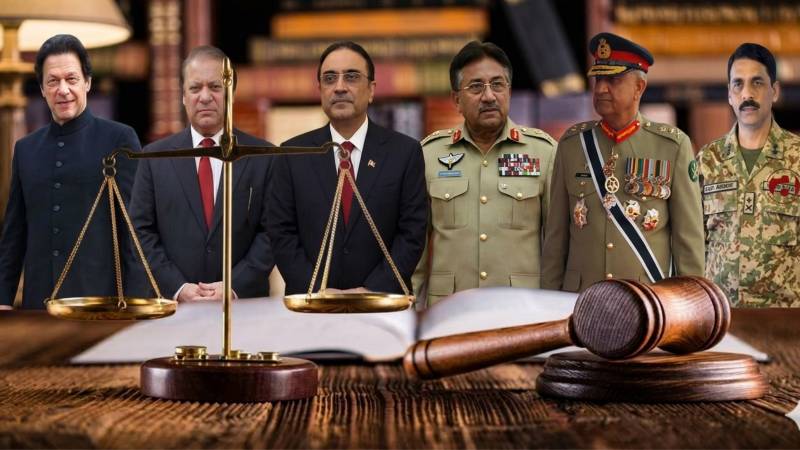
Never in the history of Pakistan, barring martial law regimes, there has been steep erosion of rule of law and the marginalization of constitutional mode of governance. It is not only the blatant violation of order given by Pakistan’s Supreme Court to ensure proper medical treatment of Imran Khan, founder of Pakistan Tehrek-e-Insaf in Al-Shifa hospital, Islamabad but in the last few years judiciary has been tamed by passing 26th and 27th amendments. The lack of assertion by lawyers representing various bar councils and the opposition parties challenging severe violation of constitution and rule of law reflects that the so-called hybrid system in Pakistan is now heavily titling in favor of military establishment with Chief of Defense Forces (CDF) Field Marshal General Asim Munir assuming more powers than the Prime Minister and the President.
Fragility of civil-military relations in which the military establishment since early 1950s till today is undermining democracy, political pluralism and civilian mode of governance is transforming Pakistan as a full-fledged deep state where neither political parties nor the civilian government is able to reclaim power.
When democracy was restored in 2008 with the exit of General Pervez Musharraf from power and 18th amendment was passed in 2010 with consensus by the parliament, there was a hope that the days of military’s intervention in politics were over. But it was a wishful thinking because the manner in which civilian governments after 2008 made a mockery of democracy and entrenched in corruption and nepotism provided military an opportunity to reassert its position culminating in the passing of 26th and 27th amendment which not only weakened superior judiciary but also gave excessive powers to CDF unprecedented in world history. It means that political parties failed to establish the culture of accountability and adherence to basic democratic norms. The violation of Supreme Court order by the government is a reflection how weak judiciary has become that it failed to take notice of blatant violation of not adhering to rule of law. It also means that the silence of lawyers, civil society, media, academia and political parties to the surge of deep state will transform Pakistan as a state where the military establishment without imposing martial law will dictate terms to their junior civilian counterparts.
The silence of international community and world press over the manner in which the hybrid system in Pakistan is taking the toll of democracy, rule of law, accountability and good governance means the country will further do down the drain in the realm of political instability and economic malaise. Does the surge of deep state in Pakistan means that political parties, judiciary, civil society and media have compromised and accepted the demise of democracy as a fait accompli? Can the youths of Pakistan, called as generation Z, rise and like their counterparts in Bangladesh, Sri Lanka and Nepal dismantle a corrupt and an authoritarian mode of governance? Why a country of 250 million people deep under the menace of poverty, under-development, absence of rule of law, extremism, lack of accountability, bad governance, corruption and nepotism is unable to save itself from predictable collapse of order?
When Baluchistan and KPK are facing violence, terrorism and breakdown of rule of law and when Punjab and Sindh are witnessing anger and antagonism of youths the situation on the ground is precarious. Gilgit and Baltistan (GB) along with Azad Jammu & Kashmir (AJK) are also not stable with the Indian Defense Minister Rajnath Singh threatening that New Delhi will absorb the two territories administered by Pakistan reflects that from all sides the country is vulnerable to multiple security threats.
One cannot just blame the military of overstepping its mandate and encroaching on matters of governance. In reality, political parties because of their lust for power, privileges and perks compromise on principles.
If the rule of law has been compromised in Pakistan with the fragility of judiciary and democracy, in that case what is the future of this country? Pakistan has already reached the threshold of economic default with its exports stagnant at 30 billion dollars and its per capita income along with low foreign exchange reserves and rising external debt crossing the red line. Henceforth, the country cannot afford further erosion of rule of law and violation of constitutional mode governance.
One can analyze why Pakistan is facing enormous crisis leading to the mitigating rule of law from three standpoints. First, Pakistan has a history of a compromised judiciary declaring military takeover justified under the doctrine of necessity. But the worst thing is to compromise on its dwindling power to act independently in superior courts. The manner in which 26th and 27th amendments were passed locking the independence of judiciary and giving unprecedented powers to CDF means that the parliament of Pakistan dominated by PPP and PML (N) lacks political will to learn from history.
One cannot just blame the military of overstepping its mandate and encroaching on matters of governance. In reality, political parties because of their lust for power, privileges and perks compromise on principles. In most cases, politicians try to get patronization by the military for the accomplishment of their power ambitions. If the CDF has assumed so much of power it is done through constitutional means in which both PPP and PML (N) because of their lust for power and insecurity from PTI voted to give unprecedented powers to the Chief of Army Staff thus elevating his position as Field Marshal and Chief of Defense Forces. Unlike General Ayub Khan who launched a coup in October 1958, abrogated 1956 constitution and assumed power declared himself as the Field Marshal. But in case of General Asim Munir it was done through the parliament which puts blame not on CDF but politicians who in order to oblige the military and secure their position on the holding of power passed 27th amendment.
Second, Pakistan will pay a heavy price of hybrid mode of governance in terms of further breakdown of rule of law in the restive province of Baluchistan; violence and terrorism in KPK, youth assertion in Sindh and Punjab along with calls for agitation and long march against the incumbents. Will CDF and senior army generals succeed in coping with serious threats in all the four provinces of Pakistan along with GB and AJK particularly when the military is facing insurgency in Baluchistan and incidents reflected anger against the men in uniform are reflected in Lakki Marwat and in a university in Islamabad?
Will history repeat itself and Pakistan will be destabilized as was done in 1971 or saner elements in political parties and in the military establishment take the cognizance of situation and refrain from further damaging democracy, political pluralism and the rule of law. If strategic decision making is the priority by those who matter and the interests of the country rather their own personal interest are taken into account in that case there is a hope for a better Pakistan but if power ambitions of some people is the norm, one can expect further erosion of economy, crisis in governance and political breakdown. Finally, the way out from prevailing crises in Pakistan which compounded because of erosion of rule of law, is reversal of all such amendments in the constitution which were aimed to protect interests of some individuals rather than the interests of the country. The proposed 28th amendment which aims to create new provinces or administrative units in Pakistan without consensus will open another Pandora’s Box. The idea that voting age be enhanced to 25 from 18 years is meant to deprive youth of their power and deny PTI its vote bank. Can Pakistan afford to carry on experiments at the expense of democracy, independence of judiciary, rights of people and so forth?
Till the time there is leadership in Pakistan which is honest, professional, hardworking and intelligent focusing on national rather their own interests the country cannot be different from its past and will plunge deeper and deeper in the web of crises. One need to remember that respect of a country is done if that country is economically developed and where there is rule of law focusing on good governance, accountability, science & technology, better education and protection of human rights.