

Click here for the previous entry in this series
Starting from a single boat bridge till 1876, during the last century-and-a-half, the Ravi has been bridged at six locations around Lahore. Some of these bridges are multilane in each direction. To some extent, and to the credit of successive governments, the bridge-building over the river has kept pace with increase in traffic. Although information about each of the existing bridges is available in fragments in some books and online sources, there is no consolidated description – as far as this author could search – regarding their construction and expansion. Hence, a brief narrative of the bridges over Ravi at Lahore would be in order, so that this history is presented and available in one written article. This author would welcome feedback regarding any information presented here that is distorted or incomplete. All relevant suggestions would be incorporated in the article as updates.
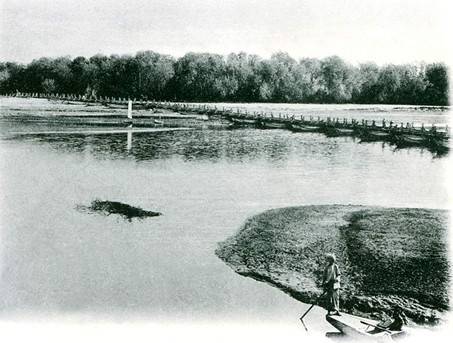
Before the railway lines were laid from Lahore to upcountry, there used to be a single boat-bridge near Kamran’s Baradari, built by the British soon after annexing Punjab in 1849, at a site previously used by the Mughals for a similar purpose. The Baradari, an elegant structure of white marble, was a royal retreat on the right bank of the river, built in the early Mughal period by Prince Kamran, the second (of four) sons of Babur, a younger brother to Emperor Humayun and governor of Kabul and Lahore at that time. The Mughal arrangement for crossing the Ravi had been to build a bridge here with about 50 boats – not as a permanent fixture but only to allow their armies and caravans to cross the river when required. According to Col Goulding (Old Lahore), the British built their boat bridge and used it as a model for the construction of other bridges in the province.
Due to the changing course of the Ravi, the Baradari was once in the midst of the river, but it is now once again on river’s right bank. It was in a dilapidated condition during the Sikh era. The then British Chief Commissioner of Punjab, Sir John Lawrence, authorised an expenditure of Rs. 6,000 in 1854, a large sum in those days, to build protective earthworks for the security of Jahangir’s Tomb complex and the Baradari against severe flooding in the river, thus saving these two structures of immense historical importance. The Baradari was used as residence for the European Superintendent in-charge of the bridge of boats. The boat bridge remained in use well into the second decade of the 20th century till the construction of the road bridge next to the railway bridge, now called Purana Pul, half a kilometre upstream of the Baradari. There is a picture (displayed below), captured in 1903 by Fred Bremmer, of that boat bridge with a factual perspective.
When the railway line was being extended in the 1870s from Lahore to Rawalpindi, bridges had to be constructed on all the small and large rivers and streams. That, of course, included the Ravi. The engineering details of this bridge are preserved by Mr Robert Trefusis Mallet, an engineer on the Ravi Railway bridge project, in his research paper titled “The Ravi Bridge, Punjab Northern State Railway” (1878). The 3,300-feet-long bridge has 33 spans, each distanced at 97.5 feet center to center of the brick piers. It had two layers; the top layer for the trains while the bottom six feet wide layer accommodated pedestrians, horses and bullocks but was too low for camels with riders. The bridge construction commenced in 1871 and completed in 1876. It has stood the test of time as it is still operational; a testimony to the marvelous railway engineers of the British Empire.
The early 20th century saw the development of road transport which necessitated construction of roads with adequate bridges over rivers and smaller water courses. The railway bridges built in the second decade of the 20th century were dual-purpose, accommodating train tracks as well as metalled roads for motorised transport. The bridges over the Indus, for instance, at Mari-Indus-Kalabagh, Khushalgarh and Attock were dual-purpose bridges of similar design with ninety-degree road turns to hold traffic in case a train was crossing the bridge. This author has traversed all these bridges in his youth.
It should be noted as a comparison that there are nearly 40 bridges over the Thames in London between the eastern and western crossings of the London Orbital Motorway
In the case of older railway bridges, like the one over Ravi at Lahore, new road bridges were constructed to cater for road traffic. Subhas Chandar Sharma notes in his book Punjab, The Crucial Decade (p 78) that the road bridge over the Ravi at Lahore was completed at a cost of Rs six lakhs (600,000) in 1914-15. The bridge, still in use though in poor repair, is very near the railway bridge. It lies on the then alignment of the GT Road. The main bus station of Lahore, the Lari Adda, is conveniently located in Badami Bagh, to the east of and adjacent to the Minto Park, at a distance of two kilometers from this bridge. Now, however, busses and trucks travel from Badami Bagh bus station upto the bund road and exit for Shahdara bridge at the Niazi Interchange. The Niazi interchange is known to locals as the ‘Batti Chowk,’ meaning the crossing with traffic light, in memory of one of the first traffic lights installed on the Bund road. The Bund road now constitutes the Lahore Ring Road with service roads along its each side. The road from Badami Bagh to the old road bridge, that should now be distinguished as Jahangir Tomb Bridge, runs parallel to the railway line and would have been deserted at the time it was built over a century ago. Now it houses the city’s large goods transport hub with thousands of trucks parked at any given time. There are scores of goods transport companies and a large Fruit and Vegetable Mandi along this section of the road. These public services make the road crowded and, at times, choked.

This author remembers crossing this old road bridge many times while travelling by bus to and from Jhelum in the mid 1950s and Gujrat in the late 1950s, when his father was posted to these cities in the provincial canal department. The bridge had already become crowded due to a variety of transport, from bicycles to horse-driven tongas, bullock carts, vespa scooters, motor cars and buses. However, there was a ray of hope as a new dual carriage bridge was under construction at about the place where the boat bridge once existed.
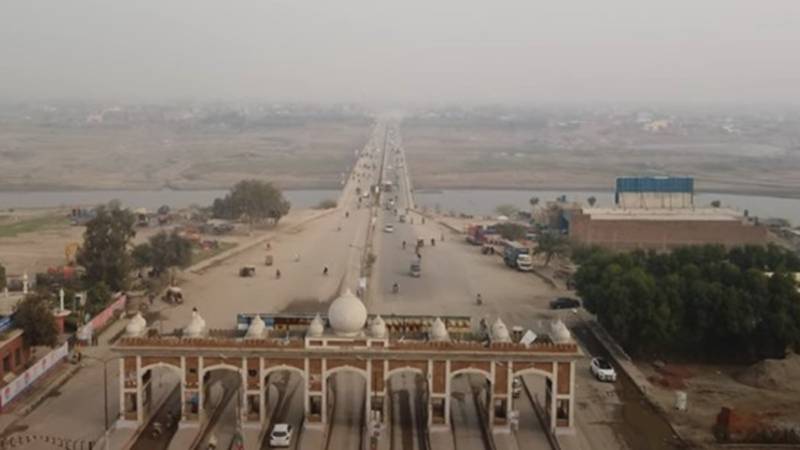
The new Ravi bridge, as it was once called and understood – but now more conveniently ought to be named as Shahdara Ravi Bridge – was completed and opened to traffic in 1961. It served the people well and was the sole bridge for 36 years, linking the city with northern Punjab. The bridge allowed unrestricted movement across the river without traffic jams or hold ups. It was widened in 2013 to accommodate the metrobus route to Shahdara. A two-lane bridge was constructed on the downstream side adjacent to the existing bridge, making it a triple carriageway with the center lane reserved for metrobus. It is being widened again. An additional three-lane bridge has again been added downstream, that will enable three lanes each for up and down movement of road traffic, while leaving two lanes for metrobus. As seen from the air, this bridge is now a four-bridge system but still laden with traffic at most times of day and night.
The third bridge over the river was constructed further downstream at Babu Sabu village as part of the M-2 motorway from Islamabad to Lahore. It was completed in November 1997. It is a wide three-lanes-each dual carriageway bridge. Over scores of crossings since its opening, this author has never not seen it jammed or blocked due to traffic; remaining in flow with vehicles plying at 100-120 kilometres per hour.
Soon after the motorway bridge, another bridge over the river was constructed and opened for traffic in February 1999. It is known as Saggian Bridge, that connects Saggian Kalan Wār with Saggian Kalan Pār. These are the names of the twin villages that once existed at this location; Wār on the Lahore side and Pār (literally across the river) on Shahdara side. Wār and Pār, meaning ‘this side’ and ‘across’ respectively, are common Punjabi trailing appendages to village names. Kalan is a word for ‘large’ or the ‘main’. Kalan is also used in Punjab to denote the main village, which is accompanied by ‘Khurd,’ meaning a small cluster of houses near but apart from the main village. Both kalan and khurd are Persian words but well-adjusted in Punjabi. The main village in this case is Saggian Suterwall, a kilometre to the south. This village is no more as it was acquired by LDA in 1970s and remodelled as the middleclass Gulshan Ravi colony, where the parents of this author constructed their house in the early 1980s. The house is now occupied by a younger brother and is always the lodging place for the author on his visits to the city of his birth, as well as the site of family gatherings. An interchange on the Saggian bridge where it connects with Bund Road was completed in May 2009 as part of Lahore Ring Road. The road leading to the bridge from the Lower Mall is the Outfall Road, now christened as Sheikh Ghulam Qadir Jillani Road. On the Shahdara side, the road out of the bridge is called Justice Kiyani Road, which joins, first, the Shahdara-Sharaqpur-Jaranwala road and, next, the Shahdara-Sheikhupura road. This bridge and road have been widened as a dual carriageway and rehabilitated recently.

The last bridge to be built over Ravi around Lahore is a little over five kilometers upstream of the Shahdara bridge system; built as part of the Lahore-Sialkot motorway (M-11) and commissioned in 2022. It is a wide six-lane bridge. M-11 branches off from the Lahore Ring Road near its western 90-degree bend close to the river. The bridge provides an easy exit to traffic proceeding from eastern Lahore (DHA, Airport) to upcountry as M-11 motorway is connected to the Lahore-Gujranwala GT Road and Lahore-Rawalpindi M-2 motorway via the Kala Shah Kaku link road.
As private housing societies continue to expand the city in the southern direction, there is a need for at least one more bridge over the Ravi, because there is none for 51 linear kilometers between the M-2 and Balloki bridges. In a 1955 published map by the US Army, based on 1921-43 data, a ferry is shown linking Amarkot (near Thokar) with Sharaqpur. Lahore can emulate this by building an Amarkot-Sharaqpur bridge, with a link to the Lahore-Multan motorway at Qila Lal Singh interchange. This would greatly facilitate the flow of traffic. Similarly, the Ravi Urban Development Authority (RUDA) development in the north and west of the city along the river will necessitate some additional bridge(s).
It should be noted as a comparison that there are nearly 40 bridges over the Thames in London between the eastern and western crossings of the London Orbital Motorway. In Paris, from the Boulevard Périphérique in the east to Boulevard Périphérique in the west, there are 37 bridges over the 13 kilometers of the river Seine through the city. There are nearly 35 bridges on the Moskva river in Moscow between the southeast and the northwest crossings on the Moscow Automobile Ring Road (MKAD). With a comparable population living on both sides of the Ravi, there is certainly a need for more bridges over the river, especially now that Shahdara and its environs have become – if ever they were not – inseparable from Lahore.
The river runs for nearly 280 km below M-2 bridge till it merges with the Chenab. There are seven bridges on this length, located at Balloki Headworks, Okara-Samundri road, Sahiwal-Samundri road, Chichawatni-Kamalia road, Abdul Hakim-Pir Mahal road, M-4 and Shorkot-Kabirwala road. Another bridge over Sahiwal-Mamukanjan road with an interchange link to M-4 on the Mamukanjan-Gojra road too is needed to cater for the increase in population and traffic in this area.