

ستاروں سے آگے جہاں اور بھی ہیں
ابھی عشق کے امتحاں اور بھی ہیں
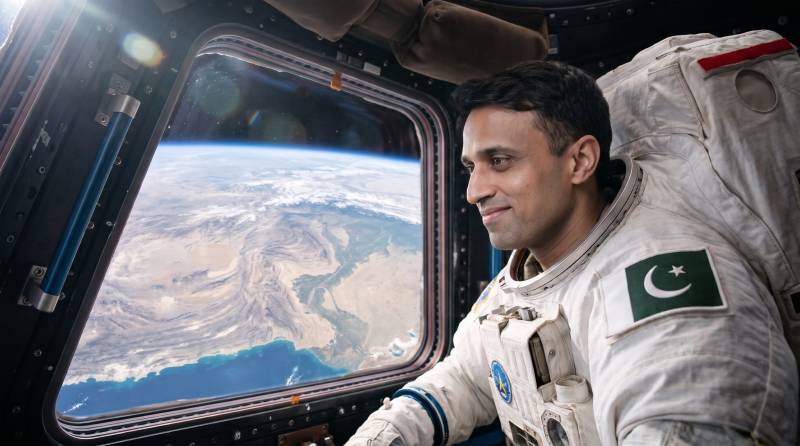
Every Pakistani is familiar with this couplet from Allama Iqbal’s poem “Khudi”. This ode to selfhood and self-discovery transcends language, cultures, borders, and perhaps even time itself. Now, it has also overcome the earth’s gravitational force and has been recited in outer space by none other than Mohammad Zeeshan Ali: Pakistan’s first astronaut who is serving as a payload specialist aboard China’s Tiangong space station for approximately a week to ten days before his scheduled return to earth.
To be clear, Zeeshan Ali is the first Pakistani man in space: he is the first Pakistani to reach orbit, as well as the first non-Chinese astronaut to board the Tiangong space station. In October 2023, Namira Salim became the first Pakistani in space when she flew on a sub-orbital spaceflight aboard the VSS Unity spaceplane crewed and commercially operated by Virgin Galactic.
The Shenzhou-24 Mission
Zeeshan Ali, a wing commander of the Pakistan Air Force (PAF), is part of the Shenzhou-24’s three-man crew, who lifted off at 8:18am Beijing time on Wednesday, November 25, along with mission commander Tang Hongbo and flight engineer Wu Yi.
Tang Hongbo, a People’s Liberation Army (PLA) Aerospace Force major general who served as a fighter pilot of the PLA Air Force until his selection into the Astronaut Corps in 2010, also holds the distinction of being the only Chinese astronaut – or taikonaut, as Chinese spacemen are called – to visit the Tiangong space station three times: first aboard the Shenzhou-12 mission in June 2021, then as commander of the Shenzhou-17 mission in October 2023, and now as commander of the Shenzhou-24 mission. Flight engineer
Wu Yi holds the rank of army colonel of the PLA, and was selected into the Astronaut Corps as part of the third group (or generation) of Chinese taikonauts announced on October 8, 2020. Like Ali, this is Wu’s first spaceflight, and all three astronauts hold master’s degrees.
While Zeeshan Ali will be returning in less than two weeks, Tang and Wu are slated for a roughly six-month stay aboard the Tiangong space station until around May 2027; they will be joined by Shenzhou-23 mission commander Zhu Yangzhu, who flew his second spaceflight on May 24 of this year, and is extending his stay to attempt becoming the first Chinese astronaut to spend a year in space. On his return to earth, Ali will be joined by Shenzhou-23 taikonauts Zhang Zhiyuan and Li Jiaying (also known as Lai Ka-ying), who is Hong Kong’s first astronaut and also a payload specialist.
Profile of Zeeshan Ali
Born in Sargodha, Pakistan, on August 22, 1986, Mohammad Zeeshan Zana Ali was inducted into the Pakistan Air Force in the mid-2000s as a general duty pilot, the dream assignment of anyone who wishes to join the military service that guards the skies of Pakistan. Not much is known about his childhood, early education, or even his military service, which is to be expected because of the strict standards of PAF operational security regarding active-duty personnel, especially fighter pilots. But this is expected to change once he returns from space; depending on whether he continues serving in the PAF, or becomes the foundation for Pakistan’s own “astronaut corps”.
China-Pakistan space cooperation
In late February 2025, the Space and Upper Atmosphere Research Commission (SUPARCO) of Pakistan signed a historic cooperation agreement with China Manned Space Agency (CMSA), under which two Pakistani astronauts would be trained at the Astronaut Center of China, of which one would be selected to undergo training as a scientific payload specialist. This set the stage for three rounds of screening and evaluation of potential Pakistani astronauts by SUPARCO and CMSA experts: the candidates were testing medical fitness, psychological resilience, physical endurance, and technical aptitude.
50 candidates were screened, of whom 19 finalists advanced to the testing and assessment phase held in China; these were further narrowed down to two candidates by April 2026: Muhammad Zeeshan Ali and Khurram Daud. Ali noted in a pre-launch interview that he was actually the last candidate to formally enter the program.
From fighter pilot to pioneer astronaut
On April 22, it was formally announced that Ali and Daud would proceed to China for their training as payload specialists aboard a Shenzhou spacecraft mission. The next day, Prime Minister Shehbaz Sharif met both of them before they departed for China. Ali recounted at the pre-launch press briefing that he began to feel the true weight of the Prime Minister’s words that he was about to write a new chapter in Pakistan’s history.
While the standard astronaut training programme at the Astronaut Center of China (ACC) is at least a year long, the training for both Pakistani space-aspirants was compressed into a seven-month period. The training encompassed spacecraft systems, emergency procedures, experiment operations, centrifuge and survival training, as well as intensive study of technical Chinese aerospace terminology. Prior to this, SUPARCO had requested a specialised intensive six-week-long Chinese language course at the Confucius Institute in Islamabad, which began some time in late 2025 and was extended upon request: all Pakistani trainees went through this language programme.
Zeeshan Ali noted the hardest part for him was mastering Chinese for switches, software, procedures, and announcements. In the grueling training, he forgot his 40th birthday: but the ACC remembered, and arranged a surprise birthday celebration for him. During training, he also studied Chinese poetry, practised calligraphy and Tai Chi, and played table tennis when he got the time to unwind. He described the training as exceeding his expectations, stating that China and Pakistan “turned a pilot into an astronaut in a remarkably short span of time”. While he quoted Iqbal in space, Ali enthralled the Chinese audience at the pre-launch press briefing by quoting famous Tang dynasty poets Wang Zhihuan and Li Bai.
Both Ali’s and Daud’s backgrounds as Pakistan Air Force (PAF) fighter pilots gave them a head start in high G-force centrifugal drills, vestibular tolerance, emergency procedures, and survival training. However, transitioning to a payload specialist required them to learn spacecraft systems, simulated spacewalk/microgravity operations, underwater neutral-buoyancy drills, emergency simulations, and the protocols for the four joint Sino-Pakistani scientific experiments.
As Zeeshan Ali’s selection for the Shenzhou-24 mission was announced on November 24 – a day before launch, in accordance with CMSA protocol – Khurram Daud was on standby as backup payload specialist for the mission, ready to step into the crew seat up until launch time if Ali became unable to fly for whatever reason. While it is not yet clear whether Daud will fly on a subsequent Chinese mission, both astronauts will serve as technical experts to help advance Pakistan’s nascent domestic manned spaceflight program.
What will Zeeshan Ali do in space?
Aboard the Tiangong space station, Zeeshan Ali’s mission is to operate one short-term experiment out of the four Pakistani scientific experiments he carried aboard Shenzhou-24 to bring to space. These four experiments – two life sciences experiments and two material sciences experiments – were selected from among 300 proposals submitted by Pakistani universities, scientists and researchers.
Zeeshan Ali will directly conduct the microalgae & photosynthetic bacteria or “green micro-factory” study during his stay: this experiment cultivates photosynthetic microalgae and bacteria in microgravity as a potential sustainable food source and regenerative life-support system, producing oxygen and recycling waste. As Ali has himself noted, progress in this area could support future long-duration human spaceflights while also improving agricultural practices and food security on Earth.
The other life sciences experiment concerns quinoa seed radiation and microgravity: it is designed to test how cosmic radiation and near-zero gravity affect the germination, genetics, and growth resilience of quinoa seeds in space.
The third experiment concerns self-healing spacecraft materials, evaluating how advanced smart materials repair structural micro-damage autonomously when exposed to the extreme thermal cycles, vacuum, and radiation of low earth orbit. The fourth experiment is categorised as the “second long-duration materials payload”, which implies that it is the other materials science projects which will be installed by Ali for year-long sequential testing on the Tiangong space station’s external/internal experiment racks. SUPARCO and CMSA have not publicly released the exact technical title of this fourth payload.
What Zeeshan Ali’s achievement means for Pakistan
Zeeshan Ali said he would carry handwritten letters from his children and father as inspiration. In a message to his family, he promised that when he first looks back at Earth, he will search for the light of their home, adding that they will still share the same moon and the same earth. “I’m not flying for myself, I carry the name of Pakistan on my shoulder, the hope of 250 million Pakistanis,” Ali said at a pre-launch press briefing. “To every child who is watching while I’m in orbit, just look up at the sky and remember that I am up there with your dreams.”
Zeeshan Ali was prescient in stating that what comes after the spaceflight matters more that the flight itself: he called the Shenzhou-24 mission “not a finish line, it is a launchpad” for future China-Pakistan cooperation “to multiple joint flights: to [the] moon, Mars, and beyond”. Referencing the famously iron-clad China-Pakistan friendship, he forcefully stated that “together, with my Chinese crewmates, I will show that this friendship is real; not only on paper, but also in orbit”. He said that learning Chinese language helped him build camaraderie and forge strong bonds with his Chinese crewmates through side-by-side training. “Exploring the vast universe, developing the space sector, and building China into a major space power is the space dream we tirelessly pursue,” he said, adding that, “I have come to see this dream as my own and as Pakistan’s too [and] it will become a reality with the Shenzhou-24 mission”.
“Going into space as an astronaut was my childhood dream, I think this is the moment my childhood dream is coming true,” Ali said to CGTN. Building on this, Zoon Ahmed Khan, doctoral candidate at China’s prestigious Tsinghua University and a fellow at the Center for China and Globalization (CCG), told CGTN Radio that Zeeshan Ali’s historic mission was not just a milestone for China-Pakistan relations. “Given Pakistan’s economic and various challenges, not a lot of young Pakistanis would imagine to be astronauts, and looking at Zeeshan today, I think it will definitely encourage young people to pursue STEM with more focus and to really aspire for the stars”.
Khan expressed the hope that upon his return from his space mission, astronaut Zeeshan Ali not only interacts with experts and researchers, but also shares his experiences with young students to motivate them to pursue their dreams. “He said that he carries the dreams of 250 million Pakistanis, and young children, they feel that adrenaline,” she said, adding that “it’s so important for a society to aim higher and work harder”.