

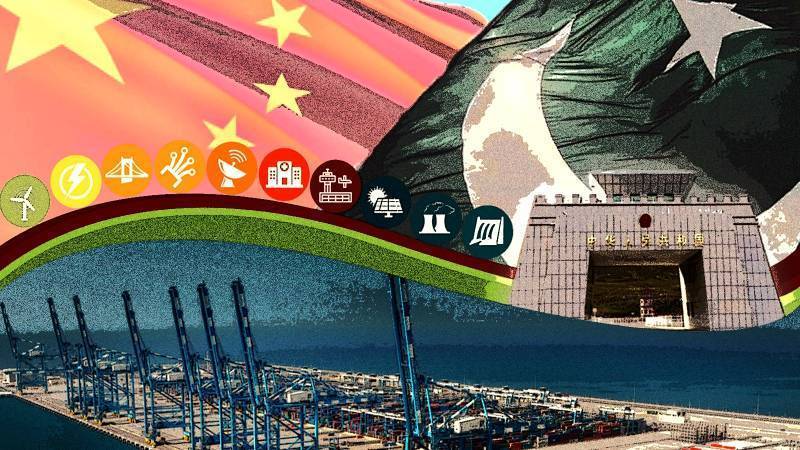
Pakistan’s strategic economic ties with China are picking up pace. Reports this past week point to a clear upswing: exports of sesame, rice, and seafood to China have risen sharply; a new memorandum on quantum and emerging technologies has been signed; and Islamabad has sought Beijing’s support to join the BRICS-backed New Development Bank.
Together, these developments signal a renewed strategic rhythm, one that closely aligns with the broader vision of CPEC 2.0.
The second phase of the China–Pakistan Economic Corridor, formally adopted under the Action Plan 2025–2029 at the recent 14th meeting of the Joint Cooperation Committee in Beijing, has now moved from paper to practice. The JCC’s key outcomes, China’s commitment to finance 85 per cent of the Karakoram Highway realignment, joint efforts to secure around 6 billion dollars in multilateral funding for the long-delayed ML-1 railway, and the signing of 21 business-to-business agreements worth 8.5 billion dollars at a conference in Beijing presided over by Prime Minister Shehbaz Sharif, reflect a new seriousness of purpose on both sides.
Taken together, these steps show a shared resolve to turn years of slow progress into measurable results. After a period of drift, CPEC 2.0 is beginning to look less like a plan and more like a process, anchored in technology, trade, and pragmatic cooperation rather than rhetoric.
Action Plan
At the heart of this renewed cooperation lies the Action Plan 2025–2029, the most comprehensive roadmap yet to re-energise CPEC. It sets out five thematic corridors: Growth, Livelihood, Innovation, Green, and Openness, aligned with Pakistan’s national Five Es: exports, equity, empowerment, environment, and energy.
The Growth Corridor focuses on industrial modernisation and export-oriented public-private partnerships. The Livelihood Corridor addresses agriculture, poverty reduction, and small projects that directly improve local living standards. The Innovation Corridor promotes digital connectivity, research, and emerging technologies. The Green Corridor highlights renewable energy and water security. The Openness Corridor encourages regional cooperation and multilateral partnerships consistent with the Chinese Belt and Road Initiative’s high-quality principles.
For Pakistan, the plan represents a shift from large, state-driven projects to smaller, sustainable and commercially viable ones. Two model industrial and technology parks in Karachi and Islamabad are expected to lead the way. The plan also stresses training, youth exchanges, and better coordination between provincial and federal institutions. What distinguishes this phase is the insistence on performance: projects are to be reviewed regularly, and accountability mechanisms are built into implementation.
With Chinese technology and local innovation, Pakistan managed to defend itself effectively in a limited confrontation, reminding observers that stability in South Asia cannot rest on unilateral advantage
Past Lessons
When CPEC was formally launched in 2015 during President Xi Jinping’s landmark visit, it was hailed as the flagship of the Belt and Road Initiative and the foundation of the All-Weather Strategic Cooperative Partnership. The first phase delivered visible gains. More than 25 billion dollars flowed into the power, transport, and communications sectors. Over 8,000 megawatts of electricity were added to the grid. New highways connected the country’s north and south. The Lahore Orange Line became Pakistan’s first metro. A fibre-optic link from Rawalpindi to Khunjerab improved digital connectivity. In Gwadar, the expressway, airport, and free zone were completed, giving the port a working base.
Initial progress was smooth. Yet shortcomings soon emerged. The planned Special Economic Zones remained mostly on paper. Policy inconsistency, bureaucratic hurdles, and political instability discouraged investors. Circular debt and delayed payments to Chinese power producers caused friction, while the pandemic and changing domestic priorities slowed everything further. By 2021, the first phase had lost momentum.
Since 2022, a revival has been underway. High-level meetings and the September Action Plan have put CPEC back at the centre of Pakistan’s development agenda. But the lessons of the early phase remain stark: infrastructure is only a beginning. The harder task is to convert physical assets into productivity and exports. Without institutional consistency and steady governance, new corridors can fall into the same traps as the old ones.
New Openings
The wider political landscape today offers opportunities that did not exist a few years ago. Pakistan has regained some strategic balance in its diplomacy and regional profile. The brief conflict with India in May demonstrated that deterrence still holds and dispelled the narrative of Indian military invincibility. With Chinese technology and local innovation, Pakistan managed to defend itself effectively in a limited confrontation, reminding observers that stability in South Asia cannot rest on unilateral advantage.
At the same time, Islamabad has sought to reset its relations with Washington while deepening its strategic partnership with Beijing. The Trump administration’s renewed pragmatism has reopened dialogue with Pakistan, reflecting a recognition that India’s utility as a counterweight to China is not absolute. For China, Pakistan remains the essential link connecting western China to the Arabian Sea and beyond, a cornerstone of its regional connectivity vision.
If Pakistan sustains political will, ensures security, and manages projects with integrity, the second phase of CPEC can still deliver on its original promise
Yet a gap persists between elite and popular perceptions. Ordinary Pakistanis overwhelmingly view China as their most dependable friend. Parts of the policymaking elite, however, continue to look westward for validation. This disconnect often blurs the clarity of Pakistan’s foreign policy. The moment offers a chance to correct that, to maintain a firm strategic anchor with China while engaging the United States and others on pragmatic, clearly defined terms.
With greater global credibility and renewed confidence, Pakistan can also advance a genuine good-neighbourly policy in South Asia, taking inspiration from China’s preference for coexistence and cooperation. Regional peace is not a slogan; it is the essential precondition for economic recovery and sustained growth. A stable environment would not only draw investment but also allow Pakistan to realise CPEC’s promise as a bridge between regions rather than a frontline of rivalries. Pakistan must stay the course, patiently and pragmatically, even if India remains unwilling to join hands.
Equally important is rebuilding people-to-people understanding with China. The Confucius Institutes established in Pakistan once played a vital role in bridging the cultural and educational gap between the two countries. Hundreds of young Pakistanis learned Chinese, and joint academic projects flourished. Security incidents and tragic attacks on Chinese educators disrupted this exchange and left a void in mutual engagement. The new Action Plan rightly highlights youth exchanges, vocational training, and education cooperation. Reviving these channels will be essential for building the social foundation of CPEC 2.0.
Way Forward
Next year will mark 75 years of Pakistan–China diplomatic relations, a milestone likely to be commemorated with new initiatives and, possibly, a visit by President Xi. The last presidential visit in 2015 inaugurated CPEC’s first phase; the coming one could set the direction for the second. The recent wave of agreements, new financing, and expanding exports shows that progress is already visible.
For Pakistan, however, success will depend on four fundamentals. First, political stability: CPEC must remain above partisan politics and leadership changes. Second, economic discipline: projects should be selected on merit, supported by realistic feasibility studies, and executed on time. Third, security: Chinese personnel and assets must be protected through coordinated mechanisms that combine civilian and military efforts, along with a credible response to TTP terrorism. Fourth, institutional capacity: federal ministries and provincial departments need competent teams that can plan and deliver at pace. The Special Investment Facilitation Council has to take the lead in facilitating Chinese and foreign investments.
For China, patience and adaptability will be key. Rather than large loans or heavy infrastructure projects, CPEC 2.0 focuses on smaller, sustainable ventures: industrial parks, technology incubators, agricultural modernisation, livelihood schemes, industrial expansion, and export-led growth. The emphasis is on business-to-business partnerships, investment facilitation for Chinese enterprises, and shared prosperity driven by technology and innovation. This evolution mirrors Beijing’s broader goal of making the Belt and Road Initiative more balanced, inclusive, and oriented toward long-term sustainability. China and Pakistan need to coordinate more closely to co-opt Iran and Afghanistan into CPEC 2.0.
Gwadar remains the ultimate test. Turning it from a symbolic port into a functioning logistics and industrial hub will require synchronising port, airport, and free zone operations, and attracting real industry such as energy, food processing, shipping, and light manufacturing. This requires a negotiated end to the Baloch insurgency. Only then will Gwadar anchor Pakistan’s place in regional trade routes, linking Central Asia with the Arab Gulf.
Ultimately, CPEC 2.0 is not about rebuilding what was done before but about doing it better. The first phase created capacity; the second must create competitiveness. The first built infrastructure; the second must build industry and innovation. The first was government-led; the second will depend on business and people.
If Pakistan sustains political will, ensures security, and manages projects with integrity, the second phase of CPEC can still deliver on its original promise: shared prosperity and regional connectivity. As both countries prepare to celebrate seventy-five years of friendship, they have the chance to turn a new page.
The road to CPEC 2.0 will be demanding, but it is not impossible, as long as the partnerships taking shape today become the foundations of tomorrow’s growth.