

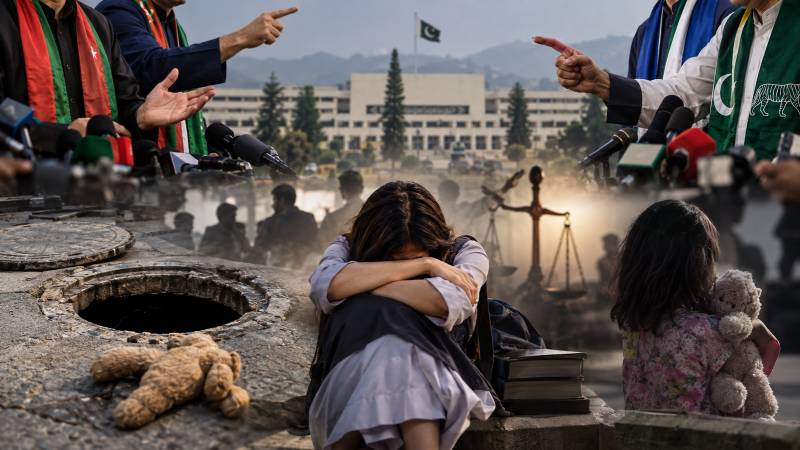
The culture of political whataboutery in Pakistan turns human tragedies into justifications for supporting political parties. In Pakistan political elections are now not only about what a party can do but also about what its opponents have not done; political debates have turned into opportunities for bringing forward the other side’s failures, pointing out their scandals and making voters remember their mistakes. Although accountability is a necessary element of democracy, a fundamental flaw arises when political involvement mainly consists of showing that the other side is worse. The culture of political whataboutery has repercussions that go well beyond elections; it influences the way ordinary people react to suffering, injustice and even death. Among its most disturbing effects is the normalisation of blaming the victim.
Imagine a student who commits suicide after having allegedly been the victim of fraud or exploitation. Rather than having the situation investigated, looking into any failures that might have led to the tragedy or showing sympathy to the family, some people instead immediately question the decisions of the student and ask why she trusted that person, why she did not act in a different way, or why her family did not protect her. Think about children who are victims of sexual abuse. Instead of directing their anger at the people who abused them and asking for justice, some people blame the parents. What were they doing? Why weren’t they looking after their children? Think about cases where children die after falling into uncovered manholes. Rather than concentrating on the public infrastructure, the duties of the appropriate authorities and the circumstances surrounding deaths that could have been avoided, political debates can soon shift to the parents. Why were the children outside? Where were their families? And, as is certain to happen, what about the previous government?
However, when political identity is closely linked with personal identity, questioning a party can start to seem like a personal attack, and supporters begin to stop assessing each incident on its own merits and instead ask whether admitting a failure might be advantageous to their opponents. When the government that they back is in charge of providing a public service, they will tend to downplay a tragedy which brings out its flaws. If the opposition brings the matter up, they might regard the criticism as political propaganda. In the case of a similar incident taking place under a different government, they may treat it as proof of that party’s incompetence.
Governments ought to be evaluated in relation to those that came before them, and claims of selective accountability merit close examination. Yet a comparison does not provide an answer to the original question. That does not mean that similar cases under another government explain why a manhole was left uncovered if a child has died as a result of it. Likewise, the fact that there is reference to another political scandal does not prove that the student was deceived or that anyone should be held responsible. The continual comparison of the tragedies linked with different parties results in a competition to place the blame. It enables the political supporters to shirk the unpleasant questions without actually answering them. As time goes on, this can cause it to appear entirely normal to avoid taking responsibility.
The practice of blaming victims is nothing new in Pakistani society; it shows up in talks about sexual violence, domestic abuse, financial exploitation and social status, the situation being influenced by unequal power relations and cultural expectations. Nevertheless, political partisanship can provide this existing tendency with an additional justification. When people feel that they have to defend a party, they might find excuses for making the victim responsible for the situation. In this way, attention is drawn away from the behaviour of the people accused of the incident, any possible failures on the part of the institution and the duties of those in power.
Responsibility is not something that has a fixed amount and which has to be taken from one person and given completely to another; instead, different people can have different responsibilities, and these responsibilities must be based on evidence not on political convenience. Above all, a victim’s dignity must not be based on whether their suffering causes a particular party to look bad. It is simple to explain this behaviour entirely in terms of the political party which is currently under criticism. Nowadays, supporters of the Pakistan Muslim League (Nawaz), or PML-N, are perhaps the ones most noticeable in some of the online discussions that have given rise to this concern. In different situations, however, supporters of the Pakistan Tehreek-e-Insaf (PTI), the Pakistan Peoples Party (PPP) or of other political groups would show the same defensive tendencies. The true test of political principle does not lie in our willingness to condemn wrongdoings committed by our opponents; it lies in our ability to admit that such wrongdoings have taken place when they are done by those we support.
The trouble starts when comparisons are used in place of answers, when accountability shifts into a contest about who is worse, and when those who have been wronged are forced to bear the responsibility of justifying a government that has failed them.
A major cost of this culture is that it lowers the standards used to evaluate political parties. A government must be judged by its capacity to deliver effective public services, to keep its infrastructure safe, to respond to emergencies, to administer justice, to create economic opportunities, and to protect its citizens. Its performance should be evaluated based on evidence, measurable results, and the experiences of the people it serves. In the meantime, the opposition parties should provide plausible alternatives, explain the way in which they would deal with the current problems, and show that their promises are realistic.
Democracy demands that citizens should require a standard higher than the minimum level needed in order for their favourite party to appear comparatively acceptable. Social media enables ordinary people to record failures, bring about awareness and ask powerful institutions for explanations. At the same time, the political responses to individual tragedies have become quick and highly visible. An incident takes place, a photograph or video goes around, and people start to take sides before the full facts are known. Political figures and their supporters may interpret the incident in a way that suits an existing narrative, while others reply with counterexamples, accusations and personal attacks.
It is true that not all political supporters act in this manner and that social media conversations don’t always reflect the views of the whole population. Yet the fact that such reactions are visible is important; when tragedies are continually turned into opportunities for partisan debate, insensitivity can start to seem socially acceptable. People might be more likely to carry on blaming the victim if they notice that such blaming is given likes, shares and approval by their political circle. The worst consequence is not merely that political debate becomes less productive; it is that people’s political affiliations can start to decide who is deserving of sympathy. When a victim is part of a community or family seen as politically sympathetic, their suffering might attract attention. But if the victim is linked to a political opponent, the response could become suspicious, dismissive or hostile. In some cases the victim has no significant political affiliation; in such instances their suffering is merely inconvenient to the argument in question.
People should evaluate political parties on the basis of their performance rather than just on their ability to highlight the failures of their opponents. Those involved in politics should ask their own leaders for explanations just as they ask the opposition for explanations. Both journalists and the general public should tell the difference between information that has been verified and speculation, and between proper investigations and hasty efforts to place the blame. Above all, people should distinguish between three questions which political debates often combine into a single one—what took place, who is responsible on the basis of the evidence, and what needs to change in order that it may not happen again?
Answers to these questions should be given even if the answers are politically inconvenient. If a child dies as a result of an unsafe public environment then the first thing to do should be to look into the circumstances, investigate any possible negligence and enhance safety. In the case of a student dying by suicide after alleged fraud or exploitation, the circumstances must be investigated in a sensitive manner, the allegations examined and those concerned dealt with in a compassionate way instead of being subjected to public humiliation. When a child is sexually abused the attention should be concentrated on the alleged perpetrator, the evidence, the protection of the child and any failures which may have permitted the abuse to take place. Questions regarding other contributing factors must not be used as an excuse for the abuse or as a means of shaming the victims and their families. The principle is simple in that you should look into the facts, allocate responsibility in a fair manner and require institutional improvements without turning people’s suffering into a political tool. The next time a student dies, a child is abused or a family suffers a loss as a result of a public failure which could have been avoided, the first thing to do should not be to ask which party can be blamed or defended. The first thing we need to do is to find out who has been affected, what took place, who is responsible and what steps can be taken to ensure it does not happen once more. A political party ought to serve the people, and the people should never have to justify their suffering in order to do so.