

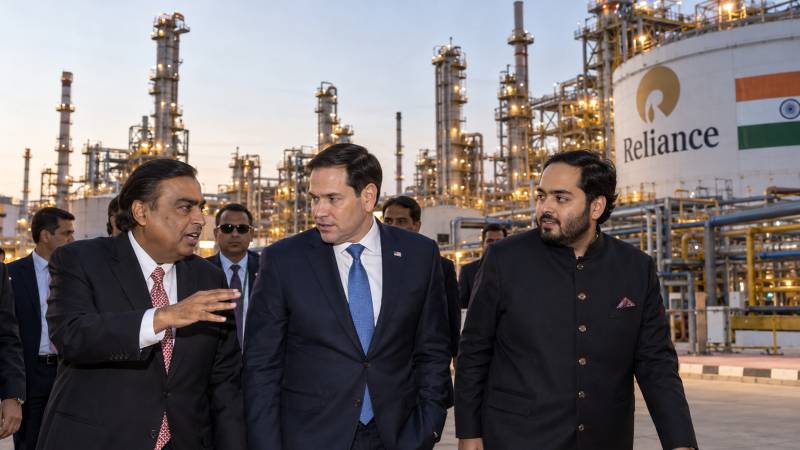
Washington wants India's refiners to swap Russian crude for Venezuelan barrels it now markets, while it buys Russian diesel for its own voters. A visitor who never went to New Delhi set the terms in India. On 21 October, America's top diplomat spent his working day at an oil refinery in India. Marco Rubio flew into Jamnagar on the Gulf of Kutch, where Mukesh Ambani and his son, Anant, received him at the Reliance complex. Its two refineries process about 1.4 million barrels of crude a day, making it the world's largest single-site refinery. Reliance later said the two sides discussed the global energy landscape and commercial partnerships. Rubio had already said what he wanted: Reliance refining more Venezuelan crude, and perhaps producing oil inside Venezuela as well. On the second idea, he told reporters that Washington would go and see "what the hold-up is."
He did not go to New Delhi. Rubio was in the capital in May, when he met Prime Minister Narendra Modi. This time, his route ran from Samarkand to Mumbai, then to Jamnagar. In Mumbai, he met Gautam Adani and Tata Group Chairman N. Chandrasekaran. External Affairs Minister S. Jaishankar flew to Mumbai to see him, after US Ambassador Sergio Gor told a Delhi audience that Washington expected Jaishankar to make the trip. The State Department announced the visit before India's Ministry of External Affairs confirmed it. Rahul Gandhi responded that Rubio had "summoned his employee to Mumbai." No meeting with Modi was on the schedule.
Protocol complaints are easy to dismiss, and the Indian opposition has its own reasons to raise them. The itinerary still deserves a close reading. It shows who Washington thinks it needs in India this month: a private refiner with spare capacity and a large diesel export business. A government with its own views on Russia, tariffs and Pakistan was a stop it could skip. Americans vote on 3 November, and diesel is on the ballot in all but name. Since the US and Israel attacked Iran on 28 February, the average US diesel price has risen about 70 per cent. The Energy Information Administration put it at $6.28 a gallon last week. AAA recorded an all-time high of $6.53 in September, and on 25 October its national average stood at $6.35, against $3.66 a year earlier. Diesel moves the trucks, tractors and freight trains of the American economy, so the increase reaches every grocery bill. An October Reuters/Ipsos poll found that nearly 80% of Americans blame Trump for higher costs.
The White House has tried several fixes. Truckers may now use red-dyed farm diesel on highways, farmers are getting $8 billion in support, and Trump has invoked the Defence Production Act to fund new refining. Prices rose again anyway. Jamnagar fits that problem. Reliance's biggest export is diesel. The company is also backing America First Refining's planned 168,000-barrel-a-day plant at the Port of Brownsville in Texas, and has signed a 20-year deal to buy its output. Trump announced it in March as a "$300 billion" deal and the first new US refinery in about 50 years. Analysts in India noted that the Brownsville region has a large Latino and construction workforce, and that Texas has a competitive Senate race this year. A photo of the man paying for the refinery helps Republicans in the last fortnight of a campaign.
The numbers explain why Rubio wanted Reliance in particular. When the Iran war choked the Strait of Hormuz, India leaned hard on Russia, and Washington itself issued temporary sanctions waivers to keep Russian oil moving. Indian imports of Russian crude hit a record of about 2.6 million barrels a day in June. Ship-tracking firm Kpler puts July at 2.57 million, August at 2.02 million and September at 1.82 million, roughly 29% below the July level. Russia's share of India's crude imports fell from more than half in July to about 35% in September, while Middle Eastern oil climbed back to 54%. Bloomberg's tanker data, which counts cargoes leaving Russia, points to a deeper drop ahead: shipments to India averaged only 310,000 barrels a day in the four weeks to 4 October, the lowest since March 2022.
Venezuela is filling part of the gap. In fiscal 2025-26, India bought just $255 million of Venezuelan crude. Between April and August 2026, it bought $3.6 billion, and Reliance took about three-quarters of it. Kpler counted 196,000 barrels a day in September and expects around 465,000 in October, which would be the highest since December 2019. Reliance's Jamnagar units are built for Venezuela's heavy, high-sulphur Merey grade, which most refineries struggle to process.
The ownership of those barrels matters. After US forces seized Nicolás Maduro in January, Energy Secretary Chris Wright said Washington would market Venezuelan crude itself and hold the proceeds in US-controlled accounts. An Indian rupee spent on Merey therefore moves through a channel Washington controls, while a rupee spent on Urals ends up in Moscow. In fairness, prices are doing much of the work. Merey has been offered at about $16 a barrel below Brent while Urals traded at roughly a $10 premium, because Chinese refiners are bidding up Russian cargoes. Kpler's Sumit Ritolia has said US tariff pressure alone does not explain the Indian pullback. Washington's leverage is in the menu: the price signal decides what India picks from the suppliers the US is willing to tolerate.
Washington is pressuring India to replace Russian crude with Venezuelan oil while simultaneously buying Russian diesel for American markets, exposing the double standards of US energy policy and leaving New Delhi’s strategic autonomy increasingly at the mercy of Washington’s commercial and political interests.
On 18 September, Trump signed the Lindsey O. Graham Sanctioning Russia and Iran Act. It lets him impose tariffs of up to 100% on goods from the five largest buyers of Russian oil and gas, including India. On 16 October, just before the first enforcement deadline, he waived those provisions in the "national interest." Rubio told reporters in Samarkand that the near-finished trade deal with India was one of the things weighed in that decision. He later told The Indian Express that about 99% of the agreement was done and that none of the tariffs was meant to punish or harm India.
The law stays on the books, though. The Global Trade Research Initiative, a Delhi think tank, pointed out that Washington can revive the tariff threat whenever it needs leverage in the talks. India is finishing a trade deal with a suspended 100% tariff hanging over the table. While it squeezed India over Russian oil, Washington was buying Russian fuel. After a phone call with Vladimir Putin on 9 October, Trump announced that Russia would supply diesel to US and world markets in stages, around 4 million tonnes, or about 29 million barrels. Russia lifted its own ban on diesel exports to make it work. Ship-tracking data on 23 October showed the first cargo heading for New York, the first Russian petroleum product bound for the US since Joe Biden banned such imports in 2022. A bipartisan group of senators has asked Trump to reverse course.
The diesel deal is one strand of a wider thaw. Special envoy Steve Witkoff met Putin in St. Petersburg on 21 October. He confirmed that the US Treasury is in direct talks with Kirill Dmitriev, Putin's economic envoy, on future trade, including diesel and Russian fertilizer exports. Dmitriev called the Graham Act waiver "a truly historic moment." The New York Times has reported that the Ukraine talks have widened into a multibillion-dollar deal for Lukoil's overseas oil assets, with investors tied to Trump's negotiators in the bidding group. India made this argument last year, noting that the US still imported Russian uranium hexafluoride, palladium, and fertilizer while penalizing Indian oil purchases. The point is harder for Washington to answer now. Russian energy is acceptable when it lowers prices at American pumps and a problem when it lowers costs at Indian refineries.
Russia has less to complain about than the import figures suggest. China is absorbing the barrels India no longer takes, and paying more for them. Washington has waived the harshest sanctions, opened a Treasury channel and agreed to buy Russian diesel. Moscow's public line on India has been the same all year. When Putin visited New Delhi last December, he promised uninterrupted fuel supplies, and Kremlin spokesman Dmitry Peskov has said India buys energy wherever it finds it beneficial. Sergey Lavrov says Modi is expected to visit Russia this year, and Jaishankar was in Moscow in August. Defense ties, from the S-400 to spare parts for an arsenal that is still largely Russian, give both sides reasons to keep the relationship calm.
Modi has been a spectator in his own government's energy diplomacy. In February, India learned the terms of its own trade deal from Trump's social media posts. In October, Washington announced the visit, the US ambassador announced where India's foreign minister would be, and Rubio set out the energy agenda to reporters in Mumbai. The Diplomat described the result as a relationship recast as a transaction, with India valued as buyer, refiner and market. Foreign Policy observed that Delhi is where India's trust gap with the US is widest, and that stopping there would have meant awkward conversations about tariffs and Washington's warmth toward Pakistan. Skipping Delhi skipped those conversations.
A prime minister who built his foreign policy brand on personal chemistry with Trump, from "Howdy Modi" in Houston to "Namaste Trump" in Ahmedabad, now watches the American secretary of state conduct the important meeting of his India visit with a businessman in Gujarat. Reliance's choices often serve Indian interests too. Still, a private boardroom is shaping energy policy for 1.4 billion people, with the elected government handling the receptions. Pakistani readers may enjoy India's discomfort. They should study it instead. During this visit, Rubio told The Indian Express that Washington's ties with Pakistan would not undermine its partnership with India, and Pakistan's own July 2025 deal on oil reserves was written in the same transactional style.
Washington's attention in South Asia goes to whoever holds what it needs that month, whether that is a refinery, a mineral deposit or a diplomatic favour. A country whose relationship with the US narrows to one commodity is exposed the moment that commodity's price moves. The Russian diesel cargo is due in New York before Americans vote. The Graham Act waiver can be withdrawn with a letter to Congress. Rubio says the India trade deal is 99% done. New Delhi should clarify who wrote the remaining 1% and whether Modi was in the room when it was written.