

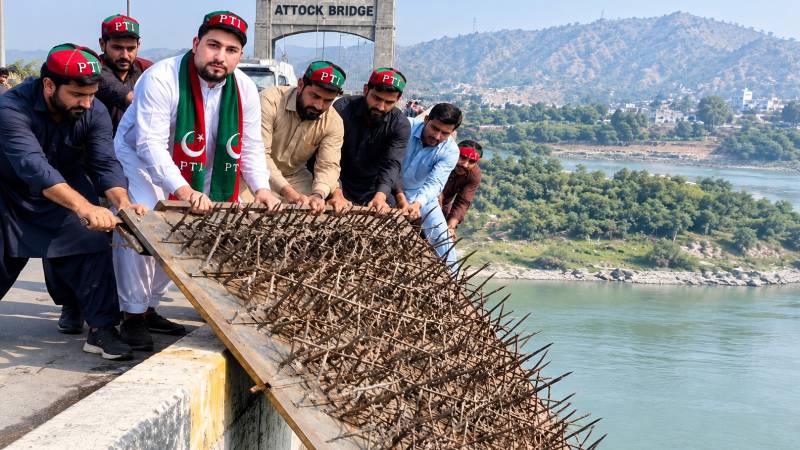
The ongoing political confrontation in Pakistan has created another serious problem that deserves attention beyond the political debate itself: the use of containers, metal barricades and large quantities of sharp iron spikes to block roads and bridges, followed by the removal and dumping of these materials into rivers and canals. The photographs accompanying this article illustrate the scale of the problem. Whatever one's political affiliation or position on demonstrations, the disposal of such hazardous material in waterways is neither a safe nor an environmentally responsible solution. A temporary measure intended to control traffic can become a long-term threat to human beings, animals and aquatic ecosystems if the materials are abandoned in rivers.
Governments have a responsibility to maintain public order and protect important infrastructure when large political gatherings are expected. At the same time, every security measure should be planned with consideration for public safety and the environment. Blocking a bridge with containers or installing barriers on a road may be temporary, but hundreds or thousands of sharp metal spikes placed across a roadway create an additional hazard when they are subsequently dismantled. If citizens remove these obstacles because they need access to roads and bridges, the material must not simply be thrown into nearby rivers or canals. Unfortunately, when political tensions are high and people are frustrated by prolonged road closures, there is a danger that barriers will be removed without any plan for their safe disposal.
The dumping of sharp metal objects into waterways is particularly disturbing because the material does not disappear when it goes beneath the surface. Rivers, canals and reservoirs are living ecosystems. They contain fish, aquatic plants and countless smaller organisms that form interconnected food chains. Large quantities of iron rods, spikes, nails and other metal structures can physically injure aquatic animals and can become entangled with vegetation and other debris. As the metal remains exposed to water, it can also corrode over time. More importantly, the physical danger may remain hidden from people who use these waterways long after the political dispute or road blockade has ended.
The threat is not limited to aquatic life. In many parts of Pakistan, rivers and canals are used by local communities for fishing, washing, recreation and other activities. People may enter shallow water without knowing that sharp metal objects have been dumped beneath the surface. Children, fishermen and swimmers could suffer serious cuts or puncture injuries if they come into contact with concealed spikes. During periods of increased water flow, loose metal objects could potentially move from one location to another, making the danger even more difficult to identify and control.
The use of containers, metal barricades and large quantities of sharp iron spikes to block roads and bridges, followed by the removal and dumping of these materials into rivers and canals, has created another serious problem that deserves attention beyond the political debate itself.
Domestic and farm animals are also vulnerable. Cows, buffaloes, goats and dogs frequently approach rivers and canals for drinking water or cooling themselves. A submerged metal spike can cause severe injuries to an animal's feet or body. An animal cannot be expected to recognise that a familiar water source has suddenly become dangerous. In rural areas, where livestock represents an important part of household livelihoods, injuries to animals can also impose an economic burden on families. This situation therefore requires responsibility from both the authorities and the public. Citizens who encounter road barriers should not throw them into rivers, canals or other natural areas. Removing a road hazard only to create a hidden hazard in a waterway merely transfers the danger from one location to another. Sharp metal barriers should instead be collected at designated locations and transported for safe storage, recycling or disposal.
The greater responsibility, however, lies with the authorities that install such barriers. When a government department decides to use containers, metal barricades or anti-vehicle devices as part of a security operation, it should also have a clear plan for their removal. The operation should not end when the political gathering is over or when a road is reopened. Officials should know where the barriers have been placed, who is responsible for collecting them and where the material will ultimately go. Environmental considerations should be incorporated into security planning from the beginning rather than treated as an afterthought.
Most importantly, authorities should immediately inspect bridges, riverbanks and waterways near locations where such barriers have been deployed. Any sharp metal material that has already been thrown into rivers or canals should be located and removed using appropriate equipment and trained personnel. The affected areas should then be inspected for remaining hazards. Where necessary, environmental authorities should assess whether the dumping has affected water quality, aquatic life or the safety of communities using the waterway.
Pakistan's rivers and canals already face considerable pressure from pollution, waste disposal, untreated wastewater and other human activities. Adding political-security debris to this burden is entirely avoidable. Political demonstrations are temporary events, while environmental damage can persist long after the political dispute has moved on. A government may have security concerns, political parties may organise protests, and citizens may disagree strongly about the legitimacy or consequences of those protests, but none of these disagreements should justify turning public waterways into dumping grounds for hazardous materials.
There is also a lesson here about the relationship between state action and public behaviour. When authorities block roads with enormous quantities of material but do not provide a clear mechanism for its removal, citizens may take matters into their own hands. That can produce unintended consequences. The solution is not to blame ordinary citizens alone, nor is it to ignore the environmental consequences of government security measures. The appropriate response is for the authorities to take responsibility for the complete process from installation to removal and environmentally safe disposal.
The photographs of the barriers should therefore serve as a warning. The issue is no longer simply whether roads and bridges should be opened or closed during a political mobilisation. It is also about what happens to the physical material used to enforce those closures. If sharp metal barriers have entered rivers or canals, they should be treated as an environmental and public-safety emergency requiring prompt removal.
Political differences will come and go, governments will change, demonstrations will end and roads will eventually reopen. Pakistan's rivers, however, belong to everyone. They are essential for communities, agriculture, animals and wildlife. No political confrontation should leave behind a legacy of hidden metal hazards in the country's waterways. The government should therefore ensure that every hazardous barrier used during such operations is properly recovered and disposed of, while citizens should also refrain from throwing removed barriers into rivers and canals. Protecting the environment is not a political favour to one party or another; it is a responsibility owed to the public, to animals and to future generations.