

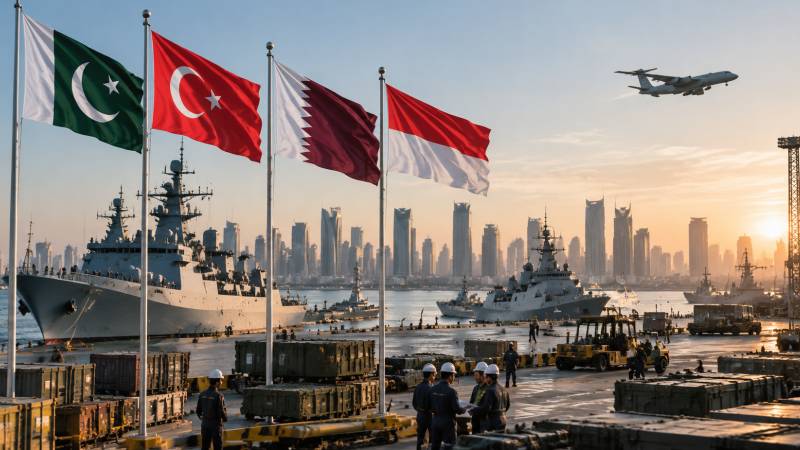
A couple of months ago I argued in these pages that the Mecca defence pact was a fine photograph and not much more, a roof promised before anyone had thought to pour a foundation. In a second piece I tried to say what that foundation would have to be. Factories, laboratories, engineers, a shared technical language, and above all a generation educated well enough to build the things these countries cannot presently buy without someone else’s permission. I did not expect to be answered quite so quickly.
On the twenty-first of October, in Doha, Pakistan, Turkey, Indonesia and Qatar put their names to the Badr memorandum. For once, and cautiously, I find myself encouraged. The first thing to understand about Badr is what it is not. It is not another mutual defence clause, not another solemn promise that an attack on one is an attack on all. It is an industrial memorandum, about joint production, technology transfer, integrated supply chains, technical training and research. In other words, it is about the foundation and not the roof. After Mecca, that is exactly the right order of business, and whoever advised it deserves credit.
Look at the shape of it and the logic is sound. Turkey brings the technology and a mature industry that already works. Pakistan and Indonesia bring manufacturing capacity, large populations and real markets. Qatar brings money. Indonesia is a welcome addition for a reason beyond its factories, because it is the largest of the four and the most democratic, and I argued last time that free minds build better than frightened ones. Four countries, four different strengths, now formally invited to pool them. This is the co-development I asked for in place of one-off arms deals, and it is a genuine step. So let me give Badr its due, and then say plainly what it still leaves undone.
It leaves out the most important thing of all, which is the classroom. The memorandum speaks of technical training, and that is good as far as it goes, but training is not education. Training teaches a man to operate the machine that someone else designed. Education teaches him to design the next one. A memorandum that trains technicians but never builds a single university of genuine international standard will produce competent assembly lines and almost no inventors. If these four are serious, Qatar’s money and Turkey’s and Pakistan’s ambition must go into raising a handful of real universities, in mathematics, physics, engineering and artificial intelligence, to a world standard and keeping them there for twenty years. Nothing in Badr does that yet. It is the gap I would most want closed.
It is silent, too, on the sky. There is not a word in it about satellites, about our own eyes in orbit or our own way of putting them there. And of everything the memorandum omits, this is the one that should worry us most, because the evidence is no longer theoretical. Ukraine, the Iran war, and our own exchange with India in the summer of 2025 all taught the same lesson in different accents. Modern wars are now won or lost in space before they are decided on the ground, through reconnaissance, early warning and real-time targeting that all run through satellites. A defence-industrial base with no independent eyes above it is a body with its vision rented from a landlord who can evict it at any moment. Badr builds the hands and forgets the eyes.
Build the minds. Put our own satellites in the sky. Write the policy, open the door to private money, and place the workshop where it will outlast an enemy’s first strike.
And it does nothing for the two chokepoints I keep returning to, the jet engine and the advanced semiconductor, neither of which any of the four can yet make, and neither of which can be trained into existence in a hurry. They have to be grown, patiently and expensively, which brings us back once more to the classroom. Now to the part that matters most for us, here, in Pakistan. A memorandum signed by four defence ministers is a letter of intent. It becomes real only when each country does its own homework at home, and ours is overdue. Pakistan needs, and has needed for years, a serious national policy for technology and defence-industrial development. Not a file in a ministry, but a real policy with real targets and a real horizon, one that outlives the government that writes it.
Above all, that policy has to break an old habit. Our defence industry has been almost entirely a state enterprise, and the state alone will never move fast enough or think boldly enough to close the gaps I have described. The private sector has to be pulled in, and pulled in with incentives that actually bite. Tax holidays for defence and dual-use manufacturing, credits for research, guaranteed purchase of what gets built, protected intellectual property, dedicated industrial zones, and an open door with real packages for the Pakistani engineers and scientists now working abroad who might be persuaded to come home. Unless substantial private money flows into this sector, and flows into it here, Badr will remain a diplomatic courtesy rather than an industrial fact.
This is where Qatar comes in, and where its role should be understood correctly. Qatar’s contribution is capital, and capital is precious. But capital sitting as mere investment potential compounds nothing. It should be deployed, into Pakistani and Turkish and Indonesian factories, laboratories and universities, where it will actually grow something. Qatar is the financier of this enterprise, and a financier’s money belongs where the work is done. Which leads me to a principle our negotiators should hold firm on, the question of where the work is actually done.
A defence-industrial base is, in any war, a target list. The first thing a capable enemy reaches for is the factories, the depots and the power that feeds them. So where the manufacturing sits is not an accountant’s question, nor a matter of national pride. It is a question of whether the thing survives the war it was built for. You do not put the workshop where a single bad week can end it. And on that test the geography decides for us. Qatar, with great respect to a generous friend, is the most exposed of the four, a small peninsula with its people and its plants packed into a short drive, in a neighbourhood that watched missiles fall on Qatari ground in 2025. Strategic depth is the one commodity money cannot buy, and Qatar simply does not have it.
Pakistan and Turkey do. We have the interior, the mountains, the distance, the room to disperse a thing so that it cannot be destroyed in a morning. The critical work, the engine lines, the munitions plants, the chip and satellite programmes, belongs deep inside Pakistan or Anatolia, or better still split deliberately across all four with real redundancy, so that no single strike, on Doha or Karachi or Jakarta or Ankara, can switch the whole alliance off. Let Qatar be the banker and the customer, honourable roles both. The arsenal should sit where it can survive the war it is meant to deter.
Badr, then, is the foundation I asked for, or the honest beginning of one. But a foundation with no laboratories on it, no eyes in orbit above it, no engines, and no safe ground to stand on is still only a slab of concrete. Build the minds. Put our own satellites in the sky. Write the policy, open the door to private money, and place the workshop where it will outlast an enemy’s first strike. Do that, and Mecca’s photograph and Doha’s memorandum will have been worth the ink. Leave it half-built, and we will simply have signed our names, very expensively, to another good intention.