

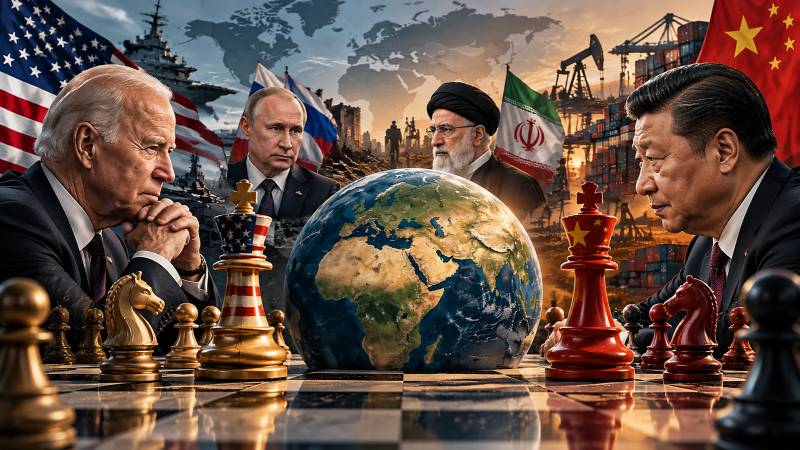
Today’s world is grappling with complex issues such as wars, economic inequality, imperialist and geopolitical rivalries, and artificial intelligence. These issues are not isolated from one another; rather, they are deeply rooted in the economic, political, and class contradictions of the modern global capitalist system. Therefore, to understand these matters, it is not enough to merely observe the outward appearance of events; an analysis of the underlying factors such as capital, property, labor, class interests, and global power dynamics is also essential. Against this backdrop, the Middle East and Palestine crisis, the Russia-Ukraine war, the escalating US-China rivalry, the issues surrounding artificial intelligence and employment, and the prospect of an Iran-US war manifest significant global contradictions in various forms. The Iran-US conflict highlights contradictions linked to national sovereignty, regional hegemony, energy resources, and the contest for global military power. The Middle East and the Palestine issue are linked to national sovereignty, regional power, energy, and global political interests; the Russia-Ukraine war reflects conflicts involving national security, geopolitical power, energy, and military interests; the US-China rivalry signifies a new contest for control over global capital, technology, trade, and production resources; meanwhile, artificial intelligence is reshaping the dynamics of productive forces, labor, and property.
The analysis of the five global issues presented below is an attempt to understand their material foundations, class relations, and internal contradictions, rather than merely providing a simple explanation of events. The aim is to examine how contemporary global capitalism interlinks issues of war, technology, economic power, and the environment, and to consider how the future of global society can be understood in light of these contradictions. The conflict between Iran and the United States is a significant manifestation of the geopolitical, economic, and military contradictions inherent in contemporary global capitalism. This dispute cannot be understood merely in terms of Iran’s nuclear program or the military rivalry between the two states; it is also deeply linked to regional hegemony in the Middle East, control over energy resources, global trade routes, and the preservation of American global influence. To comprehend this conflict from the perspective of historical materialism, it is essential to analyze not only the official stances of the states involved but also their material interests and the dynamics of global power relations.
A key economic aspect of this conflict is the strategic importance of the Strait of Hormuz, a vital passageway for global oil and gas trade. War or disruptions to transit in this area could impact global energy prices, freight costs, industrial production, and the lives of ordinary people. The United States seeks to influence Iran's policies through economic sanctions and military pressure, while Iran leverages its regional standing and strategic assets to safeguard its interests. Thus, energy and trade routes become sources of political power alongside their role as economic resources. Another fundamental contradiction in this conflict lies between national sovereignty and the strategic interests of a major power. Iran emphasizes its national security and political autonomy, whereas the United States aligns its policy with nuclear non-proliferation, regional security, and the protection of allied nations.
When assessing these claims, it is essential to evaluate military actions, economic sanctions, and their humanitarian consequences based on distinct facts and evidence. At the same time, Iran’s ties with China and Russia, and the United States relationships with Israel and Gulf allies, link this conflict to the shifting global balance of power, even though each state also maintains its own distinct interests. In the light of Marxist dialectics, the fundamental contradiction underlying the Iran-US conflict can be viewed in terms of energy, regional hegemony, national sovereignty, and the contest for global military power. A resolution is not possible merely through a shift in the military balance of power; rather, it requires a ceasefire, diplomatic negotiations, verifiable arrangements regarding the nuclear program, addressing the issue of economic sanctions, and political agreements to ensure regional security.
The Middle East crisis and the Palestinian issue represent a long-standing historical conflict within contemporary global politics. It is incorrect to view this issue merely as a religious or ethnic dispute or simply as a conflict between two nations. Underlying it are economic and political dynamics involving land, water, energy, natural resources, regional hegemony, military power, and the interests of global powers. The question of Palestine is linked to national sovereignty and land rights, as well as international power structures and regional economic interests. The Middle East's energy reserves, maritime trade routes, and strategic geographic location are important to the global economy, so the political situation in the region affects global energy, trade, and capital movements. War situations can also create new economic markets for arms, security, and military-related capital.
There is no doubt that the burden of war and political crisis does not fall equally upon the various strata of society. Ordinary laborers, farmers, impoverished families, small business owners, and the displaced bear a heavier human and economic cost of war, whereas state power structures, military institutions, and war-related economic sectors operate based on distinct interests. Here, the disparity between the interests of the ruling class and those of the general public becomes evident. The fundamental contradiction in this issue can be observed between national sovereignty and rights over land and resources on the one hand, and state power, regional hegemony, and global geo-economic interests on the other. Therefore, the question of peace is not limited merely to a ceasefire or a diplomatic agreement; it also encompasses issues of land, political rights, the distribution of resources, and economic justice. The link between this conflict and global capitalism lies in the fact that political stability—or crisis—in the Middle East impacts global energy and trade systems; consequently, understanding the Palestinian and Middle Eastern issue requires an analysis of capital, energy, and global power relations alongside the national question.
If the benefits of increased productivity are transferred to capital gains instead of being reflected in wages, working hours and social amenities, there is a clear possibility that economic inequality will increase rapidly along with technological progress.
The Russia-Ukraine War and the Question of New Imperial RivalryThe Russia-Ukraine war represents a significant contradiction within the modern global power structure. It is insufficient to view it merely as a territorial conflict between two states; rather, it involves interplay of factors such as Ukraine's national sovereignty, Russia's security claims, NATO expansion, European security, energy issues, the arms industry, and US-Russia geopolitical rivalry. The material basis of this war is linked to many economic interests. Energy reserves and routes, agricultural production, mineral resources, industrial infrastructure, trade routes and European energy supply are important in the global economy. Along with this, military industry and defense expenditure also become an important part of the war economy.
It is a fact that the burden of war on the class level falls more on the general population. Workers may lose their jobs, families are displaced, public resources are diverted to military spending, and inflation affects the quality of life. On the contrary, the demand may increase for some economic sectors related to defense industry and war wages. Thus, a contradiction arises between the war economy and the economic needs of the common people. The fundamental conflict underlying this issue can be viewed as a clash between claims of national autonomy and security and the geopolitical and economic interests of major powers. This war also signals another significant shift in global capitalism. The unipolar power structure of the global order is facing challenges from various centers of power; for this reason, we believe it is essential to understand the Russia-Ukraine war within the combined context of capital, energy, military might, and the new distribution of global power.
The growing competition between the United States and China is an important expression of the new stage of global capitalism. This competition is not only a competition of political or military power of two states, but it is connected with the competition to influence the flow of global income, trade, technology, energy and capital. Artificial intelligence, advanced chips, electric vehicles, batteries, cloud computing, data, maritime routes, and mineral resources have become key arenas of this competition. The material foundation of this rivalry lies in those sectors of global production that are crucial for future economic power. From chips and computing capabilities to energy and mineral resources, control over every vital resource of modern production shapes the strength of global capital; consequently, technology has evolved from a mere tool of production into a source of global economic and political power.
This competition affects the workers and the general public. Global supply chains change, industrial profits can shift to different countries, the nature of employment changes, and the costs of technology competition can shift to public resources. At the same time, large technology companies and capital groups gain more economic power in new sectors. The fundamental contradiction of this issue lies between the socially organized, interdependent nature of global production and the limited national and private control over the resources driving that production. While global production interconnects the entire world, its key resources remain under the influence of a few major corporations and powerful states; consequently, the US-China rivalry is not merely a geopolitical issue but also a matter concerning the redistribution of global capital.
Artificial Intelligence is bringing about a significant transformation in modern productive forces. AI, automated systems, and robotics possess the capacity to accelerate production, reduce the need for human labor, and achieve higher output in less time. However, in our analysis, the fundamental question concerns not so much the technology's capabilities as the social purpose behind its ownership and utilization. The material foundation of AI encompasses data, algorithms, chips, data centers, cloud infrastructure, and immense computing power. These resources require large scale capital, investment and infrastructure. As a result, much of AI development is concentrated in the companies and capitalist groups that control these resources. The effects of AI at the class level are mixed. On the one hand, it makes labor easier and wages more efficient, on the other hand, it is also eliminating or changing some jobs, increasing surveillance and putting pressure on the bargaining power of workers. If the benefits of increased productivity are transferred to capital gains instead of being reflected in wages, working hours and social amenities, there is a clear possibility that economic inequality will increase rapidly along with technological progress.
The main contradiction of this problem is between the forces of development and private property relations. AI has the potential to reduce human labor time, but the same potential in capitalist production is also likely to lead to unemployment, precarious employment, and wealth concentration. Therefore, we argue, the question of AI is not just a question of technology; it is a question of property, labor, class and social power. If the wealth and earning power generated by AI is used according to social needs, there is a possibility to reduce work time and make human life more free. If it remains under limited private ownership, the same technology can become a source of further concentration of capital.