

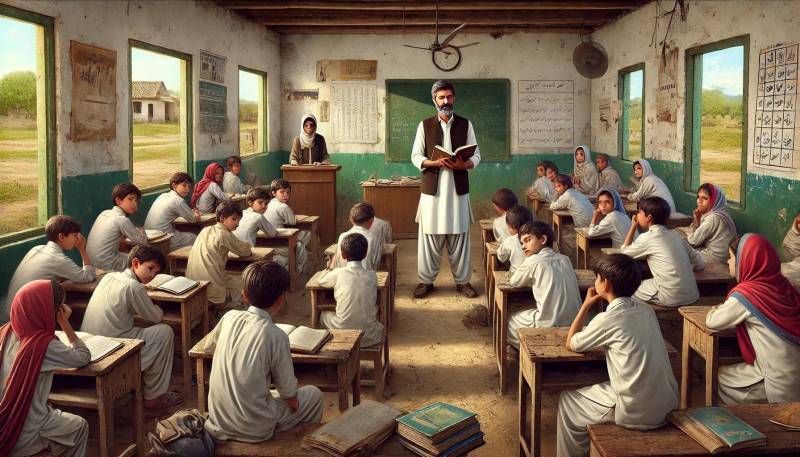
Imagine a classroom where questions are discouraged, where memorisation trumps understanding, and where students are trained to obey rather than think. This is the grim reality of Pakistan’s education system. Teachers, once revered as mentors, now struggle in an underfunded, bureaucratic, and outdated framework. Students meant to be the torchbearers of innovation, are shackled by rote learning, grade obsession, and a crumbling structure that prioritises quantity over quality. Is Pakistan truly nurturing the minds that will shape its future, or are we simply mass-producing graduates who lack critical reasoning and problem-solving skills?
The Teaching Crisis: Quantity Over Quality
Pakistan currently has approximately 1.83 million teachers across all levels of education, but the majority lack proper training. The Annual Status of Education Report (ASER) 2023 highlights that only 40% of teachers in public schools possess subject-specific knowledge at a satisfactory level. The majority rely on outdated teaching methods focused on rote memorisation, leaving students ill-equipped for analytical reasoning.
Furthermore, teacher absenteeism is a chronic problem. A World Bank report (2022) found that in some regions, teacher absence rates in public schools were as high as 20% on any given day. The lack of accountability allows mediocrity to persist, with political influences protecting underperforming educators from repercussions.
Student Mentality: Bred for Compliance, Not Creativity
Pakistani students, particularly in government schools, are conditioned to prioritise grades over understanding. The examination system reinforces cramming rather than learning, making creativity and problem-solving secondary concerns. According to the Pakistan National Human Development Report, four out of five students rely on rote memorisation to pass exams, with critical thinking not emphasised in curricula.
According to the Pakistan Economic Survey 2022-23, the country spends only 1.7% of GDP on education - one of the lowest in South Asia
This approach fosters a culture where students seek shortcuts - cheating, relying on private tutors, or paying for leaked exam papers. The Higher Education Commission (HEC) has repeatedly warned about declining university admission standards, where even top scorers struggle with basic comprehension and reasoning skills.
The Economic Divide in Education
Education in Pakistan is a tale of two systems: the privileged and the neglected. Elite private institutions offer world-class facilities, international curricula, and well-trained faculty. Meanwhile, the majority of students attend public schools, madrassas, or low-cost private schools, where the student-teacher ratio often exceeds 40:1, and basic infrastructure is lacking.
According to Pakistan Economic Survey 2022-23, the country spends only 1.7% of GDP on education - one of the lowest in South Asia. This chronic underfunding has left 22.8 million children out of school, making Pakistan home to the second-largest out-of-school population in the world.
The Politics of Education: A Vicious Cycle
Education in Pakistan is deeply politicised. Teachers’ unions wield significant influence, often prioritising political agendas over academic progress. Political appointments in education departments further erode meritocracy, leading to the recruitment of incompetent faculty members. Moreover, changes in government frequently result in abrupt shifts in curriculum policies, creating inconsistency in educational standards.
The Way Forward: Reform or Regression?
Pakistan's education system requires urgent reform. Some key steps include:
- Teacher Training & Accountability – Investing in teacher certification programs and enforcing performance-based assessments.
- Curriculum Overhaul – Shifting from rote learning to analytical and skills-based education.
- Technology Integration – Expanding digital learning initiatives to bridge gaps in rural areas.
- Increased Education Budget – Raising spending beyond the current 1.7% of GDP to improve school facilities and teacher salaries.
- Depoliticising Education – Ensuring appointments and curriculum changes are driven by expertise rather than political affiliations.
Without these changes, Pakistan will continue producing graduates who struggle to compete globally. Will we rise to the challenge and redefine education, or will we remain trapped in a cycle of mediocrity?