

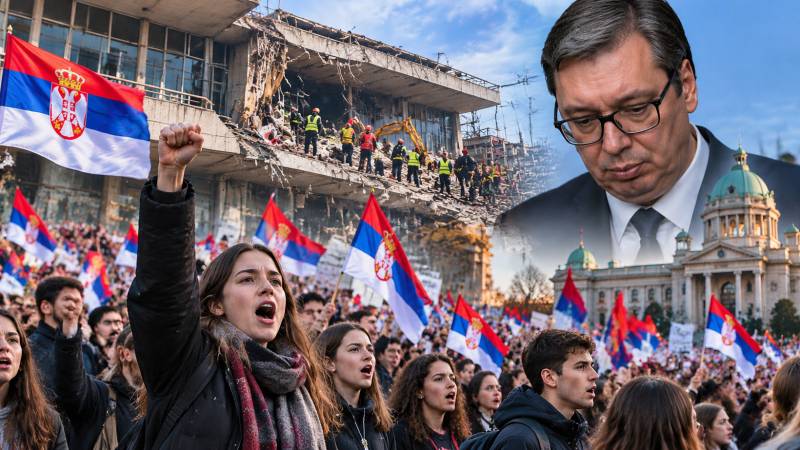
A single tragedy can sometimes expose institutional failures serious enough to transform an entire nation. On November 1, 2024, the collapse of a railway station canopy in Novi Sad, Serbia, claimed sixteen lives and raised troubling questions about construction standards, corruption, political influence and public accountability. What began as student-led demands for justice and transparent investigations gradually developed into a nationwide movement challenging an entrenched political establishment. Nearly two years later, the movement achieved a historic electoral victory on October 25, 2026. Yet its greatest challenge lies beyond winning power: transforming public anger into lasting institutional reforms that ensure accountability, professional integrity and the protection of citizens.
What distinguished Serbia's response from many previous episodes of public anger was the manner in which students organized themselves. Rather than immediately seeking established opposition leaders or creating another conventional political party, they developed participatory assemblies known as plenums. Universities became centres of collective discussion, democratic decision-making and civic coordination. Different faculties maintained organizational autonomy while cooperating around common objectives. The movement deliberately avoided excessive dependence upon a single charismatic personality, making it harder to weaken through pressure directed at individual leaders. Farmers, teachers, lawyers, scientists, artists and ordinary citizens gradually joined the demonstrations. What began as an expression of grief grew into a nationwide challenge to corruption, patronage and political dominance. Its strength came from the perception that it belonged not to a particular politician but to society itself.
The movement also demonstrated that sustained political pressure can produce consequences even before an election. Prime Minister Miloš Vučević resigned in January 2025 amid growing unrest, and a new government headed by Đuro Macut took office in April. These changes, however, did not satisfy the protesters, who increasingly regarded the problem as institutional rather than personal. Replacing individual officeholders seemed inadequate while the structures sustaining concentrated political power remained intact. Demonstrations continued throughout 2025 and into 2026 despite political pressure, confrontation and official criticism. The students eventually concluded that demands made outside parliament needed an electoral expression. Their transition from protest to organized electoral participation marked a decisive change in strategy. It also raised the stakes for Aleksandar Vučić, who had dominated Serbian politics since 2014, first as prime minister and subsequently as president. His supporters credited him with investment, infrastructure development and political stability, while critics accused his administration of weakening democratic institutions, concentrating influence and restricting meaningful political competition.
The political confrontation intensified in September 2026 when snap parliamentary elections were called for October 25. Vučić subsequently resigned from the presidency to pursue a return to the premiership. His decision turned the election into a contest not merely between electoral programs but between two competing conceptions of political authority. The ruling establishment possessed an established party apparatus, organizational experience and loyal supporters. The student-backed movement relied upon public mobilization, professional credibility and the promise of institutional renewal. Its electoral platform, Student List–Students Win, brought together university professors, doctors, economists, scientists, farmers and other citizens who had not necessarily belonged to conventional opposition politics. Cardiologist Ilija Srđanović emerged as its leading candidate, while former central bank governor Dejan Šoškić represented the inclusion of experienced economic expertise. The composition of the list itself conveyed an important message: political responsibility need not remain the exclusive occupation of professional politicians.
The weeks preceding the election were marked by considerable uncertainty. The authorities rejected accusations of widespread corruption and political repression, while opponents raised concerns about unequal media coverage, intimidation and the use of institutional advantages during campaigning. Independent observers and civil society organizations examined the electoral environment, highlighting the importance of media pluralism, voter freedom and impartial administration. The contest also revealed the limitations of predicting political outcomes from conventional party structures. Public dissatisfaction does not automatically translate into electoral victory, and movements that attract large crowds can nevertheless fail at the ballot box. The students faced the formidable challenge of converting emotional commitment into organized voting across the country. Their success would depend upon reaching citizens far beyond universities, particularly those who had become disillusioned with political opposition or uncertain about the possibility of change. By election day, the question was no longer whether the student movement had become influential, but whether it could overcome a political organisation that had appeared remarkably durable.
October 25 provided an answer that surprised even some of the movement's supporters. Large numbers of voters queued outside polling stations, producing exceptionally high participation. As the results emerged, it became evident that Serbia was witnessing a fundamental political realignment. Vučić conceded defeat, acknowledging that the Student List had won. The concession was particularly significant because it removed immediate uncertainty about whether the ruling political camp would accept the electorate's verdict. According to preliminary figures announced by Serbia's Republic Electoral Commission on October 26, the Student List received approximately 2.27 million votes, representing 52.71 per cent, and secured 140 seats in the 250-member National Assembly. The Vučić-backed alliance obtained approximately 1.69 million votes, representing 39.17 per cent, and 104 seats. The remaining seats were allocated to national-minority lists. Subject to final certification, the student-backed movement had achieved an outright parliamentary majority without depending upon a coalition of established opposition parties. A movement born from public mourning had become the country's leading electoral force.
The most enduring memorial to the sixteen victims would be a country in which no citizen is again sacrificed to institutional negligence, professional compromise or political privilege.
Belgrade and other Serbian cities erupted in celebration. Thousands gathered in public squares and streets, expressing a mixture of relief, disbelief and anticipation. After nearly two years of demonstrations, the extraordinary achievement was not simply the electoral defeat of a powerful politician. It was the transformation of sustained civic activism into a constitutional mandate. The symbolic importance of the result extended beyond Serbia's borders. Students frequently participate in political demonstrations, but comparatively few student-inspired movements succeed in creating an electoral organisation capable of winning a national parliamentary majority. Serbia's experience challenges the assumption that young citizens are politically indifferent or incapable of sustained political engagement. It also demonstrates that the distinction between street protest and parliamentary politics need not be permanent. When public mobilisation develops credible organisational structures and attracts wider social participation, it can move from demanding political change to acquiring the authority to pursue it.
The morning after the election, however, introduced a different reality. Winning power and exercising power are fundamentally different activities. As of October 27, the Student List's preferred prime minister and cabinet arrangements had not been conclusively established. Its leaderless organisational approach, highly effective during demonstrations, now confronted the requirements of executive government. Cabinet ministers must make decisions, ministries need administrative coordination, budgets require parliamentary approval, and public institutions must operate continuously regardless of political transition. A movement can unite citizens around opposition to corruption without resolving disagreements over taxation, public expenditure, international relations or social policy. The Student List's diversity is therefore simultaneously an advantage and a potential source of tension. Its members must demonstrate that collective decision-making can coexist with clear executive responsibility. Equally important, the new parliamentary majority must avoid reproducing the excessive concentration of authority that it criticised so effectively while in opposition.
The central challenge will be institutional reform. Serbia requires independent investigations into allegations of corruption, transparent public procurement, credible judicial processes, professional appointments and stronger safeguards for media freedom. Yet reforms undertaken in the name of justice must themselves respect the law. Replacing officials solely because of perceived political association would risk exchanging one form of patronage for another. The test of institutional renewal is whether professional competence, evidence and legally established responsibility determine administrative decisions. The railway tragedy that initiated the movement provides an appropriate starting point. Its causes and surrounding decisions must be examined through independent technical investigation and due process, ensuring that victims' families receive answers and that lessons are incorporated into enforceable safety standards. An electoral victory cannot retrospectively restore sixteen lives. It can, however, create an opportunity to strengthen the institutions responsible for protecting others.
Serbia's historical experience provides a revealing parallel. During the final years of Slobodan Milošević's rule, student activism and organized civic resistance contributed significantly to the political mobilisation culminating in his removal in October 2000. The Otpor movement became internationally recognised for its nonviolent methods and its ability to transform public frustration into collective action. The comparison with 2026 is instructive, although the political circumstances are different. Both episodes demonstrate that authoritarian tendencies can encounter effective resistance when citizens develop organizational networks beyond conventional political institutions. Yet history also warns against treating the removal of a political leader as sufficient evidence of democratic consolidation. Institutions can retain habits of political dependence long after governments change. The real achievement of a democratic movement must therefore be measured not simply by the downfall of an established administration, but by whether its successors strengthen the constitutional limitations upon their own authority.
Serbia's student revolution represents both an extraordinary accomplishment and an unfinished experiment in democratic transformation. The movement has demonstrated that sustained civic resistance can challenge entrenched political power through constitutional means. Its victory has created an opportunity to restore professional independence, strengthen public institutions and renew confidence in democratic participation. But the greatest achievement will not be recorded in the number of parliamentary seats won or the political career brought to an end. It will emerge when public officials can be investigated without interference, engineers can reject unsafe construction without fearing political consequences, journalists can question governments without intimidation, and citizens can criticise their elected representatives without being treated as enemies of the state. The concrete canopy at Novi Sad collapsed within moments, taking sixteen lives with it. Nearly two years later, the political consequences of that tragedy helped bring down an establishment that had seemed secure for more than a decade. The laws of physics explain why the concrete fell; the failures of public accountability help explain why its collapse became a national political crisis. Serbia's students have now demonstrated their ability to change a government. History will judge them by whether they can help change the system that made their revolution necessary. The most enduring memorial to the sixteen victims would be a country in which no citizen is again sacrificed to institutional negligence, professional compromise or political privilege.