

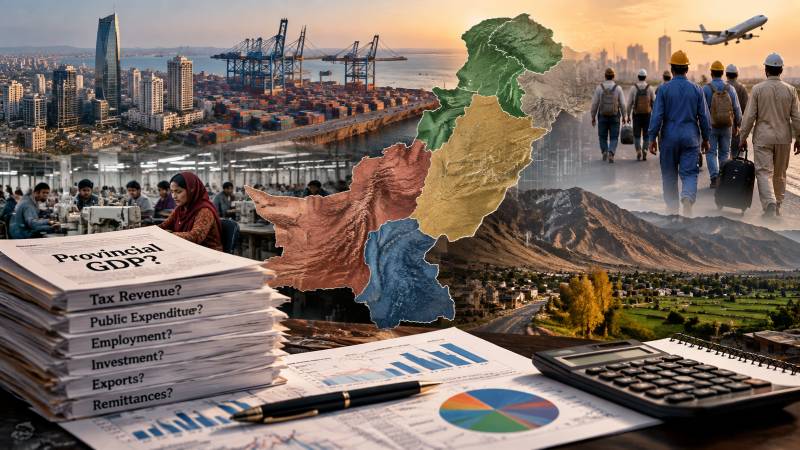
A column by Dr Hafiz A. Pasha, “Performance of the Provincial Economies” (Business Recorder, September 2, 2025), highlights a significant institutional weakness: Pakistan still lacks official annual Gross Regional Product (GRP) accounts for its provinces. Economists must therefore estimate provincial performance using information drawn from different sources and statistical extrapolations. Pasha’s study attempts to fill a gap that should have been addressed by the country’s statistical institutions. Drawing on censuses, surveys, statistical publications and other government sources, he estimates the size, composition and growth of the four provincial economies. His findings reveal differences in their economic structures and growth trajectories. Yet these remain research estimates, not an official, regularly updated system of provincial accounts.
The distinction matters. Without reliable provincial GRP data, it is difficult to determine how much economic value each province produces, which sectors drive growth, how productivity changes, or whether public expenditure is expanding productive capacity. National GDP shows the aggregate size of the economy but cannot, by itself, explain why some regions advance while others fall behind. Nor does a province’s share of national GDP reveal how economic activity translates into local employment, household income, tax revenue and investment.
Pasha’s estimates suggest that provincial economies have followed different growth paths, with Khyber-Pakhtunkhwa recording stronger estimated growth than Balochistan over the period examined. The fact that an economist must assemble data from multiple sources to assess provincial performance illustrates the gap in the country’s statistical system. The issue is not whether researchers can produce useful estimates, but why the state does not maintain and publish consistent, authoritative provincial accounts.
The problem extends beyond measuring provincial GDP. Pakistan needs a clearer picture of where economic value is created, where taxes are collected, how federal revenues are distributed and where public money is spent. These are related but distinct measures. A product may be manufactured in one province, marketed by a company headquartered in another and exported through a port in a third. Business addresses, tax records, customs data and production statistics may therefore attribute different parts of the same economic activity to different locations. Without a consistent accounting framework, it is difficult to establish each province’s contribution to the national economy.
The 7th National Finance Commission (NFC) Award illustrates why these distinctions matter. Its formula for distributing resources among provinces assigns 82 per cent weight to population, 10.3 per cent to poverty and backwardness, 5 per cent to revenue collection or generation, and 2.7 per cent to inverse population density. Although these criteria recognise differences in provincial needs, population remains the dominant factor. A less populous province that generates substantial economic activity may question whether its contribution and infrastructure requirements are adequately reflected in resource distribution. Similar disparities can exist between districts within a province. Reliable economic data would help assess these differences while supporting both equitable development and the expansion of productive capacity.
Provincial averages can also conceal significant differences between districts. Karachi, for example, is a major centre of industry, trade, finance and services, attracting workers from other provinces and rural Sindh. How much economic value is generated in the city? How much tax revenue is attributable to its economic activity? And how much do federal, provincial and local governments spend on its transport, water supply, sanitation and other essential services? Sindh’s share of national GDP or its federal transfers alone cannot answer these questions.
The country needs not only better economic performance, but reliable public data to establish where progress is occurring, what drives it and who continues to be left behind.
Reliable provincial and district-level data would help explain the factors behind stronger-performing regions and identify lessons for less-developed areas. The purpose is not to give additional advantages to regions that are already economically stronger, but to understand how their experience might help others progress. Planning must also recognise that areas generating substantial economic activity and employing people from outside their boundaries may face additional demands on infrastructure and public services.
Remittances require particular care in this analysis. They are not domestic production and should not be counted directly as provincial GRP. They are earnings generated abroad and transferred to households in Pakistan. Their geographical distribution and use nevertheless matter: better data could help establish where funds are received and whether they support investment and productive enterprises as well as consumption.
The relationship between exports and remittances makes the need for sound economic measurement especially clear. In a recent Dawn article, former State Bank deputy governor Riaz Riazuddin reported that exports fell from 17.3 per cent of GDP in 1992 to about 10 per cent in 2025. Remittances, after declining to 1.1 per cent of GDP in 2000, rose to 9.9 per cent. These figures illustrate the growing importance of overseas workers’ earnings relative to exports.
Both exports and remittances provide valuable foreign exchange, but their implications for domestic productive capacity differ. Exports are linked to domestic production, employment and productivity, while remittances represent income earned by Pakistanis working abroad. The growing importance of overseas employment raises a policy question: should Pakistan not invest more systematically in the education, technical training and professional qualifications needed to prepare its workforce for changing international labour-market demands?
The Philippines offers relevant experience in organising overseas employment, although its policies and circumstances cannot simply be transferred to Pakistan. A well-prepared workforce can improve employment prospects abroad and strengthen remittance earnings. But this should not divert attention from the need to expand domestic exports, investment and productive employment. Overseas employment and domestic production should be treated as complementary sources of economic opportunity, not alternatives.
Pakistan therefore needs a public economic information system that makes key indicators accessible to citizens, researchers and policymakers. Official provincial GRP accounts should be published annually, with sectoral breakdowns and transparent methodologies. These should be complemented by comparable provincial and district-level data on tax revenue, federal transfers, development expenditure, investment, employment, productivity and exports. Export statistics should, as far as practicable, distinguish the place where goods are produced and value is added from the location of the exporting company or port. Remittance data should show, as reliably as possible, where funds are received, while keeping these financial transfers distinct from domestic production.
Such a system would not automatically resolve disputes over resource distribution or guarantee better governance. It would, however, provide a firmer basis for evaluating economic performance, understanding regional disparities and directing development resources. Until Pakistan develops that capacity, claims of economic recovery will remain incomplete. The country needs not only better economic performance, but reliable public data to establish where progress is occurring, what drives it and who continues to be left behind.