

I moved to the Bay Area in 1979 from Davis, which is where I lived for five years as an economics student at the University of California. At some point, I heard of a magical place called Point Reyes Seashore. Some quick research located it on a map. It was located just 30 miles west and northwest of San Francisco and just an hour to an hour-and-a-half removed from most points in the Bay Area.
But it was not until the summer of 2006 that I got to visit that lovely wilderness. It was a classic case of love at first sight. Point Reyes offered serenity and silence, as do most wilderness areas. It also provided incredible views of the Pacific Ocean. But what made it stand out was the wildlife that abounded in the area.
I observed seagulls flying in the air and sitting on the beach, in colours ranging from black to white. Crows and several other types of birds were also to be found in the area. Years later, I visited Bodega Bay, a town located just half an hour away. These same birds were to be found there. And then I came to know that Alfred Hitchcock had chosen to locate his iconic mystery movie The Birds there.
Elephantine seals were found lying on the beach at Point Reyes. And then there was the prize that trumped them all: the Tule elk (Cervus canadensis nannodes).
According to the National Park Service, Tule elk are endemic to California, meaning they are found only here. Point Reyes National Seashore remains the only National Park unit where tule elk can be found. The majestic animals you see as you travel through the park embody the restoration of the dominant native herbivore to the California coastal ecosystem. They shape the landscape around them as they did for centuries before they were extirpated by humans. They symbolise the conservation of native species and ecosystem processes, one of the primary missions of the National Park Service.
The tule elk's presence is treasured by visitors, photographers, naturalists, and locals alike. Their image has been expressed in the local folk art, numerous local and nationally published photographs, and even on the local trade/barter currency where they are depicted alongside cattle, coho salmon, and local produce as being emblematic of the community.
The exotic deer hosted parasites and diseases that could have killed the elk –I was happy to see how the reintroduction was succeeding, and that I saw more elk than exotics
Since 2020, the elk population at Tomales Point has fluctuated up and down with changing environmental conditions, with a low census count of 283 individuals in 2015 to a high count of 585 individuals in 2007, and an average of approximately 420 individuals over the last 20 years from 1999 to 2019. Hunting is prohibited in the area.
We revisited Point Reyes in February 2016, when contractors were upgrading the energy efficiency of our house. We returned in May 2022 after the restrictions that were imposed by the pandemic had been limited and we needed a change of scenery.
A few days ago, we were seized once again with the temptation to revisit Point Reyes. The best time to see them is Autumn, which is the mating season for the Tule Elk. Rutting season is the annual mating period for hoofed mammals like elk, driven by shorter daylight hours and a surge in testosterone. Antlers grow on the males, the bucks, and they become supremely photogenic.
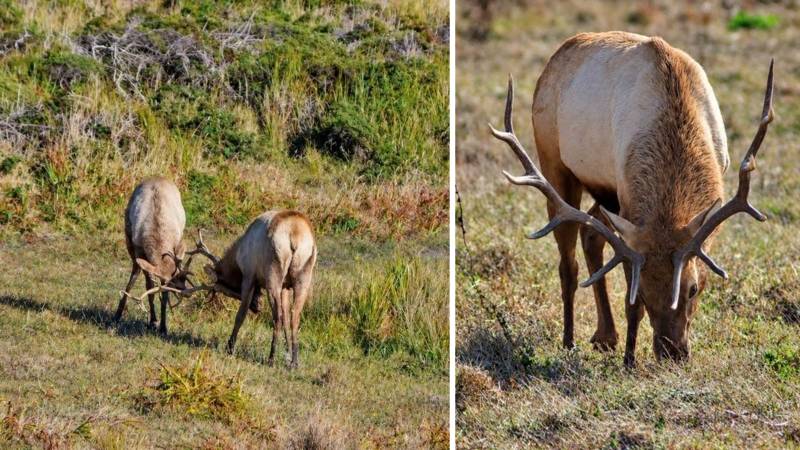
The males make loud calls called bugles to attract females and warn other males. Bucks lock antlers and fight to show strength and win mates. They rub their antlers on trees and scrape the ground to leave their scent, marking their boundaries.
Seized with the temptation to view them in action, we followed Oscar Wilde’s timeless advice: “The best way to fight a temptation is to yield to it.”
We got in our Tesla and put Point Reyes as the destination in the Navigation button. This time we would drive with the Full Self-Driving (FSD) feature turned on. We left our house around 12:30 pm and got hungry as we approached Berkeley along the way. We stopped in the Fourth Street area at a diner which turned out to be quite good.
The FSD worked great, both in the city and on the freeway. We went smoothly through the automated toll plaza at the San Rafael Bridge. Then we exited the freeway for Sir Francis Drake Boulevard. The speed limit was considerably lower, and the car automatically recalibrated its speed. At some point, we entered the mountainous area, and the road became quite winding.
The car was traversing the winding road at the speed limit, but it was going a bit too fast for our comfort. The fear factor was turned on because there was a sharp cliff on the side of the road next to us. I turned off FSD and drove manually at a slower speed. When the road resumed its non-winding nature, I turned FSD back on.
We headed to Drakes Beach. The temperature had dropped to 64 F, considerably lower than the 84 degrees it was just half an hour earlier. Several seagulls had formed an interesting formation on the beach. But there were no seals or Tule elk. We had seen them on our prior visits. It was disappointing, and we wondered if we would see them at all on this trip.
One of the landmarks at Point Reyes is the lighthouse, which was built in 1870. The lighthouse serves a great purpose in such a foggy area, as there is no beach to wash up on; it is on a rocky cliff. Day or night, the light may be the only thing visible to ships. But we decided to skip it since it was quite windy that day. Now we set our sights on Pierce Point, which is where the elk are normally found. To get there, we had to take an exit to a less well-maintained road.
The surface was rough, and there were several potholes on the road. The car kept on driving at the posted speed under FSD, and the ride became somewhat uncomfortable. The Tule elk were nowhere to be seen. I had a sinking feeling we would not see them at all on this trip. They wander all over the wilderness, which stretches far and wide.
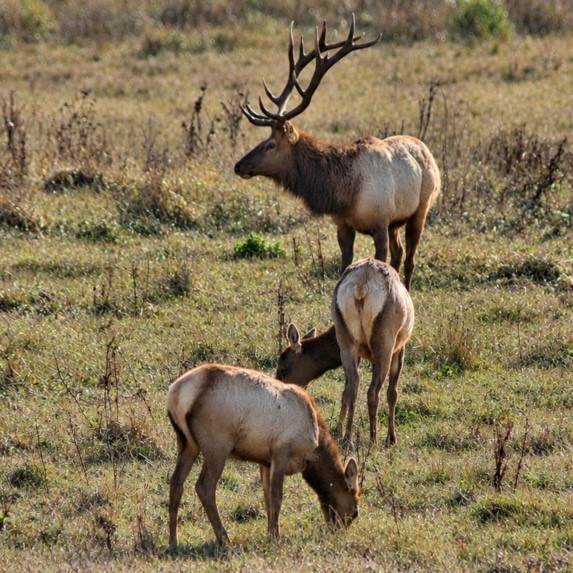
Suddenly, on the left side of the road, which ultimately borders the sea, I spotted a large herd of the prized species. There were more elk in this herd than I had ever seen before. The herd was spread out over an area the size of two football fields.
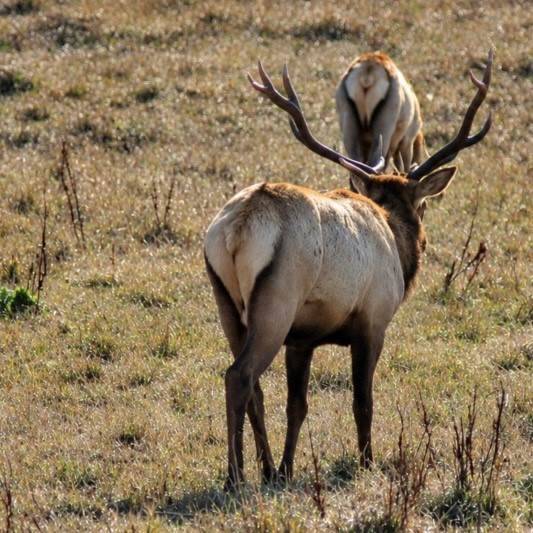
Some had antlers on their heads, and a few had very large antlers. We spotted a couple of bucks sparring with each other. And then we heard a loud cry, a bugle, and traced it to the biggest elk, who was located the furthest away from us. It was seeking to create a harem by scaring off other males.
I stopped the car and got out to take several pictures with my digital SLR camera. Unfortunately, in the rush to get out of the house, I had forgotten to change the zoom lens, which is best used for astronomical, night-time photography. It has manual focus and manual shutter speed. I took several shots, but all of them ended up being overexposed. Later, when I was back home, I downloaded the images and used ChatGPT to adjust the exposure. The results were quite good, yet another magical feat made possible by AI.
We reached Pierce Point and parked the car next to a historic ranch house which is now public property. Sadly, there were no Tule elk in the vicinity. Somewhat surprised and disappointed, we decided to head back on the road that had brought us here. Along the way, we were rewarded with another sight of the elk. This was a smaller herd on the other side of the road near Tomales Bay. I got out of the car to take some pictures, but they got scared and started to run away. I was still able to take a few shots.
I posted a few images on social media. They elicited a few comments, including this from a former employee of California’s Department of Fish and Game (now called the Department of Fish and Wildlife):
“It is nice to see them out there! During part of my career, I worked to prepare the Point Reyes for returning Tule elk by harvesting most of the exotic Fallow and Axis deer that had been introduced by a rancher to run a hunting operation on his ranch. The exotic deer hosted parasites and diseases that could have killed the elk, so my supervisor and I made multiple trips out there from Sacramento, our headquarters, to kill and process meat to support some ‘soup kitchens’ for homeless and impoverished people in the Bay Area. We didn’t completely exterminate the exotic deer, as I saw a few on a later visit to the Seashore, but I was happy to see the reintroduction was succeeding and I saw more elk than exotics.”
As we entered the winding road segment of the drive, I adjusted the speed of the car to the “sloth” mode, which is the slowest of the five modes in FSD. This time the car negotiated the turns without alarming us. We came home with some incredible memories.
Postscript. Besides the beauty of Point Reyes, and the presence of exotic wildlife, is its human history. On the 13th of November 1542, Spanish explorer Juan Rodríguez Cabrillo sighted and named “Cabo de Pinos” (Point Reyes), but missed the entrance to San Francisco Bay, a lapse that mariners would repeat for the next two centuries and more, due to the fog that characterizes the area. The Spanish explorer Sebastián Vizcaíno named the land Punto de los Reyes (“Kings' Point”) when his ship, the Capitana, anchored in Drakes Bay on the Day of the Three Kings (Epiphany, or the end of the 12 Days of Christmas) on the 6th of January 1603. The British naval explorer, Francis Drake, a notoriously successful pirate known for his successes on the high seas, sailed into the area on his ship, The Golden Hinde, on the 17th of June 1579, to repair his ship. The cliffs reminded the homesick sailors of the white cliffs along the English Channel, and they named it Nova Albion, with Nova meaning new and Albion being an ancient name for England.
Drake stayed for 36 days in the area, repaired his ship, cultivated ties with the original inhabitants of the area, the Coast Miwok, who had lived there for centuries, and traded gifts of food and material with them. Drake, who would later be knighted, claimed the area for Her Majesty, Queen Elizabeth I. This was also the era of William Shakespeare.