

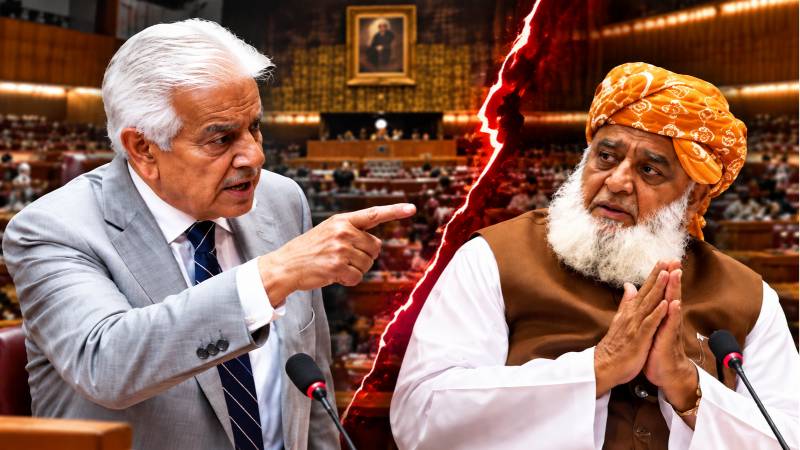
The exchange of accusations between Maulana Fazlur Rehman and Defence Minister Khawaja Asif in Parliament has once again brought Pakistan’s civil-military tensions into sharp focus. Beneath the political confrontation lies a more fundamental question: who actually governs Pakistan—the elected government, Parliament, or the military establishment? The question is not new, but it has acquired renewed urgency as the country’s constitutional and political arrangements continue to evolve. Pakistan has a prime minister, a federal cabinet, a bicameral Parliament and an established constitutional framework. Yet the existence of these institutions does not, by itself, establish that they exercise effective authority over the decisions for which they are held accountable.
The central contradiction of Pakistan’s hybrid system is that constitutional institutions remain formally responsible for governing the country, while the extent of their practical autonomy is increasingly contested. The elected government is answerable to the public for economic performance, foreign policy, internal security and political stability. But when questions arise over who determines the direction of these policies, the relationship between constitutional responsibility and actual power becomes difficult to ignore. This is the heart of Pakistan’s democratic crisis. The issue is not simply the influence of one institution over another. It is whether the constitutional balance between elected civilian authority and the military establishment has shifted so far that Parliament and the federal cabinet risk becoming secondary to other centres of power.
Cooperation between civilian and military institutions is necessary. Pakistan faces serious security challenges, a difficult regional environment and complex international relationships. Military expertise is indispensable in defence and national security. But consultation must not become a substitute for constitutional authority, and institutional coordination must not obscure who is legally responsible for making decisions. The distinction between advising, influencing and deciding is fundamental. A constitutional system can accommodate close cooperation among institutions only when their respective responsibilities remain clear and accountable.
Pakistan’s history offers ample evidence of the consequences of an imbalance in civil-military relations. The country has experienced prolonged periods of direct military rule and successive elected governments whose freedom of action has varied considerably. The military establishment has exercised substantial influence over defence, national security and foreign policy, while its involvement in domestic political affairs has repeatedly shaped the country’s democratic trajectory. The contemporary hybrid system represents a different configuration of this longstanding problem. Elected politicians occupy public office, governments are formed through parliamentary arrangements, and legislation continues to be enacted. Yet the decisive question remains whether elected representatives can independently determine policy, scrutinise the exercise of state power and hold all relevant institutions accountable within the constitutional framework.
The distinction between holding office and exercising power has therefore become central to understanding Pakistan’s political system. The Constitution places executive authority within a defined parliamentary structure. The federal government, headed by the prime minister, is responsible for governing the country, while the armed forces operate within their constitutionally and legally prescribed command arrangements. The military’s professional role does not remove the responsibility of elected institutions to determine national policy through lawful procedures.
Recent changes to Pakistan’s military command structure have intensified this debate. The 27th Constitutional Amendment, enacted in November 2025, created the position of Chief of Defence Forces and altered the higher military command arrangements. Subsequent legislation in August 2026 established a statutory framework for the new command structure. These changes have raised questions about the concentration of authority, institutional oversight and the balance between military command and civilian constitutional accountability.
The significance of these developments extends beyond the powers of an individual officeholder. The more authority is concentrated within a single command structure, the more important it becomes to ensure that its exercise remains transparent, legally defined and subject to appropriate oversight. The debate should not be reduced to personalities or questions of personal popularity. It concerns the institutional design of the state. Constitutional arrangements must be assessed not merely by the offices they create but by the distribution of authority they establish and the safeguards they provide against its unchecked exercise. Parliament’s own role in this process deserves particular scrutiny. A legislature that approves consequential constitutional changes within a compressed timetable, without sufficiently broad deliberation and meaningful political consensus, risks weakening the representative legitimacy on which constitutional reform depends. The formal passage of legislation may satisfy a procedural requirement, but the quality of democratic deliberation is equally important.
Parliament must be more than the venue in which decisions are announced, defended or endorsed. It must remain a forum in which national policy is debated, competing interests are represented and the executive is held accountable. Its authority cannot be measured solely by the number of laws it passes; it must also be measured by its ability to scrutinise the exercise of power. Foreign policy offers a revealing example of this challenge. Pakistan’s relationships with the United States, China and Saudi Arabia, its position amid tensions involving Iran, and its response to regional conflicts all carry consequences for national security, economic stability and domestic politics.
Military participation in strategic deliberations is both expected and necessary. The question is whether the elected government and Parliament retain a meaningful role in determining the country’s commitments, assessing their implications and ensuring accountability for decisions taken in Pakistan’s name. Defence cooperation with Saudi Arabia illustrates the importance of this distinction. Decisions concerning military deployments, bilateral security commitments and regional conflicts may involve sensitive information. But confidentiality over operational details cannot become a blanket justification for excluding Parliament from scrutiny of the broader strategic and political consequences.
The constitutional question is not whether every operational detail should be made public. It is whether the country’s elected representatives can obtain sufficient information to evaluate major commitments, debate their implications and hold the government accountable for the policies it pursues. The same principles apply to the responsibilities of Foreign Minister Ishaq Dar, Defence Minister Khawaja Asif and Interior Minister Mohsin Naqvi. Their formal portfolios establish clear areas of responsibility, but the public is entitled to understand how important decisions are actually made, how ministries coordinate their work and which constitutional authorities are responsible for particular policies.
The visibility of a minister, or the prominence of an individual in a particular policy area, does not by itself establish that constitutional authority has shifted elsewhere. Such conclusions require evidence. The appropriate test is whether the relevant ministries exercise their lawful responsibilities, whether the cabinet deliberates meaningfully and whether the prime minister can direct government policy through established constitutional procedures. If major decisions are effectively determined outside the institutions constitutionally responsible for them, the resulting ambiguity undermines accountability. Ministers may be expected to defend policies they did not meaningfully shape, while those who exercise decisive influence may remain beyond ordinary parliamentary scrutiny. This disconnect between responsibility and authority is one of the most serious weaknesses of a hybrid political system.
The same question arises in economic management. Finance Minister Muhammad Aurangzeb’s position, or speculation about changes in the composition of the cabinet, is less important than the broader issue of who determines Pakistan’s economic direction. Budgetary priorities, taxation, public borrowing, negotiations with the International Monetary Fund and decisions about development expenditure affect millions of citizens. These policies also shape the relationship between the federal government and the provinces. They should emerge from a transparent process of government deliberation and remain subject to meaningful parliamentary scrutiny.
The distinction between holding office and exercising power has therefore become central to understanding Pakistan’s political system. A government cannot credibly claim full political responsibility if it lacks the corresponding authority to determine its policies. Equally, the existence of informal influence does not absolve elected officeholders of responsibility for the decisions they approve or implement.
Speculation about the possible removal of a minister cannot establish where economic power resides. The more relevant questions concern who sets policy priorities, who negotiates major commitments, how decisions are reviewed by the cabinet and Parliament, and whether elected representatives can challenge or revise those decisions. A government cannot credibly claim full political responsibility if it lacks the corresponding authority to determine its policies. Equally, the existence of informal influence does not absolve elected officeholders of responsibility for the decisions they approve or implement. Accountability must follow the actual exercise of power, not merely the titles attached to public office.
The implications of this imbalance extend beyond civil-military relations. They reach into the structure of Pakistan’s federation and the relationship between the centre and the provinces. Debates over new administrative units, constitutional amendments, the National Finance Commission Award, provincial autonomy and the distribution of natural resources cannot be treated as purely technical questions. They concern the political rights, economic interests and historical identities of Pakistan’s constituent units.
The federation depends on more than the formal division of powers. It also depends on trust: the confidence of the provinces that their constitutional rights will be respected, their resources will be distributed through agreed arrangements and their political future will not be determined without meaningful consultation. The Eighteenth Constitutional Amendment represented an important step towards greater provincial autonomy. Any proposal to alter the existing balance between the federation and the provinces must therefore be examined carefully, particularly where it concerns resource distribution, fiscal arrangements, provincial powers or the creation of new administrative units.
Administrative restructuring may be justified in particular circumstances. But it cannot substitute for political consent, nor should it be used to bypass the constitutional rights of the provinces. Changes affecting provincial boundaries, representation or the distribution of resources must follow the applicable constitutional procedures and respect the role of the relevant representative institutions. The concern becomes particularly acute when such proposals are perceived as part of a wider process of centralisation. If provincial governments and political communities believe that decisions affecting their resources, powers and identities are being imposed by a narrow circle of decision-makers, the resulting mistrust can deepen existing political divisions.
Federal cohesion cannot be sustained through administrative orders alone. It requires a credible commitment to constitutional fairness and political participation. This is especially important in a country as diverse as Pakistan, where provincial identities, historical grievances and unequal economic development have long shaped political relationships. National unity is strengthened when citizens and provinces believe they have a meaningful stake in the state. It is weakened when they perceive that decisions are made without their participation or that their constitutional rights can be overridden by powerful institutions.
The weakening of Parliament and the marginalisation of the federal cabinet therefore have implications far beyond Islamabad’s corridors of power. They affect the legitimacy of national decisions and the confidence of the provinces in the federation itself. A Parliament that cannot meaningfully scrutinise defence policy, foreign affairs, economic management and constitutional reform risks becoming a secondary institution within a system that retains the outward appearance of representative government. A federal cabinet whose deliberations are constrained by informal power structures risks becoming an administrative mechanism for implementing decisions rather than an autonomous forum for collective policymaking. Neither situation is compatible with the spirit of parliamentary democracy.
The solution, however, is not to eliminate cooperation between civilian and military institutions or to deny the legitimate professional responsibilities of the armed forces. Pakistan’s security challenges demand effective coordination, continuity and informed decision-making. What is required is a clear constitutional framework in which every institution operates within its defined mandate and remains accountable through appropriate mechanisms. Parliament must exercise its legislative and oversight responsibilities without undue pressure. The federal cabinet must function as a meaningful forum for collective decision-making. The prime minister must be able to direct government policy within the Constitution. And the military establishment must operate within the constitutional and legal framework governing its responsibilities.
These principles are not mutually exclusive. They are the foundations of a functioning state in which expertise, authority and accountability reinforce rather than undermine one another. Political consensus is equally essential when constitutional changes affect the federation. Major reforms should not be reduced to a contest of parliamentary numbers or a race to secure the votes necessary for passage. They require meaningful deliberation, consultation with the provinces and a serious effort to build agreement across political divides.
A constitutional amendment may be legally enacted through the prescribed procedure, but its long-term legitimacy also depends on whether it strengthens public confidence in the political system. Constitutional power should be exercised to resolve national problems, not to deepen institutional imbalances or entrench the dominance of any single centre of authority. Ultimately, Pakistan’s challenge is not simply to determine which individual or institution is the most powerful. It is to ensure that the exercise of state power remains consistent with the Constitution and accountable to the people. An elected government cannot be judged solely by its presence in office. Parliament cannot fulfil its purpose merely by passing legislation. And a federal system cannot remain cohesive if its constituent units lose confidence in the fairness of the constitutional arrangement.
The distinction between formal authority and effective power must be addressed openly. If Parliament and the federal cabinet continue to lose their capacity to shape policy, scrutinise decisions and exercise their constitutional responsibilities, the credibility of representative government will suffer further. Pakistan needs a political order in which the federal cabinet is more than a facade, Parliament is more than a forum for endorsing decisions, and national security does not become a justification for weakening democratic accountability. The strength of the state lies not in the unchecked authority of any individual or institution, but in constitutional supremacy, institutional balance, federal justice and public confidence.
Without these foundations, the concentration of power may deliver short-term administrative control, but it cannot guarantee lasting political stability. Nor can national unity be sustained by weakening the very institutions through which citizens and provinces participate in the exercise of power. The question Pakistan must confront is therefore fundamental: Can a federation remain politically stable and democratically legitimate when the institutions constitutionally responsible for governing the country are increasingly perceived as secondary to the centres where real power is exercised?