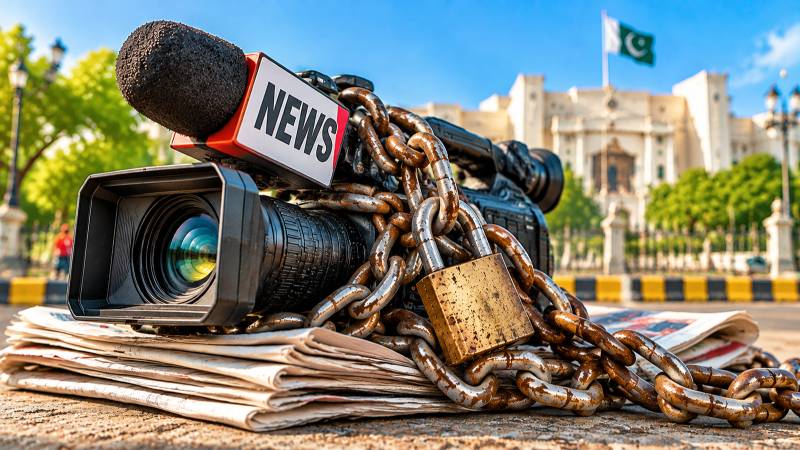
Journalism Under Siege: The Price Of Reporting In Pakistan

Despite constitutional guarantees and laws promising press freedom, Pakistani journalists continue to face physical violence, legal harassment, intimidation and enforced disappearances

Journalism Under Siege: The Price Of Reporting In Pakistan

"During the coverage of a Pakistan Tehreek-e-Insaf (PTI) rally, at one point, the Chief Minister of Khyber Pakhtunkhwa came out to speak to the media. Before I could even get close to him, plainclothes personnel began punching me repeatedly and assaulting me indiscriminately." Ali Talat Chaudhry

Ali Talat Chaudhry, an anchor for the YouTube channel Azad News, was covering Pakistan Tehreek-e-Insaf’s political activities in Lahore last month. He says he was covering the PTI rally with his journalist friend, A.K. Azad. They reported from the front of the rally, walking approximately 10 kilometers from Muslim Town Mor to Mazang Chungi, and interviewed several political leaders and ministers.

At one point, Sohail Afridi stepped out of his vehicle to respond to questions from the media and the public. Ali got off his motorcycle and began connecting a wireless microphone to his phone. As he was attaching the microphone and moving towards Sohail Afridi’s vehicle, police personnel suddenly grabbed him and dragged him aside.  He says that fortunately, his friend A.K. Azad was present at the scene. He raised his voice and brought the attention of the media professionals around Sohail Afridi’s vehicle, who immediately began recording videos. At the same time, the YouTube channel Naya Pakistan also recorded the incident and posted the video on Twitter X.

Ali Talat says that police personnel were forcibly dragging him towards a nearby prisoner van when members of the Khyber Pakhtunkhwa chief minister’s security team intervened. They asked the police to stop assaulting the journalist and release him. Only then was he freed. The police had also attempted to target his colleague, but the chief minister’s security team intervened in time to save him as well. During the scuffle with the police, Ali Talat’s microphone was destroyed, his mobile phone screen was broken, and he experienced ear pain for several hours. Later, when Sohail Afridi stopped at Jain Mandir Chowk to speak to the media, he called Ali Talat over, encouraged him, and expressed regret over the incident.

Moreover, on the same day that Sohail Afridi arrived in Lahore, journalist Agha Sheikh Sarwar was allegedly taken into unlawful custody by Punjab Police and handed over to the National Cyber Crime Investigation Agency (NCCIA). Not only individual journalists but also press freedom organizations have expressed concern over the conduct of administrative authorities in response to journalists’ professional activities.

According to Freedom Network’s 2026 report, between April 2025 and March 2026, journalists in Pakistan faced more than 125 incidents in which they were subjected to violence. The report formally documented at least 129 incidents in Pakistan. These included two incidents in which journalists were killed. Five journalists received death threats, and 58 legal cases were registered. Most of these cases were related to legislation concerning electronic media. In 11 incidents, threats were accompanied by acts of harm, while two cases of enforced abduction or disappearance were reported. Further in this regard, the RTI’s filed to Ministry of Human Rights, PEMRA and Ministry of Information & broadcasting remains unaddressed by the authorities.

The Prevention of Electronic Crimes Act (PECA), originally introduced in 2016 to prevent cybercrime, has increasingly been used as a legal instrument against journalists and freedom of expression, particularly following amendments introduced in 2025.

It is worth noting that, according to Reporters Without Borders, Pakistan ranked 158th in the World Press Freedom Index in 2025 and improved to 153rd in 2026. In 2021, Pakistan ranked 145th, while in 2022 it ranked 157th. Volker Türk, the United Nations High Commissioner for Human Rights, said in his message ahead of World Press Freedom Day on 3 May that journalists take serious risks to dugout the reality, so they should be protected in all circumstances. However, he noted that almost no country remains entirely safe for those who speak the truth. Ali Talat says that since the physical assault, he has experienced severe and persistent headaches throughout the day. Noise and fatigue make the pain unbearable, and he feels intense pain in a specific area of his skull. Ali Talat says he decided not to register a First Information Report (FIR) about the incident. His first reason is what he describes as the Punjab Police’s traditionally uncivilized, disrespectful and arrogant attitude. His second reason is that, since 27 September, the crackdown on digital media journalists covering PTI has become extremely severe.

The Global Investigative Journalism Network (GIJN), an international organization that supports and trains journalists, recommends that when journalists face negative or hostile reactions because of their professional activities, they should take certain measures. The recommended guidelines include keeping digital copies of identification and educational documents in cloud storage. To ensure their safety, journalists may also seek refuge visas or international fellowships. These measures can help journalists continue working in such environments with a positive outlook and a new perspective. Human rights lawyer Arbab Jahangir Edhi says that the Prevention of Electronic Crimes Act (PECA) has been used to silence journalists through legal means. The PECA Act, originally introduced in 2016 to prevent cybercrime, was made more effective as a tool against freedom of expression by the government and state institutions in 2025, including through provisions allowing criminal proceedings. Meanwhile, the government of Pakistan promises to provide journalists with a safe working environment.

On 2 November 2025, Prime Minister Shehbaz Sharif said, on the International Day to End Impunity for Crimes against Journalists, that the government would take all necessary measures to protect journalists and enable them to continue their work. However, the situation on the ground is entirely different. The question arises here that, on the one hand, the government has enacted the Protection of Journalists and Media Professionals Act, which explicitly assures journalists of protection, including against government institutions. Yet, many journalists continue to face violence, with state authorities held responsible for 60 percent of the reported incidents. So, what is the purpose of enacting these laws? Similarly, the United Nations Human Rights Committee expressed concern over reports of threats, violence, enforced disappearances and pressure against journalists in Pakistan. It also stressed the need for the effective implementation of laws designed to protect press freedom. However, the situation on the ground continues to fall short of these concerns.