

A stubborn myth persists that Zulfikar Ali Bhutto “destroyed” Pakistan’s economy with his state-planning instincts and selective nationalisations. Decades of venomous propaganda have cemented this narrative, portraying Bhutto as an economic vandal whose policies plunged the nation into ruin. Yet, strip away the biases, and a starkly different reality emerges—one where competent state intervention not only averted collapse but laid the foundations for sustained growth, even amidst unprecedented global and domestic shocks. This article dismantles that myth, revealing Bhutto’s tenure as a period of resilience and strategic vision that made Pakistan’s economy more resilient.
The Anti-Bhutto Biases of Pro-Establishment Analysts
The skewed portrayal of Bhutto’s economic legacy owes much to analysts whose ties to Pakistan’s anti-Bhutto establishment colored their accounts. Take Shahid Javed Burki, a World Bank official from 1974 to 1999 and a cousin of Imran Khan, born to a military family. Burki briefly served as Pakistan’s de facto Finance Minister for 67 days in 1996–1997 under a caretaker government after the dismissal of Benazir Bhutto’s second government in November 1996. In his book Pakistan Under the Military: Eleven Years of Zia Ul-Haq (1991), Burki praises Zia’s economic gains but glosses over the social costs of Islamization and repression. This soft stance reflects a broader pattern: framing authoritarian rule favorably while downplaying its long-term damage.
Similarly, Ishrat Husain, another World Bank veteran (1979–1999) and later Governor of the State Bank of Pakistan (1999–2005) under Musharraf, critiques Bhutto’s nationalization in Pakistan: The Economy of an Elitist State (1999). Husain attributes economic mismanagement to Bhutto but often sidesteps the broader context—elite resistance, global pressures, and the establishment’s sabotage of his reforms. His selective lens aligns with the anti-Bhutto narrative, underrepresenting the systemic constraints Bhutto navigated.
In contrast, S. Akbar Zaidi, an independent academic free from governmental affiliations, offers a balanced view. In Issues in Pakistan’s Economy (1999), Zaidi critiques Bhutto’s nationalisation policies but situates them within the challenges of elite opposition and external shocks. He credits Bhutto with advancing social justice, arguing that his policies aimed to reduce inequality and empower the working class through public sector expansion. Zaidi’s detachment from state institutions enables a nuanced approach grounded in data and evidence.
The Historical Context: State-Led Development in Asia
Bhutto’s embrace of state planning wasn’t ideological zeal—it was a pragmatic response to Asia’s postwar reality. In the 1970s, state-led development was the regional norm. China and Vietnam, newly free from colonial rule, used public investment to drive industrial and social gains. Even Asia’s so-called free-market success stories relied heavily on state control: Taiwan’s banks remained government-owned for decades, and Singapore’s largest bank, DBS, is still state-run. Singapore—often praised as a capitalist model—could be deemed socialist by some measures: public spending is 18% of GDP, state-owned enterprises generate 37% of output, 90% of land is publicly owned, and 80% of citizens live in government housing. As economist Joe Studwell writes in How Asia Works (2013), “The state’s role in directing investment was critical to the success of East Asian economies.” Why, then, is Pakistan’s similar experiment treated with such disproportionate scorn?
Bank Nationalisation in South Korea: A Parallel to Pakistan
Pakistanis often admire South Korea’s “miracle” without recognising a key driver: bank nationalisation. After the Korean War (1950–1953), South Korea faced stagnation, a fragile agrarian economy, and reliance on U.S. aid. Korea faltered amid instability until General Park Chung-hee’s 1961 coup ushered in a military regime focused on rapid industrialisation. Park nationalised major banks—such as Hanil, Choheung, and Korea First—acquiring shares at nominal prices to consolidate control. The Korea Development Bank was created to fund industrial projects, mobilise savings, centralise credit allocation, and curb elite dominance.
Nationalised banks powered Park’s Five-Year Plans, channelling low-interest loans to export sectors like textiles, electronics, and steel, and to emerging chaebols such as Samsung and Hyundai. This fueled the “Miracle on the Han River,” with GDP growth exceeding 8% annually. Banks also financed critical infrastructure. Though politically directed lending later led to non-performing loans (NPLs), partial privatisation didn’t begin until the 1980s under Chun Doo-Hwan, after the economy had already taken off. As Ha-Joon Chang notes in Bad Samaritans (2007), “The Korean state used its control over the financial system to discipline firms and direct resources to strategic industries.” This mirrors Bhutto’s approach, yet Pakistan’s critics rarely draw the comparison.
Pakistan Under Bhutto: Rebuilding from Ruin
When Bhutto took power in December 1971, Pakistan was a broken nation. The secession of East Pakistan had gutted its economy, military defeat had crushed morale, and war debts choked the treasury. Yet within a year, exports climbed from $591 million in 1972 to $817 million in 1973, surpassing $1 billion by 1974. This rebound wasn’t luck—it stemmed from public-sector resolve. Over $600 million in state funds were invested in fertiliser and cement plants, laying the foundation for industrial growth for the future.
Pakistan’s average GDP growth was 5.90% from 2003 to 2008, and just 3.42% from 2015 to 2025
Critics cite Bhutto’s 1972 nationalisation of thirty-one heavy-industry units as economic sabotage. Yet six were modest cement works, and two major foreign-owned fertiliser complexes—Exxon’s and Dawood-Hercules’s—were spared. Far from a wealth grab, the state intervened to rescue loss-making, subsidised firms. Representing 20% of the industrial base in 1972, these units—built with public support—required restructuring, not dissolution. Nationalisation was a response to the inefficiencies and inequities of a private sector that had failed to deliver broad-based growth.
Industrialisation in Pakistan: The Public Sector’s Pioneering Role
The notion that Pakistan’s industrialisation was a private-sector-led development is a fallacy—the public sector blazed the trail. The Pakistan Industrial Development Corporation (PIDC), founded in 1952, transformed a near-non-existent industrial base. By 1988, it had launched ninety-four units—fertilisers, shipbuilding, heavy machinery, jute, textiles, cement, chemicals, sugar—many later privatised into firms like Bannu Woollen Mills, Maple Leaf Cement, and Adamjee Chemicals. This public-private baton pass birthed local champions, fostering capital and expertise. The state didn’t stifle enterprise—it ignited it.
Public Sector Investments Under Bhutto: Foundations for Growth
After 1972, Bhutto doubled down on cement and fertiliser, investments that fueled later economic gains. He tapped Syed Babar Ali, a brilliant industrialist, to lead the National Fertiliser Corporation (NFC), a fully state-owned entity. In 1971, Pakistan imported over 50% of its fertiliser; by 1976–77, with $500 million in public funds and Babar Ali’s stewardship, domestic output nearly doubled.
History’s Biggest Oil Price Shock: Resilience Through State Action
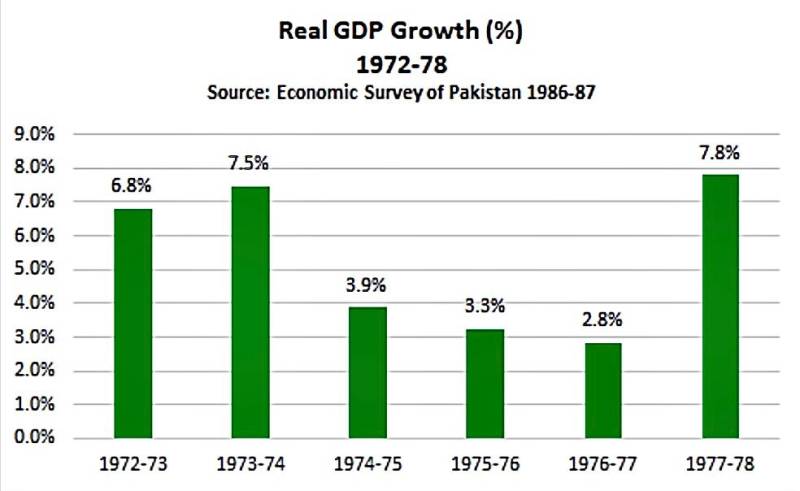
Public investment didn’t just rebuild industry—it steadied Pakistan through some of the worst external shocks of Pakistan’s economic history. Between September 1973 and April 1974, oil prices quadrupled from about $3 to $12 per barrel following the Yom Kippur War and Arab oil embargo—the worst economic shock in Pakistan’s history. Two record floods soon ravaged crops and infrastructure. Despite these challenges, average GDP growth under Bhutto was 4.85% over five years (1972–1977), according to the Economic Survey of Pakistan 1986–87.
Suppose we account for the damage from the oil shock and massive floods—and attribute the strong recovery in 1977–78 (in the 12 months immediately after Bhutto’s ouster) to his policies. In that case, the average annual GDP growth rises to 5.35%. For perspective, Pakistan’s average GDP growth was 5.90% from 2003 to 2008, and just 3.42% from 2015 to 2025.
Mohsin S. Khan of the IMF wrote, “it is not obvious from the numbers that the 1970s were characterised by ‘generally poor performance and relative stagnation.” There is evidence to suggest that the low growth in the mid-1970s was due to the oil price shock, the world recession that followed, and an extremely adverse weather cycle, which resulted in large-scale floods and crop losses. The strong recovery in 1977-78 lends support to this argument.
The economy didn’t falter—it endured, laying the groundwork for the recovery under Zia, who benefited from Bhutto’s public-sector investments. Even Dr. Ishrat Husain, in Governing the Ungovernable (2018), acknowledged: “While the economic performance was impressive during Zia’s period, it was not due to any fundamental policy or institutional reform. Pakistan benefited from the output that came on-stream from large public-sector investments made in the 1970s, the most significant among them being the Tarbela Dam that added considerably to irrigation water availability and hydel power capacity, together with the establishment of fertiliser and cement factories.”
Bhutto’s vision was bold: to redistribute resources, extend credit to rural areas and small businesses, and align banking with national goals such as industrialisation and poverty reduction
Matthew McCartney, who teaches economics at the University of London, writes in Pakistan: The Political Economy of Growth, Stagnation and the State, 1951–2009 (2011): “It is often overlooked that the advent of Bhutto saw several distinctive liberalisation measures. Between 1971-72 and 1975-76 import restrictions were abolished for over 300 commodity items, the Export Bonus System (EBS) was abolished, tariff rates were lowered on intermediate and capital goods, and the degree of cascading tariff in the tariff system was reduced.”
Progress of Nationalised Industrial Units Under Bhutto
If nationalisation had “destroyed” the economy, the numbers would show it—but they don’t. Rafi Raza, an Oxford-educated lawyer who served as a special assistant to Bhutto, documented the progress of the nationalised industries in his 1995 book Zulfikar Ali Bhutto and Pakistan, 1967–1977.
Sales of nationalised industries jumped from Rs 1,428 million in 1972–73 to Rs 2,349 million in 1973–74—a 64% leap. According to the Economic Survey of Pakistan (1992-93), notable progress was made in the production of the following:
| Product | 1970-1 (In Thousand and tons) | 1976-7 (In Thousand and tons) | % Increase per annum |
| Fertilizers | 375 | 824 | 20 |
| Vegetable Ghee | 136 | 326 | 23 |
| Sugar | 519 | 736 | 7 |
| Mild Steel Products | 196 | 270 | 6 |
| Cement | 2702 | 3071 | 2.5 |
According to Akbar Zaidi, (Issues in Pakistan’s Economy, published 2005), at constant 1969/70 prices, public-sector investment’s share of total investment soared from 12.8% in 1969–70 to 60.2% in 1974–75. Bhutto boosted allocations to public sector investments because, as Zaidi noted, “private investments had already started to climb down even before nationalisation struck it down in 1972.”
Agriculture and Exports
The agriculture sector also reported gains during the Bhutto period. Wheat yields rose from 977 kg/hectare in 1965–70 to 1,251 in 1971–75, while rice yields increased from 1,507 to 1,549 kg/hectare, with absolute gains across major crops—wheat, rice, cotton, and sugarcane—according to the Pakistan Economic Surveys. For instance, wheat production rose from 6.48 million tons in 1970–71 to 9.14 million tons in 1976–77; rice from 2.2 to 2.7 million tons; and sugarcane from 23.17 to 29.5 million tons, as reported in the 1987–88 Economic Survey.
Exports surged by 153% in 1972–73 over the previous year, and manufactured exports rose 19% in 1973–74—from Rs 8,551 million to Rs 10,161 million. Overall, exports grew from $591 million in 1971–72 to $1.14 billion in 1976–77, according to the Economic Survey of Pakistan. These gains underscore the vigor of Bhutto’s strategy and his administration’s competence amid extremely challenging domestic and global conditions.
Bank Nationalisation Under Bhutto: Vision and Vulnerability
On January 1, 1974, Bhutto nationalised Pakistan’s private banks, targeting the “22 families” who monopolised finance. In an article published in The Times of London, March 22, 1973, Dr. Mahbub ul Haq, the most prominent economist of Pakistan’s history, wrote: “For all practical purposes, the 22 families had become by 1968 both the planning commission and the ministry of finance for the private sector. They preempted most investment permits, import licenses, foreign credits and government patronage because they controlled or influenced most of the decision-making forums handing out such permissions. They had virtually established a stranglehold on the system and were in a position to keep out any new entrepreneurs.”
Bhutto’s vision was bold: to redistribute resources, extend credit to rural areas and small businesses, and align banking with national goals such as industrialisation and poverty reduction. The number of bank branches swelled from 3,418 in 1971 to 6,737 in 1977, with a focus on underserved regions. Following nationalisation, a major drive to expand the banking system was led by the five largest banks. Between January 1974 and March 1976, the number of branches increased by 54%, deposits by 80%, loans by 65%, and bank employees by 35%. The directed lending channelled 70% of institutional credit to agriculture and small industries. Nationalised banks also financed public projects, advancing Bhutto’s industrial agenda.
Since 1977, forty-eight years of “pro-business” policies—deregulation, privatisation, and market-first dogma—have enriched Pakistan’s military-industrial-feudal elites while delivering little real progress
The rot began under Zia-ul-Haq (1977–1988), whose regime saw a significant rise in non-performing loans. A World Bank report (Pakistan: Current Economic Situation and Prospects, March 22, 1991) noted: “The nationalised commercial banks (NCBs) carry significant non-performing loans, due to poor credit analysis (partly due to political pressures) and willful default (supported by weak credit recovery mechanisms).” A State Bank of Pakistan report in 2000 noted that non-performing loans had reached nearly 20% in the early 1990s and the condition continued to deteriorate throughout the decade.
The banking sector’s problems were less about nationalisation per se and more about the governance failures that followed—especially under Zia-ul-Haq and Nawaz Sharif. Bhutto remained in office for only three years after the nationalisation of banks. It was the mismanagement in the subsequent years that turned them into a crisis, to the point that some of the largest nationalised banks were technically bankrupt by the early to mid-1990s.
This assessment aligns with my own understanding of the financial condition of the banks during the 1990s, based on my official dealings with them and meetings with senior officials of major nationalised banks and the Pakistan Banking Council. Lending to powerful groups—such as the Sharifs—and populist schemes like the Yellow Cab debacle (involving $500 million in loans, of which 75% turned bad) further aggravated the crisis. Zia and his protégés, such as Nawaz Sharif, were primarily responsible for promoting a culture of using banks for political patronage.
Overall Economic Indicators During Bhutto’s Tenure
Bhutto had his share of bad luck. The 1973 floods caused widespread devastation across Punjab, Sindh, and parts of Khyber Pakhtunkhwa, submerging over 4,000 villages and damaging vast tracts of farmland, especially cotton and rice crops. Hundreds of lives were lost, tens of thousands displaced, and infrastructure—including roads, bridges, and irrigation canals—was severely damaged.
The 1976 floods were even more catastrophic, affecting over 10 million people and destroying around 425,000 homes. Torrential monsoon rains caused major rivers to overflow, particularly in Punjab and Sindh. More than 500 people died, over 1.5 million acres of crops were inundated, and the economic toll was immense, prompting a national emergency and international relief efforts.
Despite the loss of East Pakistan, a fourfold oil-price surge, and two crippling floods, Bhutto’s five-year average GDP growth stood at 4.8%. His first two years saw over 7.1% average annual growth—the best post-1971 performance. These often-overlooked figures reflect an economy that demonstrated remarkable resilience under pressure.
Towards the end of his tenure, Bhutto made a political miscalculation with limited economic justification. On July 17, 1976, he nationalized flour mills, rice husking mills, and cotton ginning factories—a move likely driven by the desire to control food prices amid soaring inflation following the oil shock. This alienated the trading class, which played a key role in the 1977 post-election agitation. The decision was reversed beginning in 1978 under Zia-ul-Haq, with most affected units returned to private hands by 1980.
The Bhutto Era: An Excuse for Elite Failure
Since 1977, forty-eight years of “pro-business” policies—deregulation, privatisation, and market-first dogma—have enriched Pakistan’s military-industrial-feudal elites while delivering little real progress. The Dawood group thrived on fertiliser subsidies and power deals, while the Habib family floundered in U.K. banking, unable to compete in a truly open market. Pakistan’s so-called Sugar Mafia, dominated by politically connected groups, continues to profit at the economy’s expense.
According to the Pakistan Economic Survey 2024–25, tax exemptions to businesses totalled $21 billion in just one year. A level playing field in a competitive economy should be free from such distortions. Otherwise, there is little incentive to work hard or invest in productive industry when quick profits can be made through land allotments, subsidies, and tax manipulation. For decades, Pakistan has followed policies that discourage large-scale industrialisation—undermining the high growth seen in many Asian economies since the 1990s.
Female literacy still lags. Factories, dams, and schools that could have transformed society were neglected. Why? Pakistan’s elites are largely mediocre and self-serving, lacking Bhutto’s vision of state-driven progress. They hoard rent-seeking companies and offer little beyond anti-nationalisation rhetoric. Had Bhutto not been ousted at 49 and hanged at 51, he might have refined his policies and pushed Pakistan further. As Ian Talbot reflects in Pakistan: A Modern History (1998), “Bhutto’s economic policies, though flawed, represented a genuine attempt to address structural inequalities.”
Conclusion
The toxic and biased myth that Bhutto’s nationalisation policies wrecked Pakistan’s economy overlooks the concrete achievements and strategic foresight of his tenure. Confronted with immense internal and external crises, Bhutto’s pragmatic state-led interventions revitalised key industries, expanded public infrastructure, and laid the critical groundwork for sustained growth. Far from economic vandalism, his policies embodied a visionary effort to dismantle entrenched elite monopolies and promote inclusive development.
What this article does not even cover are Bhutto’s important initiatives to expand diplomatic and economic ties with Gulf countries, alongside removing restrictions on Pakistani citizens’ mobility by affirming their right to travel freely and obtain passports. These moves were pivotal in encouraging labour migration to the Gulf, which significantly boosted remittance inflows starting in the 1970s. Today, remittances from overseas Pakistanis constitute one of the largest sources of foreign exchange, surpassing even merchandise exports. Appreciating Bhutto’s legacy means understanding that sustainable progress depends on a balanced partnership between a proactive state and a dynamic private sector—an insight as vital today as it was then for Pakistan’s economic future.