

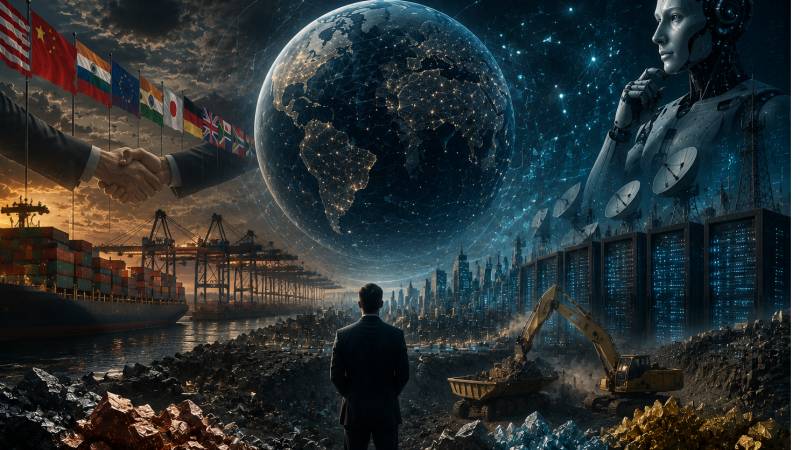
The global balance of power is gradually undergoing a profound transformation. Unlike the Cold War, the world is no longer divided into two clear ideological camps. Instead, a quieter but more fundamental shift is taking place. Artificial intelligence, semiconductor technology, rare earth minerals, and digital infrastructure are becoming the new foundations of global influence. The competition is no longer only about territory or military strength. It is increasingly about controlling the technologies that are likely to shape the twenty-first century.
For many decades, oil was the main source of geopolitical power. It shaped alliances, military interventions, and economic influence across the world. Control over oil reserves and energy routes largely determined global diplomacy and strategic decisions. Today, however, the foundations of power are gradually shifting from oil fields to data centers, semiconductor manufacturing, lithium reserves, and algorithmic systems. As a result, nations leading in these fields are increasingly shaping the future international order.
China stands at the center of this transition. Unlike the Soviet Union, its challenge to the United States is not based mainly on military or ideological rivalry. It is driven by technology, industry, economic growth, and even civilizational factors. Over the past few decades, Beijing has invested heavily in infrastructure, artificial intelligence, semiconductor manufacturing, and global supply chains. Through projects such as the Belt and Road Initiative, it has expanded its influence across Asia, Africa, and parts of the Middle East. China is steadily establishing itself as an alternative center of global power.
Meanwhile, the United States remains the dominant global power. Washington continues to lead in military strength, financial influence, and technological innovation, particularly through the companies based in Silicon Valley. However, recent restrictions on advanced chip exports and other economic measures against China suggest that Washington is increasingly concerned about China's technological rise. These measures reflect a broader concern that the future global leadership may depend more on technological strength than on military conflict.
This is where the growing importance of rare earth minerals becomes evident. They are no longer only scientific terms known to specialists; they have become valuable strategic assets. Modern technologies, ranging from electric vehicles and fighter jets to smartphones and AI hardware, depend heavily on these materials. Since China controls much of the world's rare earth processing, it holds an important advantage in the technological competition that is shaping the future.
Understanding the changing global balance of power, the growing importance of semiconductors is equally significant. In earlier centuries, empires competed for control over ports, waterways, and colonies. Today, that competition has shifted towards semiconductor manufacturing and digital infrastructure. Modern economies, military systems, and the rapid advancement of artificial intelligence all rely on microchips. Any disruption in their supply can weaken even the strongest countries. Taiwan has therefore become strategically important not only because of its strategic location but also because it produces many of the world's most advanced semiconductors.
Economically, artificial intelligence and automation are changing the job market faster than many societies can adapt. This shift is wiping out certain career paths while creating new forms of digital inequality among workers. Socially, human connections are moving toward digital networks, and screens.
At the same time, the Gulf states are making efforts to reduce their dependence on oil. Saudi Arabia and the United Arab Emirates are investing heavily in technology, infrastructure, artificial intelligence, tourism, and global finance. These efforts highlight that future economic and strategic influence will depend not only on natural resources, but also on adapting to a technology-driven world. Together, these developments suggest that the era of complete American dominance is gradually coming to an end. However, the emerging international order cannot be described as fully multipolar. Instead, the world is entering a phase of competitive interdependence. States remain economically connected while at the same time competing to secure greater strategic autonomy.
Artificial intelligence has emerged as one of the defining features of this new era. It is no longer just another technological innovation; it has become an important instrument of geopolitical power. Countries that lead in AI development are likely to gain significant influence over global finance, warfare, education, media, and cybersecurity. For this reason, the global competition for AI is about much more than technological innovation. It is ultimately about shaping the future structure of economies, societies, and international politics. The effects of this transformation are not limited to governments or large corporations. They are also reaching ordinary people. Many of these changes are gradual, so they often go unnoticed. Yet their long-term impact could be significant.
Economically, artificial intelligence and automation are changing the job market faster than many societies can adapt. This shift is wiping out certain career paths while creating new forms of digital inequality among workers. Socially, human connections are moving toward digital networks, and screens, which is slowly altering how people talk to each other and form personal bonds. Cognitively, constantly consuming short-form digital media and content chosen by algorithms is damaging our attention spans, memory, and capacity for deep critical thinking.
The ethical challenges surrounding artificial intelligence are becoming more serious every year. As AI systems play a greater role in decision-making, it may become increasingly difficult to separate human judgment from machine influence. In such a situation, even the meaning of personal freedom may need to be reconsidered. Future conflicts may not focus only on territory or natural resources, but also on human consciousness, information, and individual autonomy.
The twenty-first century is therefore witnessing more than a geopolitical shift. It is witnessing a broader civilizational transformation. The struggle for global influence is no longer limited to armies, borders, or traditional diplomacy. It now includes data, technology, artificial intelligence, minerals, and digital influence. The countries that succeed in these domains are likely to shape not only international politics but also the intellectual, economic, and social future of human civilization.
History reminds us that world order does not collapse overnight. Instead, it declines gradually, often without being fully recognized by those living through it. The changes we see today also follow the same pattern. They are happening slowly, but they will have lasting effects. Most of the world's attention is still focused on daily political events. Yet a new global balance of power is quietly taking shape.