

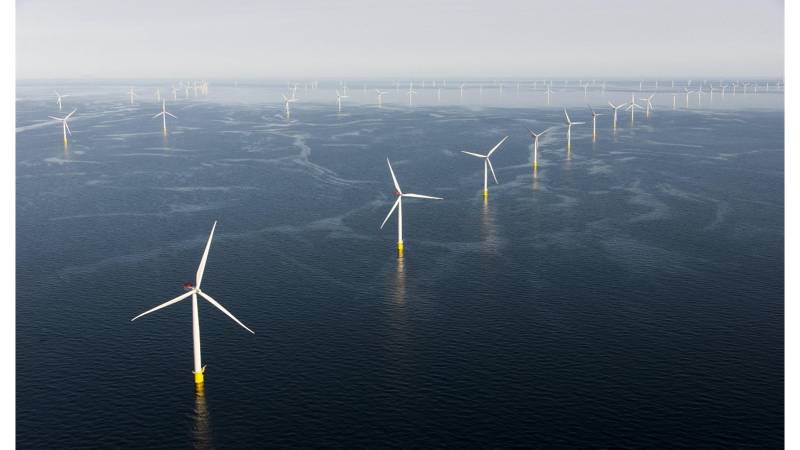
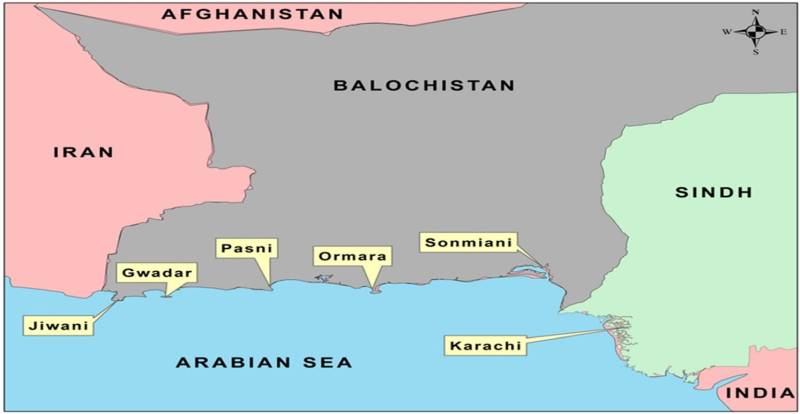
The debate about energy in Pakistan mainly revolves around aspects such as electricity costs, imported fuels, solar power, and land-based wind farms. There is, however, one more source of energy that merits mentioning: the wind in the Arabian Sea. With its long shoreline by the Arabian Sea that hits the coast of Sindh and Balochistan, Pakistan’s coastal waters can be used for the development of offshore wind energy, an energy technology already providing electricity in many countries around the world. However, so far, the identified offshore wind energy resource has not been successfully utilised in Pakistan.
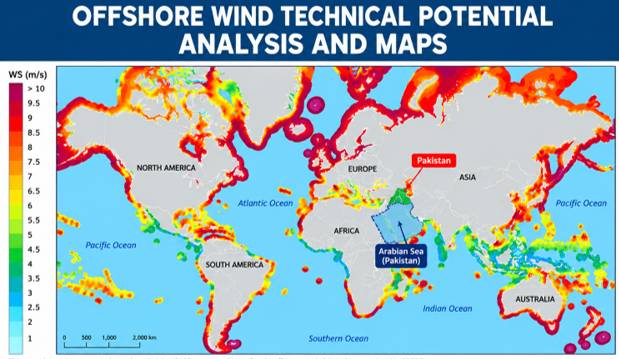
The assessment by the World Bank highlights this energy source. According to the estimates, the offshore wind energy technical potential of Pakistan amounts to approximately 21 GW, of which about 17 GW is fixed-bottom wind and about 3 GW is floating wind. These numbers indicate the need to analyse the potential of the Arabian Sea for long-term energy development in Pakistan.
However, it is important to remember that technical potential does not mean the same as electricity. It takes the following steps to start implementing offshore wind energy technology: conducting further research, making investments, performing environmental assessments, and carrying out governmental planning.
The Global Offshore Wind Report 2026, produced by the Global Wind Energy Council (GWEC), and the report by the International Renewable Energy Agency (IRENA) and the Global Alliance Wind Offshore (GOWA) on the Emerging Role of Offshore Wind in Energy Security in Small Island Developing States provide valuable insights on the significant challenges and opportunities for Pakistan.
An Opportunity Beyond the Shoreline
Offshore wind entails the production of electric energy with the help of wind turbines located in the ocean. Offshore wind turbine technology does not depend on land as in the case of land wind farms, but takes advantage of wind potential available over the coastal areas as well as further away into the ocean. There are two kinds of offshore wind technology. Fixed-bottom devices have their foundation attached to the ocean bottom, and floating devices rest on floating platforms that are secured to the ocean bottom.
The offshore wind map of Pakistan prepared by the World Bank in March 2020 and updated later in the same year indicates that Pakistan has a total technical potential of offshore wind installation of 21 GW within a 200-mile distance from the coastline. According to this map, around 17 GW of fixed-bottom devices and nearly 3 GW of floating devices can be installed in shallower waters of less than 50 metres and of less than 1,000 kilometres from the shoreline respectively.
The fundamental principle must be that the development of green energy should not happen at the expense of marine ecosystems or the livelihoods of coastal people
While the resource assessment is significant, it does not guarantee the future production of 21 GW of electricity. It cannot state that every area is suitable for development, that the intended projects are economically viable, or that the generated power can be delivered to customers. The map is based on data from the Global Wind Atlas; however, actual projects require precise site measurements. To start with, Pakistan should map the conditions of its Sindh and Balochistan coast. In other words, the government has to establish the average wind speed, water depth, seabed type, wave characteristics, and distance from the shore, shipping ways, and electricity transmission access points.
Offshore wind may also be vital for other sectors beyond electricity generation. It can eventually aid in industrial development, new skill acquisition, port operations, marine engineering, and maintenance work. Countries with established offshore wind energy industries have created a complete supply chain around turbine making, steel structures, subsea cables, vessels, and the port sector.
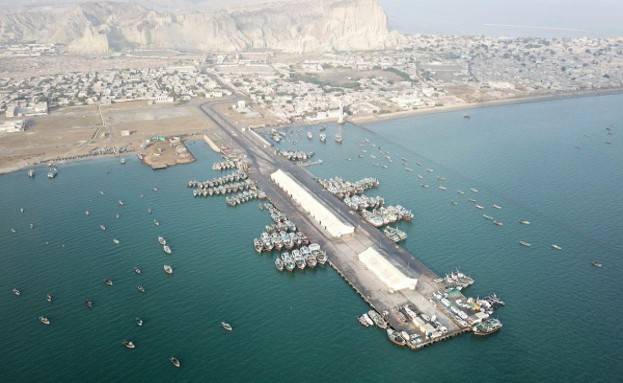
In Pakistan, these opportunities should be regarded as potential avenues to be researched instead of guarantees of economic activity. The country needs to work out what can be produced locally and what would be imported if there is a sizeable enough pipeline of projects that could sustain investments in new facilities.
What the Global Offshore Wind Industry Teaches Us
Offshore wind has transitioned from a concept to a proven technology. The GWEC report predicts that in 2026, over 9.3 GW of offshore wind was installed worldwide, which means that the total installed capacity of offshore wind was around 92.5 GW at the end of this year. China held its leading position as the biggest market while Europe continued controlling about half of the world’s offshore wind capacity.
In the long run, GWEC believes that offshore wind capacity is going to grow significantly. Projections imply that over 328 GW of new capacity will be built in order to reach total global installations of around 420 GW by 2035. Nonetheless, these are only estimations; hence, outcomes can vary. The report acknowledges the fact that financial constraints, postponed auctions, supply chain issues, and occasional changes in government policy may slow down some projects.
This worldwide growth demonstrates that offshore wind energy is becoming a significant component of energy planning in the long run. With offshore wind, however, it proves that windy regions do not automatically lead to industry growth for any country. Governments must prepare the necessary infrastructure and favourable conditions.
India gives a good example of a regional comparison. According to GWEC, by April 2026, it had about 56 GW of onshore wind—what makes it a leader in this field—but no offshore capacity at all at that moment. The country has noticed the availability of approximately 70 GW of offshore wind fields, too, mainly in Gujarat and Tamil Nadu, and has taken some measures to support this trend through policies and finances. Nevertheless, bidding companies were not very interested in that area, and some tenders have been cancelled in 2025.
The moral for Pakistan seems to be clear: defining the resource only opens up opportunities. Investors require reliable information, transparency, and realistic project costs, as well as access to financing and assurance that electric energy can be connected to the grid.
The report published by IRENA and GOWA presents another useful dimension. The report deals with offshore wind potential as a source of energy security for Small Island Developing States (SIDS). These states are usually hugely reliant on fuel imports and pay high prices for electricity. Offshore wind can help make their energy supply more diversified, minimise risks associated with volatile fuel prices, and ensure more resilient electricity grids.
Although Pakistan is not a SIDS country and implementation of the recommendations from the report is not directly applicable to the country, crucial insights on coastal energy planning, coastal infrastructure, financing, and environmental protection have been provided in the report. IRENA emphasises the fact that offshore wind can be applicable for some countries and locations but not for others.
IRENA reports that the global average electricity cost for fixed-bottom offshore wind projects that were launched in the year 2025 was calculated to be around USD 78 per megawatt-hour. This was 63% less than what it was in 2010. However, this is the global average and not an estimation for offshore wind projects in Pakistan. Local conditions, financing costs, depth of water, availability of ports, and transmission infrastructure can lead to a very different calculation in Pakistan.
Protecting the Sea, Its Communities, and Its Islands
It is important to focus on the marine environment while talking about offshore wind in Pakistan. The Arabian Sea is not just an empty body of water that can easily be turned into real energy sources but rather is a sea that includes maritime activity, fishing, marine inhabitants, coastal livelihood, transportation, tourism, and a natural environment with ecosystems important for Pakistan.
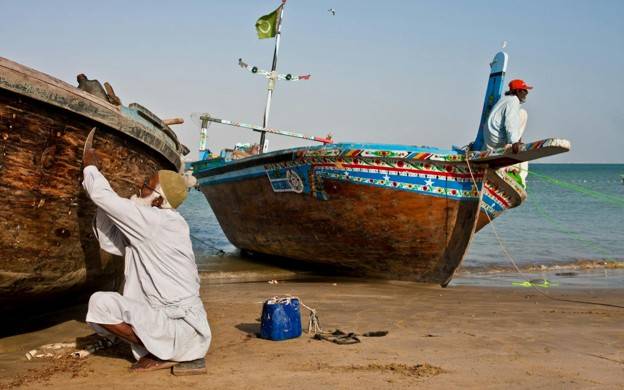
The coastal people depend on the sea in terms of revenue and food security. And this should be taken into account while planning offshore wind projects. The installation of wind turbines, underwater cables, constructing ships, and setting the project regions can impact fishing areas.
Fishing communities need to be consulted before places for offshore wind projects are selected, not after major steps in decision-making have been taken.
IRENA's report emphasises the importance of marine spatial planning, which is the study of how the sea is used for different purposes. This method is especially relevant for Pakistan since the coastline and islands make it necessary to exercise caution regarding the environment. According to the World Bank map, there are areas marked as coastal reference points which include Hingol National Park and Keti Bunder Wildlife National Park. Nevertheless, the map does not make an elaborate evaluation of the environmental impact of separate project locations or provide information on whether the sites are suitable for wind energy development at sea.
It shouldn't be assumed by Pakistan that every coastal zone with advantageous wind characteristics is a location for wind turbines. Numerous studies would need to take into account aspects like the marine ecosystem, migratory bird populations, fish populations, the currents spent from the ocean floor, and the changes the process will impose on the environment.
The reports mention that different activities can be carried out in a marine environment simultaneously. The incorporation of aquaculture and ocean rehabilitation within the framework of offshore projects is cited as an example of integrated development by GWEC. Such developments bring perspectives, but they cannot be regarded as an automatic solution to environmental issues, as each project depends on local ecological conditions and appropriate monitoring.
The natural islands of Pakistan need to be incorporated into the greater discussions around marine protection and sustainable use of resources. They should not be seen merely as potential sites for wind farms. Some sensitive habitats and protected areas might also be deemed inappropriate for development, while some of the other areas might be subject to scientific assessment. It is also possible to point out the differences between the natural islands and the term "energy islands" as used in wind power technology. The latter term refers to the artificial platforms created to connect the electricity networks and the renewable energy installations, while the former is used to refer to natural islands.
The fundamental principle ought to be that the development of green energy should not happen at the expense of marine ecosystems or the livelihoods of coastal people. Public involvement, clear environmental assessments, and monitoring should be part of the process from the start.
Building a Realistic Roadmap for Pakistan
Pakistan does not need to begin by announcing a huge offshore wind target. It needs to begin by building a reliable understanding of its own coastal resources and the conditions required for development.
First, priority number one should be making a detailed study regarding the offshore wind resource and providing a feasibility study for areas along Sindh and Balochistan. The study will provide updated wind measurement, seabed surveys, water depth, wave and weather conditions, marine biodiversity, and the sites of present economic activities. The 2020 World Bank map can be a good reference, but it would not be able to substitute modern studies on the local level.
Second, the second priority should include the procedure of marine spatial planning at a national level. The relevant agencies, coastal authorities, environmental institutions, fishermen, researchers, and local communities should join efforts in order to define the possible and impossible areas. It would help to prevent any contradictions between electricity development, fishing, transportation, tourism, and environmental conservation.
Third, the assessment of electric systems is also very important. The offshore wind farms require underwater cables, offshore sub-stations, cooperation with a local grid, and possibly the use of energy storage solutions.
Financing is another important hurdle. The development of offshore wind projects requires significant funding and takes a long time to implement. Pakistan will need to have transparent site allocation procedures, established legal and regulatory frameworks, clear procurement processes, and a reliable method of electricity procurement. International organisations could help finance preliminary studies and provide consulting services in design and infrastructure planning. Whether financing will be provided or not lies in the quality of project preparation as well as the investment conditions of the country.
Another opportunity is to train local personnel. Educational institutions of Sindh and Balochistan may begin forming expertise in marine engineering, offshore safety, environmental monitoring, electrical engineering, port operation, and wind energy technology.
The action plan of the GWEC underscores the critical role of collaboration among government entities and businesses, reliable auctioning methods, easier licensing processes, financing, supply chain development, and electrification. While useful principles for Pakistan, those principles should accommodate the specific economic and institutional traits typical of this country. The report produced by IRENA also stresses the need to connect renewable energy aims with grid and marine spatial plans, technical standards, affordable finance options, and regional collaboration.
Pakistan should also explore opportunities to learn from its neighbours and neighbouring economies. The experience of India demonstrates that even supportive policies and technical feasibility do not guarantee the success of the developers. More developed markets' experience makes it clear that the provision of port facilities, power lines, qualified staff, and ecological safety has to be made long before the construction process starts.
The Arabian Sea could provide Pakistan with a different route to achieving a more varied and sustainable energy future. The World Bank says Pakistan could produce some 21 GW of electricity from offshore wind alone, making the option very interesting for the Pakistani authorities. However, the main question is not about how quickly Pakistan will announce a large offshore wind goal. The real question is whether the country has developed the know-how, legal framework, infrastructure, and trust needed to exploit this energy source in a responsible way.
Offshore wind should not be considered an immediate solution to Pakistan's electricity problems. It is a long-term opportunity requiring extensive research and proper planning. If Pakistan starts to work on the issue today, it will be able to make better decisions about its coastal energy resources, safeguard coastal communities and ecosystems, and prepare for the introduction of the energy-making technology that is becoming more and more important in the future.