

The Food and Agriculture Organization’s 2026 report, Water and Land Accounting in Sindh, Pakistan: Quantifying Water Availability and Uses, asks a basic question: how much water does Sindh receive, how much does it use, and where does the rest go? At a time when farmers face shortages, groundwater quality is worsening in many areas, drainage problems continue and the Indus Delta suffers critically, a reliable picture of the province’s water is essential.
The report is useful because it looks beyond canal supplies and tries to account for rainfall, groundwater, agriculture, wetlands, forests, drainage and other uses. Yet its findings need careful reading. Some numbers, quoted without their qualifications, could create the false impression that Sindh has a surplus of water ready for more irrigation or other purposes. The report does not show that such a surplus exists.
It estimates average annual rainfall at about 23 billion cubic metres (BCM), of which roughly 15.5–16 BCM is considered usable, and average canal diversions at about 57 BCM. These figures matter, but they must be understood in context. Rainfall is uneven and erratic. Not all of it becomes available for crops; some evaporates, some soaks into the soil, and some becomes runoff or groundwater recharge. Water diverted into canals does not automatically reach every farmer at the right time and place.
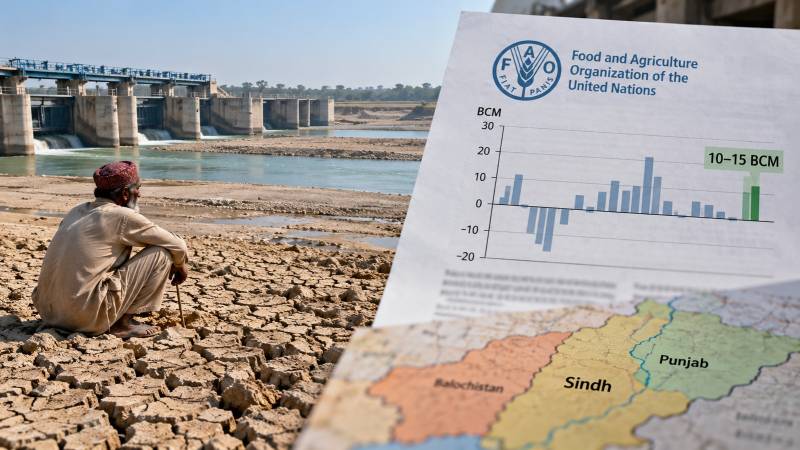
The period covered is another limitation. The study mainly examines five years, from 2012–13 to 2016–17, with some productivity calculations based on 2015–16 data. It is a historical baseline, not a verified account of Sindh’s water position in 2026. The estimated water balance needs special attention. Depending on the scenario, the report puts excess water for drainage and recharge at about 33 BCM under Scenario I and 19 BCM under Scenario II. It also shows a positive closing balance of roughly 10–15 BCM, which the report itself says needs further study. These numbers can easily be read as proof of unused water. That would be a serious misreading.
A positive closing balance in an accounting model does not mean an equal volume of water is physically stored, accessible or free for new allocation. It may reflect incomplete data, uncertain estimates, assumptions about use, or flows whose destinations are not fully known. Water not recorded as a formal canal delivery may still recharge groundwater, support wetlands, feed drains or sustain ecosystems. The report also estimates average river-reach losses between Guddu, Sukkur and Kotri at about 13 BCM. “Losses” here should not be taken to mean water simply vanishing or being wasted. These flows include seepage, evaporation, withdrawals and water entering aquifers and wetlands—processes that may support other users and ecosystems. Without knowing where the water actually goes and how much can genuinely be recovered, it cannot be treated as an extra resource available for redistribution.
An accounting balance is not the same as a physically available surplus. Groundwater estimates reinforce the need for caution. Under Scenario I, pumping is put at about 4.5 BCM; under Scenario II it rises to around 17 BCM. This large difference stems mainly from different assumptions about cultivated area and cropping intensity. The report itself notes that groundwater pumping was estimated indirectly, not from a full inventory of tube wells, pumping hours and actual abstraction. Quantity alone is not enough. Quality, location, recharge rates and extraction rates all matter. In some parts of Sindh groundwater is relatively fresh and useful; almost 78 percent groundwater in Sindh is saline or brackish. A cubic metre of saline water is not the same as a cubic metre of usable freshwater. Canal systems and groundwater are also interconnected, and water moves across administrative and irrigation boundaries. The apparent provincial surplus cannot be accepted without a much clearer understanding of groundwater conditions.
Sindh’s water crisis is not merely about total quantity. Shortages at the tail-end, groundwater salinity, waterlogging and a dying Delta show that access, timing, quality and distribution matter as much as the volume of water itself.
The report gives crop water productivity figures of roughly 0.30 kilograms per cubic metre for cotton, 0.50 for rice, 0.68 for wheat and 3.2 for sugarcane. These help compare how much crop is produced per unit of water consumed through evapotranspiration. They do not, however, measure farmers’ income, profitability or the efficiency of the whole irrigation system. There is also a common misconception that every gain in irrigation efficiency automatically saves water for the province. Water that seeps from canals or fields may recharge groundwater or return through drains and become available to downstream users that also becomes main source of drinking water. Reducing seepage at one place can improve local efficiency while reducing water available elsewhere. Real savings must be judged across the entire system, including recharge and return flows.
Another gap is the incomplete accounting of coastal areas and mangroves. About 0.58 million hectares could not be fully included because of insufficient information. This matters because the Indus Delta is a living system that supports fisheries, mangroves, biodiversity and coastal livelihoods. Environmental flows are an essential requirement of the river, not leftover water after human use; that aspect have been missed by the report.
The report’s strongest contribution is its clear call for a reliable, regularly updated water accounting system. It points to weaknesses in agricultural statistics, inconsistencies in cultivated-area estimates, and gaps in data on groundwater, drainage, storage and other uses. Sindh needs to reconcile the records of the irrigation, agriculture and statistical departments; update crop areas regularly with satellite imagery checked against field surveys; measure groundwater abstraction and quality; and monitor canal diversions, drainage flows and environmental needs. Annual accounts should distinguish between water entering the province, water actually available for use, water already consumed, water supporting recharge and ecosystems, and water that can genuinely be recovered.
For farmers the message is simple: provincial totals mean little unless water reaches the farm at the right time, in the right quantity and of acceptable quality. Better practices can help, but farmers also need reliable supplies, fair distribution, working drainage and technical support. Most importantly, better water management must not become an argument for reducing Sindh’s legitimate share of Indus waters. The 1991 Water Apportionment Accord remains the basis of inter-provincial distribution. The FAO report neither decides provincial entitlements nor shows that Sindh has uncommitted water available for extra allocations or new canal projects. Sindh faces shortages in tail-end areas, groundwater depletion and salinity, waterlogging elsewhere, weak drainage and too little freshwater reaching the Delta—all at the same time. These conditions are not contradictory. They reflect a complex system in which access, timing, quality and distribution matter as much as total quantity.