

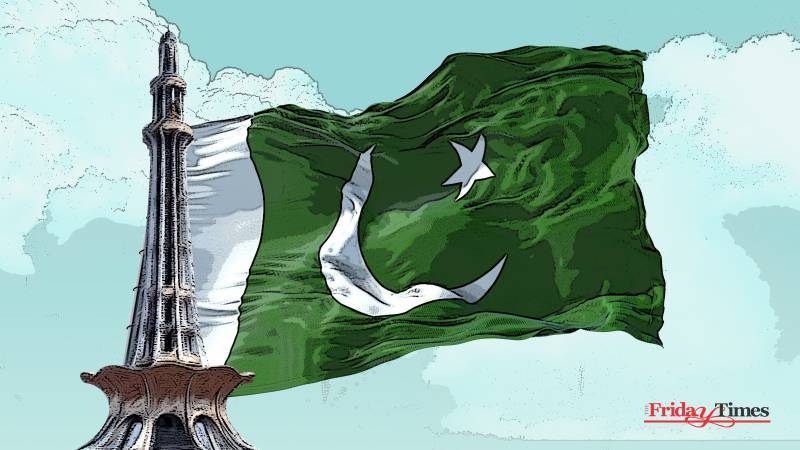
The nation will celebrate tomorrow's 86th Pakistan Day, with the hope that the present hybrid-plus government, working on the dictates of those who matter in the Land of Pure, will strive to forge a broad political consensus for undertaking the much-needed reforms in all spheres of governance and fix decades-old chronic socio-economic maladies. For many, it may sound like an oxymoron. There is consensus on transforming Pakistan into an egalitarian, democratic, peoples’ republic, rather than a ‘hard state’ (literally), not in contradistinction to Gunnar Myrdal's ‘soft state’. It alone can help Pakistan achieve much-cherished self-reliance and prosperity for all and come out of dark debt prison.
On March 23, 1940, All India Muslim League in its annual session at Lahore [22-24 March 1940] passed the Lahore Resolution that ultimately paved the way for a separate homeland [Pakistan] for the Muslims of British India after a long-drawn struggle against colonial rule. This memorable day and adoption of Pakistan’s first constitution is celebrated as ‘Pakistan Day’ every year.
The unprecedented sufferings of Pakistanis, especially the poor and less privileged, will continue unabated no matter how many Pakistan Days we celebrate unless the state and society are restructured on the principles of equity, fairness, and justice—the fundamental elements of constitutional democracy, enunciated in Article 3 of the Constitution of Islamic Republic of Pakistan [“the Constitution].
Anarchy, terrorism, lawlessness, economic meltdown, and chaos in today’s Pakistan are because of the captivity of the State in the hands of the militro-judicial-civil complex, absentee landowners, maulvis (clergy), pirs (spiritual leaders), industrialist-turned-politicians and traders. Pakistan’s economy serves the privileged classes. The militro-judicial-civil complex not only enjoys unprecedented tax-free benefits at the cost of taxpayers’ money but also not delivering for what it is being paid. The absentee landowners and industrialists, unscrupulous traders, and state functionaries amass more and more wealth by exploiting landless tillers, industrial workers, and common citizens, respectively.
The unscrupulous traders create artificial hikes in prices of essential items and thrive on the hard-earned incomes of the poor and the fixed-income classes. They even do not spare the hapless citizens during the holy month of Ramadan as prices go beyond the reach of even well-to-do middle-class families. Adding insult to injury, the government imposes unbearable, oppressive indirect taxes on the poor and extends benefits to the rich and the mighty. This is the dilemma of today’s Pakistan, where we are celebrating the 86th Pakistan Day commemorating the Lahore Resolution and adoption of the country’s first constitution.
It is an undeniable fact that after 78 years of independence, the State Oligarchy of Pakistan—the militro-judicial-civil complex—has pushed the country into great turmoil. What a pity that a nuclear state ensnared in a deadly debt trap, cannot provide basic amenities of life to the vast majority of its population.
We even lack cheap nuclear energy for commercial and domestic use! Wealth and power are concentrated in a few hands and overwhelming burden of taxes stands shifted to the less-privileged permanently! The elitist economy favours the rich and mighty—with every passing day the rich-poor divide is widening. This paradox depicts what Zulfikar Ali Bhutto highlighted in his masterpiece, Myth of Independence.
The anti-people alliance of elites is the root cause of our many ills. Through cross marriages, the elites ‘look after’ each other well and manage to perpetuate control over State institutions and economic resources. For civil bureaucrats, life revolves around good postings, lucrative benefits, foreign tours, and promotions. Officers having political clout are requisitioned by federal and provincial ministries. They either are relatives of ministers or are close to them.
The so-called civil servants (behave like gora sahib believing to be more privileged than colonial masters) serve the interests of political masters, rather than people, even if law and regulations do not permit so. This has destroyed the entire structure of civil services, where ‘political connections’ are now the name of the game.
Borrowings recklessly from local banks and foreign lenders continue to push the nation into the darker abyss of the ‘debt prison’
Polarisation, favouratism, and politicisation within State institutions are showing their disastrous results. Law and order in the street have collapsed and terrorists attack any place they want with impunity. The State despite taking enormous taxes is asking people to arrange their security while the government machinery is busy serving and protecting the rulers alone.
Shehbaz Sharif, even during his second tenure as Prime Minister, has not learned any lessons from his past mistakes. He continues to act like a “servant” of those who matter in the land and keeps on promoting nepotism and cronyism. Once again, under his rule, many high-caliber officers placed in the surplus pool have been denied postings/promotions they deserved on merit, and the “loyalists” and “flatters”, though junior, are enjoying lucrative posts and benefits. There seems no end to such brazen acts on the part of the political elite that keeps on humming the mantra of democracy but acts in an authoritarian and irresponsible manner.
Privileged ruling classes and State Oligarchy will never be interested in creating an egalitarian Pakistan. Borrowings recklessly from local banks and foreign lenders continue to push the nation into the darker abyss of the ‘debt prison’—debt servicing alone is now the largest burden on the economy taking away all the taxes collected by the Federal Board of Revenue (FBR) and even large part of non-tax collections. This year's fiscal deficit will be around Rs. 8500 billion, while debt servicing alone may reach Rs. 10 trillion. In the budget 2024-25, prepared under the guidance of the International Monetary Fund (IMF), debt servicing allocation was Rs. 9.775 trillion.
Dr. Ishrat Husain, in his book, Pakistan: The Economy of an Elitist State, has observed that in sharp contrast to the East Asian model of ‘shared growth’, based on rapid economic development coupled with a rapid reduction in poverty and more equitable distribution of the benefits of development, in Pakistan, the elitist model confers political and economic powers to a small coterie of the elite (parasites).
While quoting Dr. Ishrat’s work, Dr. Khalil Ahmad, in his book, Pakistan Mein Riasti Ashrafiya Ka A’roj (Rise of State Oligarchy in Pakistan), has also concluded: “Pakistan is presently owned and exploited by elites whereas it should belong to the people of Pakistan”.
The powerful State officials, hands in glove with the rich and the corrupt, exploit the system for self-aggrandisement. For example, the FBR through SROs [Statutory Regulator Orders] provides “legal” ways and means to the mighty and wealthy sections of society to amass huge wealth—exemptions and concessions given to them by acts of Parliament are worth four trillion rupees now.
Our oppressive economic system protects and promotes the interests of the exploitative classes in utter violation of Article 3 of the Constitution. Since its inception, Pakistan nurtured an exploitative system, which has been gaining strength with each passing day. Presently, all forms of exploitation and repression are so deeply rooted that they are even taking away the guaranteed “right to life” from the poor, which is to talk of fulfilling the promise mentioned in Article 3 of the Constitution.
Article 3 reads: “The State shall ensure the elimination of all forms of exploitation and the gradual fulfillment of the fundamental principle, from each according to his ability, to each according to his work”. It was Zulfikar Ali Bhutto, who for the first time, thought of including in the Constitution, what he called the basic principle of Islamic socialism. In fact, he borrowed it from socialism. It was considered the lower stage of communism with Marx’s contention, “from each according to his ability, to each according to his needs”.
Income inequalities are widening—resources are being transferred from the poor to the rich through manipulative indirect taxes and high inflation that is taxation without legislation
Karl Marx had specific conditions in mind for such a creed to work in a society where artificial intelligence (AI), robotic technology, and social organisation would substantially eliminate the need for physical labour as we are witnessing under the current industrial revolution in the production of goods and services, where “labour becomes not only a means of life but life's prime want”.
Marx explained that in such a society, each person would be motivated to work for the good of society, despite the absence of a social mechanism compelling him or her to work, because work would become a pleasurable and creative activity. Marx intended the initial part of his slogan, “from each according to his ability” to suggest not merely that each person should work as hard as he/she can, but that each person should best develop his/her particular talents.
Unfortunately, as a nation, we have collectively failed to abide by the supreme law of the land. Theoretically, all admit that the Constitution is supreme and each organ of the state has to perform its duties and functions in accordance with the constitutional scheme, but practically unelected institutions dictate their commands. Resultantly, we all are disillusioned as even after 78 years of existence, the political will to implement Article 3 and other fundamental rights guaranteed in Chapter 1 of the Constitution is totally non-existent.
The prevalent system protects the interests of the privileged classes and the judiciary is no exception. The laws that our judiciary interprets and protects with zeal ensure the “sanctity of private property” and “exploitation of the have-nots”. The judiciary is not a revolutionary organ—it is a product of the existing socio-economic system. It is naive to expect from the judiciary any avant-garde. To get socioeconomic justice, the people will have to wage relentless struggle and exert moral pressure on elected representatives.
The oppressive tax system blatantly violates Article 3 of the Constitution as the vast majority pays exorbitant indirect taxes even on essential commodities of everyday use while the mighty sections of society—the big absentee landowners, industrialists, judges, generals, and bureaucrats—are amassing wealth and enjoying unprecedented tax exemptions. The rich absentee landowners are either avoiding or paying negligible agricultural income tax—only 0.06% of GDP.
Income inequalities are widening—resources are being transferred from the poor to the rich through manipulative indirect taxes and high inflation that is taxation without legislation. The exploitative classes, even mafias, fund politicians. The anti-people alliance of greedy businessmen, tax officials, and politicians deprives the state of revenue worth billions. The mighty sections of society are engaged in tax evasion and money laundering.
The burgeoning fiscal deficit, ever-increasing and unsustainable debt servicing coupled with monstrous debt burden are not isolated phenomena. These are results of failure to undertake fundamental structural reforms, enforce fiscal discipline, crack down on the parallel economy, increase tax collection, abolish perks and benefits of the ruling elites, eliminate wasteful expenses, dismantle rent-seeking structures, ensure the rule of law, and stop reckless borrowing and ruthless spending.
The problem of Pakistan is not scarcity of resources, but unwillingness in their proper utilising and managing their equitable distribution, and absence of effective administrative and justice systems to check socio-economic injustice
Resource mobilisation for social services should have been the top priority of the successive governments by improving infrastructure, social services, growth of small and medium-sized firms in the industrial sector, and efficient/productive farming for an employment-intensive and equitable economic growth process. However, neither the military governments nor the so-called civilian governments since 2008 have done anything for the empowerment of the masses by ending economic apartheid and running large corporations with equity stakes for the poor through public-private partnerships. This alone could have set the stage for a structural change to help achieve economic growth for the people and by the people, which is presently confined to the elites only.
The most disturbing and painful reality of Pakistan is the unabated/shameless indulgence of ruling elites in wasteful expenditures. Look at their lifestyle when the majority of the population is undernourished and suffering extreme hardships due to the wrong policies of successive governments.
To become an economically self-reliant nation, the rulers will have to take the first step by starting to live at a modest level. True independence requires self-reliance for which fundamental reforms are inevitable. There is no dearth of ideas and good people for such reforms. We only lack the political will to abolish elitist structures that are the main impediments to ensuring equal opportunities for all citizens and extending to common people the benefits of public spending and economic growth.
It is time that all pro-people forces and masses en bloc revive the resolve of the founders of Pakistan for establishing a true democratic rule, egalitarian society, and impartial accountability of all, not selective of politicians when in opposition or someone being defiant to those who claim to be so-called defenders of Nazaria-i-Pakistan (Pakistan ideology) and their cronies.
The so-called defenders of ideological frontiers (sic) abuse and exploit ideology and religion to deprive the people of their inalienable right to self-governance and prosperity. The process of accountability should be for all, and it must be strictly as per law and across the board, fulfilling all requirements of Article 10A of the Constitution.
The problem of Pakistan is not scarcity of resources, but unwillingness in their proper utilising and managing their equitable distribution, and absence of effective administrative and justice systems to check socio-economic injustice.
It has been mentioned time and again by various writers that without imposing any new taxes and reducing the rates, the total revenue collection at the federal level alone can be Rs 30 trillion (Rs. 1800 billion direct taxes and Rs. 1200 billion indirect taxes) if existing tax gap is bridged by broadening of tax base and introduction of simplified system and people-friendly federalised administration.
This level of collection is possible but as a first step, we will have to reform our State machinery. Expensive State property occupied by them as “residences” must be recouped and commercially utilised through long-term lease. Their benefits and perquisites should be monetised. A Consolidated Pay Package for them, fair and adequate, would reduce corruption remove a strong sense of elitism and improve governance.
For politicians and all State functionaries, an independent and effective accountability apparatus is the need of the hour. Without the fundamental structural reforms, we cannot establish a truly democratic polity extending socio-economic justice for all, rapid growth ensuring job opportunities for millions of young people, whose frustration is on the rise with every passing day as elites are showing apathy towards them and enjoying luxuries at the State’s expense.
Naked exploitation of the have-nots and dehumanisation of society are leading to gruesome incidents where people are taking the lives of innocents without any remorse or repentance. We will have to move fast to reverse this trend and make Pakistan a republic for the people and not the elites alone. The time has come to make a firm resolve on 86th Pakistan Day, and take definitive actions to implement in letter and spirit all provisions of the supreme law of the land, especially Article 3 of the Constitution.